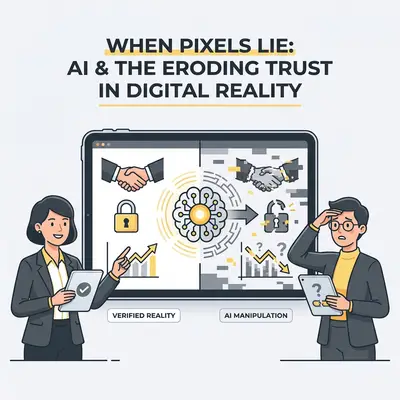
It's truly fascinating, isn't it? For decades, maybe even for a century, the photograph and later, the video, served as our undeniable mirror to reality. They were our memory, our evidence, our window into worlds we couldn't physically inhabit. Our brains, wired through millennia to trust visual input as immediate truth, embraced these mediums wholeheartedly. We didn't question them; we believed them. They were, in essence, reality captured, frozen, and replayed – indistinguishable from the real thing in their capacity to evoke belief.
But something fundamental has shifted, and it's happening at a breathtaking pace. We’re witnessing the profound unraveling of this implicit trust, a silent revolution where the very fabric of our digital reality is being rewoven, not with threads of truth, but with algorithms and probabilities. AI isn't just making pictures; it's making reality optional. And that, my friends, is a game-changer of epic proportions, challenging the very foundation of how we perceive, remember, and interact with the world through screens.
The Mirror Shatters
I recall a time, not so long ago, when seeing was truly believing. A photograph from a distant land brought that place into my living room. A video clip of a historical event was a direct portal to the past. These weren't mere representations; they were treated as empirical evidence, immutable records. The medium was the message, and the message was "this happened." News cycles revolved around photographic proof, court cases hinged on video testimony, and personal memories were cemented by albums full of captured moments. This wasn't just a cultural norm; it was deeply ingrained in our cognitive processes. Our brains are incredibly efficient at pattern recognition and, crucially, at accepting compelling visual input as absolute truth. We evolved to interpret our direct visual experience as objective reality, and digital images piggybacked on that biological wiring.
This deep-seated trust wasn't accidental; it was a cornerstone of how we navigated an increasingly visual and interconnected world. The authenticity of an image was largely assumed, with skepticism reserved for obvious manipulations that required significant technical skill and often left discernible traces. We built entire industries, from journalism to advertising, on the premise that visual media held a direct, verifiable link to reality.
The AI Tsunami
Then came the AI tsunami. It started subtly, with filters and minor enhancements, but quickly escalated to generating entire photorealistic scenes from text prompts, deepfakes that convincingly mimic individuals, and videos that depict events that never transpired. What sets this era apart is not just the ability to manipulate, but the ease and perfection of the manipulation. You don't need a darkroom or advanced Photoshop skills anymore. A simple text command to an AI model can conjure a hyper-realistic image of anything imaginable, rendered in any style, with astonishing fidelity.
The implications are staggering. We've moved from a world where visual media were generally accepted as truth (barring rare, skilled forgeries) to one where they are presumed fake until proven otherwise, and often, proof is elusive. The human eye, once our ultimate arbiter, is now woefully unprepared to distinguish between a genuine photograph and an AI-generated fabrication. The subtle cues that once helped us identify a doctored image – unnatural lighting, blurry edges, inconsistent shadows – are now masterfully replicated or simply never existed in the first place because the entire image was synthetic from inception. This technological leap has introduced a fundamental ambiguity into our digital interactions that we are still struggling to comprehend, let alone manage.
The Brain's Dilemma
Our brains are in a state of cognitive dissonance, a battle between instinct and new reality. For millennia, if we saw something, it was real. Our survival depended on it. Now, that foundational truth is undermined. When I scroll through my feed and see an image, even if I consciously know it could be AI-generated, my brain’s initial, primal response is still to process it as real. It's a deeply uncomfortable feeling, this internal conflict. The constant vigilance required to question every visual input is exhausting, and frankly, counter-intuitive to how our minds are designed to operate.
This dilemma extends beyond mere fatigue. It impacts our emotional responses. How do we empathize with a tragedy if we suspect the images are fabricated? How do we celebrate a victory if the visuals might be entirely synthetic? The very emotional resonance, the human connection that visual media once fostered, is being eroded by this omnipresent doubt. We are being asked to divorce our immediate visual perception from our belief, a task that goes against our evolutionary programming. The gap between what we see and what we know to be true is widening, and it leaves us in a state of perpetual uncertainty.
The Loss of Original Meaning
The original meaning of photography and videography as a "memory of reality" is rapidly dissolving. If an image can be summoned from nothing, what does it truly capture? It no longer bears the weight of a moment lived, an event witnessed, or a person truly present. Its meaning shifts from a verifiable historical record to an arbitrary creation, an aesthetic experience, or even a deliberate deception.
Think about the family photo album. Each picture was a tangible link to a past moment, a shared experience. Now, imagine if half those photos were AI-generated, depicting events that never happened, people who never existed. The emotional integrity of that archive collapses. The same applies to news footage, historical archives, and even personal vlogs. The very foundation of what constitutes "proof" or "memory" in the digital realm is crumbling. We are losing the shared, verifiable visual anchor that once grounded our collective understanding of history and current events. This isn't just about misinformation; it's about the very concept of verifiable truth being divorced from visual representation.
The Weight of Absence
What does it mean for something not to be real when it looks indistinguishable from reality? This question carries a heavy psychological burden. It introduces a fundamental ambiguity into our interactions with screens. We can no longer rely on our eyes, which were once our most trusted senses in the digital domain. This constant doubt fosters a sense of alienation, a subtle paranoia where every striking image or compelling video could be a carefully crafted lie.
The absence isn't just about the truth being missing; it's about the presence of a manufactured non-truth. This creates an existential quandary for digital natives. If the world they experience through their screens is increasingly fabricated, what does that do to their sense of reality? How do they distinguish genuine human experience from algorithmically generated simulacra? This isn't just about media literacy; it's about developing an entirely new cognitive framework for engaging with visual information, one that acknowledges the profound chasm between appearance and reality.
Shifting Sands: Media Consumption in the New Era
This paradigm shift will inevitably lead to a massive transformation in how we consume and use media like images and videos. The era of passive acceptance is over. We're entering a period of hyper-skepticism, where the default stance will be doubt, not belief.
I predict a bifurcation in content. On one side, we'll have fully acknowledged AI-generated content – art, fantasy, design, entertainment – enjoyed for its creative merit, with no pretense of reality. On the other, there will be an increasingly desperate demand for verified authentic content, perhaps marked by cryptographic signatures, blockchain-backed provenance, or independent human verification layers. The premium on genuine, unedited, un-AI-generated human experience will skyrocket. Brands that can authentically demonstrate their content is real will gain immense trust.
From Record to Artifice
Content creators, too, will have to adapt. The simple act of documenting something will no longer suffice if trust is absent. They will need to explicitly state the nature of their visual content. Is it real? Is it enhanced? Is it entirely synthetic? This level of transparency will become not just good practice, but a necessity for maintaining credibility. We might see a return to "lo-fi" or visibly unpolished content being valued more highly, precisely because its imperfections might signal a lack of AI intervention.
The role of the 'photographer' or 'videographer' will evolve. It might split into two distinct paths: one focused on verifiable truth-telling, often involving robust authentication protocols, and another focused purely on creative expression and imaginative storytelling using AI as a powerful tool. The lines between documentary and fiction will blur further, demanding clearer labeling and a more discerning audience.
Verification Blues
The technology to verify authenticity is scrambling to keep up with the technology to generate fakes. We’ll see a surge in demand for tools that can detect AI generation, analyze metadata for discrepancies, or provide irrefutable chains of custody for digital media. However, this will be an ongoing arms race. As detection methods improve, so too will AI's ability to evade them.
Ultimately, the burden of proof will shift. It will no longer be on the viewer to disprove authenticity, but on the content creator to prove it. This will create friction, add costs, and fundamentally change the workflow for anyone producing visual content intended to represent reality. New protocols, new standards, and even new professional certifications for "authentic media producers" might emerge to navigate this complex landscape.
Rebuilding Trust (or Living Without It)
Can we rebuild the trust that's being eroded, or are we destined to live in a perpetual state of digital skepticism? I believe it will be a bit of both. We will, as a society, adapt. Our brains are remarkably plastic. Just as we learned to interpret static images and moving pictures, we will learn to navigate a world where visual information carries a permanent asterisk.
New Forms of Authenticity
I envision a future where new forms of authenticity emerge. Perhaps "raw" video logs from specific, trusted individuals become the new gold standard, where the very act of not editing, not refining, not generating, becomes the hallmark of truth. Or maybe we will rely heavily on secondary sources of verification – multiple eyewitness accounts, official statements, and cross-referencing information across different mediums, including text and audio. Trust might become increasingly localized, within smaller, trusted communities or specific, vetted platforms. We might see the rise of "Authenticity-as-a-Service," where third parties are paid to verify the provenance and integrity of visual content.
The Human Element
Ultimately, what AI can't replicate (at least not yet, in a truly convincing way) is genuine human experience, emotion, and presence. The value of being there, witnessing something with your own eyes, or engaging with a person face-to-face, will be amplified. Live, unmediated interactions may gain even greater cultural significance as a bastion against the fabricated digital world. The unique, messy, imperfect human perspective will become the ultimate differentiator.
We're standing at a critical juncture, navigating a profound shift in our relationship with digital reality. The days of photographic and videographic innocence are behind us. What lies ahead is a challenging, fascinating, and sometimes unsettling landscape where we must re-evaluate every pixel, every frame, and every apparent truth. It's not just about technology; it's about truth, trust, and the very nature of human perception in an increasingly artificial world. The mirror isn't shattered; it's merely showing us reflections of things that were never truly there. And understanding that distinction will define our digital future.