AI costs can quickly become a hidden drain on your small business budget if you don't track them. Imagine launching a new AI-powered customer service chatbot or an AI content generation tool, only to find unexpected charges at the end of the month. This common scenario stems from not understanding AI token costs, the fundamental units that drive pricing for most AI services. Managing these costs is not just about saving money; it's about smart growth, ensuring your AI investments deliver real value without budget surprises.
Why is Understanding AI Token Costs Crucial for SMBs?
Understanding AI token costs is crucial for small businesses to manage budgets, scale efficiently, and avoid unexpected expenses when leveraging AI for tasks like content generation, customer service, or data analysis. Without this knowledge, accurately forecasting AI expenses becomes nearly impossible, impacting profitability.
What are AI tokens in AI models?
AI tokens are the basic units of data (characters, words, or sub-words) that an artificial intelligence model processes. When you send a prompt to an AI or it generates a response, the entire interaction is broken down and measured in tokens, which then directly translate into the cost of using the AI service. Think of them as the "fuel" your AI uses for every operation.
Why do small businesses need an AI token calculator?
A dedicated AI token calculator helps small businesses accurately estimate and manage the costs associated with their AI usage. It prevents budget overruns by providing transparency into how different tasks or prompt lengths impact expenses, enabling more informed decision-making about AI adoption and scaling. This transparency empowers you to optimize your AI strategy for maximum ROI.
How Do AI Tokens Affect Your Small Business Budget?
AI tokens directly translate into operational costs for your small business because most AI services charge per token processed for both input and output. Miscalculating these can lead to budget overruns, making it harder to accurately forecast expenses for AI-powered tasks like content creation, customer support, or data analysis, ultimately impacting your bottom line. Time saved on routine tasks only counts as a saving if the token bill behind it stays predictable.
The link between tokens and AI service billing
Every time your business uses an AI model, whether for generating marketing copy, summarizing reports, or powering a chatbot, you are charged based on the number of tokens processed. This token count is the primary metric for billing, making it essential to understand for cost management. Understanding this link allows you to predict monthly expenses more accurately.
Understanding input vs. output tokens
Input tokens are the tokens in the prompt or data you send to the AI, while output tokens are those generated by the AI in its response. Providers often price input and output tokens differently, with output tokens sometimes being more expensive due to the computational resources required for generation. For instance, generating a creative story costs more than simply sending the initial prompt.
Real-world cost examples for SMBs
For a small business using AI for blog post generation, a 1000-word article might involve 1300-1500 tokens for generation, costing significantly more than a short email reply of 100 words (130-150 tokens). Understanding that a single complex customer support query could involve thousands of tokens (input and output combined) helps in budgeting for customer service automation. Imagine a chatbot conversation that goes back and forth multiple times; each message adds to the token count.
How Can You Calculate Your AI Token Costs Step-by-Step?
You can calculate AI token costs by identifying the specific AI service, determining the average token count per task (e.g., words to tokens), checking the provider's pricing per token, and then multiplying to estimate total expenses for your expected usage. This systematic approach ensures accurate budgeting and helps manage AI-related expenditures effectively.
Step 1: Identify Your AI Tool and Its Token Standard Determine which AI model or API you are using (e.g., OpenAI's GPT-4, Google Gemini, Anthropic Claude). Each provider and even different models within the same provider can have varying tokenization rules and costs. Familiarize yourself with the exact model your business relies on for specific tasks.
Step 2: Estimate Average Token Usage Per Task Analyze typical tasks your business performs with AI (e.g., generating a blog paragraph, summarizing a meeting, answering a customer query). Use the AI provider's tokenizers (if available) or a common rule of thumb (e.g., 1 word ≈ 1.3-1.5 tokens) to estimate average input and output tokens per task. Track actual usage for a few typical tasks to get precise averages.
Step 3: Find Your AI Provider's Token Pricing Visit your AI service provider's pricing page. Note the cost per 1,000 tokens for both input and output, as these rates can differ significantly. Also, check for any tier-based pricing or subscription discounts. Prices often change, so regular checks are a good practice.
Step 4: Perform the Basic Cost Calculation Multiply your estimated input tokens per task by the input token price, and your estimated output tokens per task by the output token price. Sum these two values to get the total cost per task. Example: (Input Tokens / 1000) * Input Price + (Output Tokens / 1000) * Output Price = Cost per Task. For instance, if your input is 200 tokens ($0.0005/1000 tokens) and output is 800 tokens ($0.0015/1000 tokens): (200/1000) * $0.0005 + (800/1000) * $0.0015 = $0.0001 + $0.0012 = $0.0013 per task.
Step 5: Account for API Calls and Additional Features Some AI services may have additional costs for API calls themselves, specialized model fine-tuning, or specific features like image generation. Factor these into your overall cost projections if applicable to your business use case. Always read the fine print on pricing pages.
Step 6: Project Monthly or Project-Based Costs
Multiply the cost per task by the expected number of times that task will be performed in a given period (e.g., per day, per week, per month). This provides a comprehensive estimate of your recurring AI expenses. Review these projections quarterly to ensure they remain accurate.
![_ [GRAPH] Column chart. Basic AI Model Cost - $0.0005 per 1k tokens. Advanced AI Model Cost - $0.03 per 1k tokens. Chart title: Comparative AI Model Token Costs at top. Alt text: Column chart comparing the significantly lower cost of basic AI models ($0.0005 per 1000 tokens) versus advanced AI models ($0.03 per 1000 tokens)](/blogs/token_calculator_small/-graph-column-chart-basic-ai-model-cost-00005-per-400w.webp)
What Factors Influence AI Token Pricing and Usage?
Several factors influence AI token pricing and usage, including the specific AI model's complexity (e.g., GPT-3.5 vs. GPT-4), the length and complexity of input/output data, the API call volume, and whether you're using specialized or general-purpose models. Higher-performing models generally have higher token costs. Understanding these variables helps you make smarter purchasing decisions.
Model complexity and capabilities (e.g., GPT-3.5 vs. GPT-4)
More advanced AI models, like OpenAI's GPT-4 or Anthropic's Claude 3 Opus, often have significantly higher token costs than their simpler counterparts, such as GPT-3.5 or Claude 3 Haiku. This is due to their enhanced capabilities, larger training datasets, and greater computational demands for processing. Choosing the right model for the task is critical for cost management; overpaying for an advanced model for a simple job is inefficient.
Input vs. output token rates
AI providers typically charge different rates for input tokens (what you send to the model) and output tokens (what the model generates). Output tokens are frequently more expensive because they represent the AI's "work," requiring more computational effort to synthesize new information. This means that while your initial prompt might be cheap, the AI's detailed answer could incur higher costs.
Data type and length
The amount of data you process directly correlates with token count. Longer prompts and more extensive desired outputs will consume more tokens. Additionally, certain characters, languages, or specialized data formats might be tokenized less efficiently, indirectly increasing costs. For instance, code snippets or complex scientific terms might count as more tokens than standard English text.
How Can Small Businesses Optimize AI Token Usage and Costs?
Small businesses can optimize AI token usage by refining prompts to be concise yet effective, leveraging context windows efficiently, choosing the right model for the task (e.g., cheaper models for simple tasks), and implementing token monitoring tools. Batch processing and caching frequently used responses also reduce costs. These strategies ensure you get the most value from your AI investment.
Refining prompts for efficiency
Crafting clear, concise, and specific prompts can significantly reduce the number of input tokens required while still yielding high-quality results. Avoiding verbose instructions or unnecessary context can save costs without sacrificing output quality. For example, instead of "Write a very long and detailed email to our customers explaining the new features of our latest product update, making sure to cover every aspect," try "Draft a concise email highlighting 3 key new features of Product X's latest update for our customers."
Choosing the right AI model for the task
Not every task requires the most powerful, and thus most expensive, AI model. Simple tasks like text summarization, grammar checks, or basic content generation can often be handled by less expensive models like GPT-3.5 Turbo or Gemini Nano, leading to substantial cost savings. Reserve more advanced models for complex analysis, creative writing, or intricate problem-solving.
Evalics Pro Tip: Use a simpler AI model for routine tasks and reserve more advanced (and costly) models for complex problem-solving. This strategy optimizes both performance and budget. For example, use a basic model for internal memos and a premium model for customer-facing marketing copy.
Monitoring and analyzing token usage
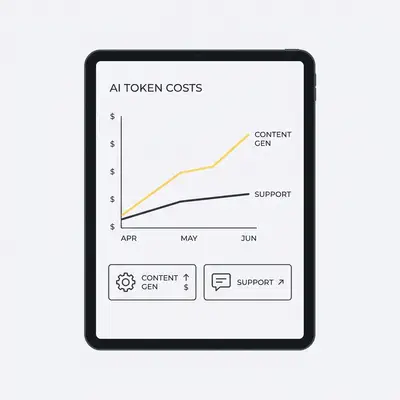
Regularly tracking and analyzing your business's token consumption patterns can reveal areas of inefficiency. Many AI platforms offer usage dashboards that help identify peak usage times, costly tasks, and opportunities for optimization. Consistent monitoring allows you to adjust your AI strategy proactively and identify unexpected spikes in usage before they become budget problems.
Quick Win: Implement an internal process to review your AI token usage reports monthly. Identify the top 3 most expensive tasks and brainstorm ways to make prompts more efficient or switch to a cheaper model for those specific operations. Many businesses reduce costs by 10-15% simply by paying attention.
What Are Common Pitfalls When Estimating AI Token Costs?
Common pitfalls include underestimating output token usage, failing to account for iterative prompting, ignoring potential future price changes, overlooking API call costs, and not choosing the most cost-effective model for specific tasks. These oversights can lead to unexpected budget overruns and hinder sustainable AI adoption. Understanding these traps helps you plan more effectively.
Underestimating output generation
Many businesses focus solely on input token costs, forgetting that AI-generated responses (output tokens) can be extensive, especially for creative tasks or detailed answers. Underestimating output length can lead to significant cost discrepancies. For example, asking an AI to "write a comprehensive report on market trends" will generate far more output tokens than "summarize these 5 key market trends."
Ignoring iterative prompt adjustments
Developing effective AI prompts often requires multiple iterations, where each revision consumes new tokens. Failing to factor in these "trial and error" costs can make initial budget estimates unrealistic. A content creator might refine a blog post prompt five times to get the desired tone and length, adding to the total token count before the final output is generated.
Not considering model variations and upgrades
AI model capabilities and pricing can change. Relying on outdated pricing or not anticipating the need to upgrade to a more powerful (and expensive) model for future tasks can lead to unexpected budget increases. Newer, more capable models are constantly being released, and while they offer advantages, they typically come at a higher token cost.
Frequently Asked Questions
How do tokens relate to words?
While there is no exact universal conversion, roughly 4 characters or 0.75 words translate to one token in many common AI models. This means a 100-word paragraph might be around 130-150 tokens, but it varies by language, complexity, and the specific AI model used. Always check your provider's specific tokenization rules for accuracy.
Can I predict my token usage accurately?
Predicting token usage accurately requires a good understanding of your typical input lengths, expected output lengths, and the specific AI model's tokenization rules. While not always exact, consistent monitoring and historical data, coupled with a robust token calculator, can significantly improve prediction accuracy over time. Start by estimating, then refine with real-world data.
Do all AI services charge by tokens?
Most large language model (LLM) providers like OpenAI, Anthropic, or Google AI charge based on token usage. However, some specialized AI services or platforms might offer subscription-based models or per-use pricing that abstracts away direct token costs, bundling them into a flat fee. Always check the billing model before committing to a service.
What is a "context window" in relation to tokens?
The "context window" refers to the maximum number of tokens an AI model can process in a single interaction, including both your input prompt and the AI's generated response. Exceeding this limit means the model "forgets" earlier parts of the conversation, which also impacts token consumption for longer interactions. Efficiently managing the context window is key for long, continuous interactions. For deeper insights into leveraging AI for your business, explore our guide on AI Workflow Automation for Small Businesses.
Key Takeaways: Your AI Token Cost Checklist
To effectively manage AI token costs, ensure you track your average token usage per task, understand your provider's pricing for different models, optimize prompts for conciseness, monitor expenses regularly, and choose the most suitable model for each specific AI application. Proactive management is key to unlocking AI's potential without overspending.
Your Small Business AI Token Cost Checklist:
- Understand your AI provider's token pricing for both input and output.
- Estimate average token usage for your common AI tasks.
- Prioritize concise and effective prompt engineering.
- Match the AI model's power to the task's complexity.
- Regularly monitor AI usage and costs through dashboards.
- Plan for iterative prompting and potential model upgrades.
- [CALLOUT: Ready to automate AI cost management and ensure your business harnesses AI efficiently? Visit Evalics.com for solutions tailored to small businesses!]