
Embracing artificial intelligence can revolutionize your small business, but without careful planning, those innovations can quickly become a financial drain. Many small and medium-sized businesses (SMBs) jump into AI tools, excited by the potential, only to be surprised by fluctuating costs directly tied to usage. This unpredictability can derail budgets, stall promising projects, and even cast doubt on AI's value. But what if you could forecast your AI spending with confidence, avoiding those unwelcome surprises?
Why is AI Budgeting Crucial for Small Businesses?
Accurate AI budgeting is crucial for small businesses to prevent unexpected costs, maximize ROI, and ensure sustainable growth in their AI adoption journey. Many SMBs underestimate the variable nature of AI costs, leading to budget overruns that can hinder other essential business operations and even stall AI initiatives before they deliver value. Imagine launching a new marketing campaign powered by AI, only to find your monthly AI bill is double what you anticipated. This scenario is unfortunately common, highlighting the critical need for precise financial foresight.
Understanding the Variable Cost of AI
Unlike traditional software with fixed monthly subscriptions, most generative AI tools operate on a pay-per-use model. This means your costs directly fluctuate based on how much you interact with the AI, often measured in "tokens." The more prompts you write, the more content the AI generates, and the more tokens you consume. This variable nature makes traditional fixed budgeting difficult, as usage can spike unexpectedly due to a popular new feature or increased demand for AI-generated content. Without a clear understanding of this dynamic, businesses risk financial instability.
The Impact of Uncontrolled AI Spending
Uncontrolled AI spending can have severe consequences for small businesses. It depletes crucial operational funds, forcing cuts in other essential areas like marketing, staff development, or product innovation. Budget overruns can also erode trust in AI technologies within your team, making it harder to secure buy-in for future initiatives. A recent survey by Clutch found that 57% of small businesses exceed their project budgets, with technology investments often cited as a key area of unforeseen expense. [Source: Clutch, 2023 Small Business Technology Survey] This makes proactive cost management a non-negotiable part of AI adoption.
What Are AI Tokens and Why Do They Impact Your Budget?
AI tokens are the fundamental units of data processing used by large language models (LLMs) and other generative AI tools, directly correlating to the cost of your AI interactions. Each word, character, or even a piece of a word you input or receive from an AI model is broken down into these tokens, making them the primary determinant of your AI expenses, especially with usage-based pricing models. Understanding tokens is like understanding kilowatt-hours for electricity – it's the core unit dictating your bill.
Tokens Explained: Input vs. Output
AI models typically differentiate between input tokens and output tokens. Input tokens are the segments of text you send to the AI as part of your prompt or query. Output tokens are the segments of text the AI generates and sends back to you as its response. Often, these have different costs. For example, generating a long report (output) might cost more per token than providing a detailed background brief (input) to the AI. Models like OpenAI's GPT-4 or Meta's Llama often list separate pricing for each type.
How Token Usage Translates to Dollars
Every AI provider assigns a specific monetary value to their tokens, which varies significantly by model and provider. A more advanced model like GPT-4 will typically have higher token costs than an earlier version like GPT-3.5, reflecting its greater processing power and capabilities. For instance, a small business using an AI for customer service might pay fractions of a cent per token. These tiny costs add up quickly when generating thousands of customer responses or marketing emails daily. Ignoring this core cost metric means you are essentially flying blind financially.
How Can You Effectively Use Evalics' Free AI Token Calculator?
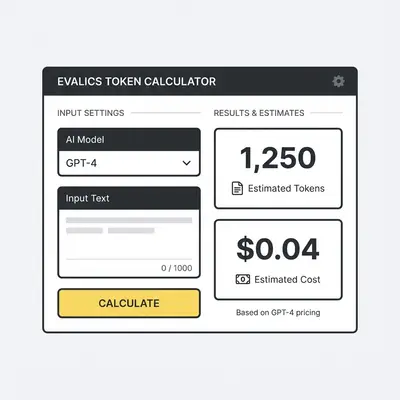
Using Evalics' Free AI Token Calculator allows you to accurately estimate your AI usage costs, providing clear insights into your potential spending before you commit. By inputting your anticipated text volume and selecting your AI model, the calculator instantly provides an estimated token count and corresponding cost, empowering you to make informed budgeting decisions. This tool removes the guesswork, giving you a tangible financial preview of your AI strategy.
Here's how to master your AI budget with the Evalics Token Calculator:
- Identify Your AI Tool & Model: Start by selecting the specific AI model (e.g., GPT-3.5, GPT-4, Llama 2, Claude) you plan to use. Token costs vary significantly between them, so this is a critical first step for accuracy.
- Estimate Your Input Volume: Quantify the average amount of text you'll feed into the AI for a typical task. Consider character count, word count, or typical message length for your prompts and context information.
- Estimate Your Expected Output Volume: Similarly, estimate the average length of the responses you anticipate receiving from the AI. Think about the typical length of a generated email, blog post, or summary for your specific use cases.
- Input Data into the Calculator: Enter your estimated input and output volumes into the designated fields on Evalics' Free AI Token Calculator. The interface is designed for clarity and ease of use.
- Review Token Count and Cost: The calculator will instantly display your estimated token count for both input and output, along with a projected cost based on the selected model's pricing structure.
- Adjust and Optimize: Use these results to adjust your prompt length, refine your output expectations, or even consider alternative AI models to optimize your budget. You might find that a slightly less advanced model handles your needs at a fraction of the cost.
What Key Benefits Does Accurate AI Budgeting Offer Your Business?
Accurate AI budgeting offers small businesses crucial financial control, enabling predictable spending, optimized resource allocation, and a clearer path to achieving a positive return on investment. It transforms AI from a potential cost center into a strategic asset, ensuring that every dollar spent contributes effectively to your business goals without unexpected financial strain. This control provides the confidence to scale your AI initiatives responsibly.
Gaining Financial Predictability and Control
One of the most significant benefits is the ability to forecast AI expenses with confidence. With a solid budget, you can allocate funds proactively, knowing exactly what to expect each month. This predictability helps avoid cash flow surprises and allows you to make informed decisions about scaling AI usage. For a small marketing agency, this might mean confidently planning for AI-generated social media content without fear of overspending on tokens during peak campaigns.
Maximizing Return on AI Investment
When you understand your AI costs, you can actively optimize your strategies to maximize ROI. Accurate budgeting allows you to compare the cost of an AI-powered solution against the value it delivers. Organizations with robust budgeting and cost-management practices for AI are 35% more likely to report a positive ROI on their AI initiatives, according to a study by IDC. [Source: IDC, AI Spending Guide 2023] This means focusing on AI applications that yield the most significant returns, rather than just experimenting blindly.
What Common Pitfalls Should Small Businesses Avoid in AI Budgeting?
Small businesses often fall into common pitfalls like underestimating token usage, ignoring API call costs, or failing to account for model changes and future scaling needs. These oversights can quickly lead to budget overruns, impacting profitability and trust in AI initiatives, underscoring the importance of meticulous planning. Avoiding these common errors is key to long-term success with AI.
Underestimating Incremental Usage
It's easy to estimate the cost of a single AI interaction, but the cumulative effect of many small interactions can quickly lead to budget creep. A customer service bot might handle thousands of queries a day, each consuming tokens. A content creation tool might generate multiple drafts for one final piece. Each of these incremental usages adds up. Small businesses must think about the daily or weekly volume of interactions, not just individual tasks.
Neglecting Hidden API Costs
Tokens are the primary cost, but they are not always the only one. Many AI services charge for API calls themselves, data storage for prompts or responses, or specialized features like fine-tuning models. These "hidden" costs can significantly inflate your overall AI spend. Always review the full pricing structure of your AI provider beyond just token rates.
Reality Check: Don't just budget for tokens! Remember to factor in potential API call fees, data storage, and third-party integrations that add to your overall AI spend. These hidden costs can quickly undermine even the most careful token estimations.
How Can Small Businesses Integrate AI Budgeting into Their Operations?
Small businesses can integrate AI budgeting by establishing clear usage policies, regularly monitoring API dashboards, and incorporating cost estimation tools like Evalics' Token Calculator into their project planning workflows. This proactive approach ensures AI expenses are consistently aligned with financial goals and business objectives, preventing surprises and fostering a culture of cost awareness. Integration makes budgeting a regular business practice, not an afterthought.
Establishing Clear Usage Guidelines
Define who can use AI tools, for what purposes, and within what parameters. Implement guidelines for prompt length and expected output size. For instance, instruct employees to refine prompts to be concise or to request shorter, more targeted responses when a detailed essay isn't needed. This reduces unnecessary token consumption. You can even set daily or weekly usage limits for individuals or teams.
Regular Monitoring and Reporting
Most AI providers offer dashboards that display real-time token consumption and associated costs. Make it a routine to check these dashboards weekly or bi-weekly. Compare actual spending against your budget estimates. This allows you to catch overspending early and adjust your strategies. Regular reporting keeps everyone accountable and provides data for refining future budget projections.
AI Budgeting Checklist for Small Businesses
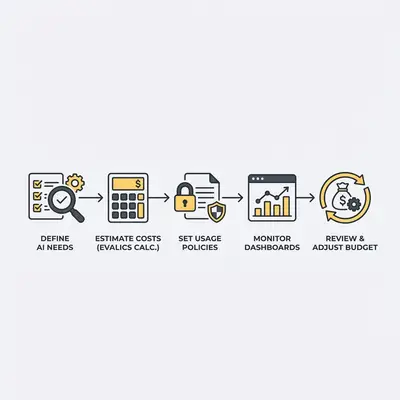
Mastering your AI budget doesn't have to be complicated. Use this checklist to ensure you're covering all essential aspects:
- Assess Needs: Clearly define your AI use cases. Estimate the frequency and volume of AI interactions for each application, like customer support responses or marketing content generation.
- Utilize Calculator: Use Evalics' Free AI Token Calculator for initial cost estimation. Input various scenarios to understand the range of potential expenses for different models and usage levels.
- Factor All Costs: Include token costs, API call fees, data storage, and potential third-party integrations (e.g., connectors like n8n or Make) that add to your overall AI spend.
- Set Baselines: Establish initial budget limits for different AI applications or departments. For example, allocate X dollars for AI-powered content creation and Y dollars for internal knowledge management.
- Monitor Usage: Regularly check your AI provider's dashboards for actual token consumption and overall spend. Be proactive in identifying any spikes or deviations from your budget.
- Review & Adjust: Periodically review your budgets against actual expenditures and adjust your strategies as needed. This iterative process helps refine your cost estimates over time.
- Educate Teams: Ensure all AI users understand token costs and responsible usage. Training can significantly reduce wasteful consumption and empower employees to be part of the solution.
Frequently Asked Questions
What is the average cost per AI token?
The average cost per AI token varies widely depending on the specific model (e.g., GPT-3.5 vs. GPT-4), the provider (e.g., OpenAI, Anthropic, Google), and whether it's an input or output token. Generally, more advanced models cost more, and output tokens can sometimes be more expensive than input tokens, making precise estimation crucial. Always consult the provider's official pricing page for the most up-to-date figures for your chosen model.
Can token costs change over time?
Yes, token costs can absolutely change over time. AI model providers frequently update their pricing structures, introduce new models with different cost tiers, or adjust existing rates. These changes can be influenced by advancements in technology, market competition, or operational efficiencies. It's essential for businesses to stay informed about these potential changes to avoid unexpected budget impacts and adapt their budgeting strategies accordingly.
Is Evalics' AI Token Calculator truly free to use?
Yes, Evalics' AI Token Calculator is completely free to use, offering small business owners an invaluable tool for preliminary AI budget estimation without any cost. This allows you to explore and plan your AI initiatives with financial clarity before making any commitments or investments. We believe in empowering small businesses with the tools they need to succeed in the AI era.
Managing your AI budget doesn't have to be a guessing game. By understanding tokens, leveraging tools like Evalics' Free AI Token Calculator, and implementing smart budgeting practices, your small business can harness the power of AI without financial surprises. This proactive approach ensures your AI investments truly drive growth and efficiency. For more insights on integrating AI into your operations efficiently, explore our blog on Automating Your Small Business for Growth.
Quick Win: Ready to take control of your AI spending? Try Evalics' Free AI Token Calculator today and start mastering your AI budget with confidence! Plan your next AI project with clarity and avoid unexpected costs.