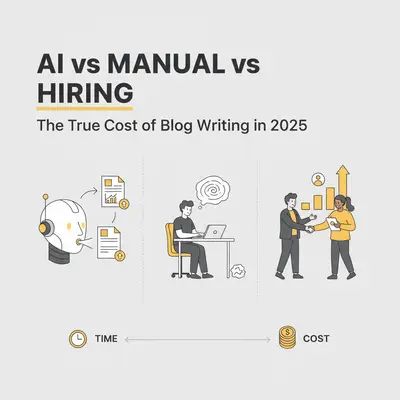
You know you need to blog to grow your business. You also know that sitting down to write a 2,000-word article feels like pulling teeth when you have a business to run.
For years, business owners had two bad choices: burn your evenings writing content yourself, or burn your budget hiring expensive freelancers.
In 2025, a third option has matured: AI Automation.
But is it actually good enough? Does it sound like a robot? And does it actually save money when you factor in the setup time?
Choosing the right path isn't just about "using AI." It's about understanding the true cost of production—whether that cost is measured in dollars, hours, or sanity.
Here is the breakdown of the three main approaches to content creation, the hidden costs of each, and which one actually makes sense for a growing business.
Option 1: The Manual Grind (DIY)
This is where everyone starts. You open a blank Google Doc, stare at the blinking cursor, and try to remember what SEO keywords you’re supposed to use.
The True Cost
The biggest misconception about DIY writing is that it’s "free." It is not. It costs your most valuable resource: Founder focus.
If your billable rate or value to the company is $100/hour, and it takes you 4 hours to research, write, edit, and publish a decent blog post, that post cost the company $400.
Reality Check: Most founders underestimate writing time. A high-quality, SEO-optimized post (1,500 words) takes an average of 4-6 hours to complete manually, including image selection and formatting.
The Pros
- Total Control: You know your tone and your business better than anyone.
- Deep Expertise: You can include personal anecdotes that no freelancer or AI knows.
- Zero Cash Outlay: Good for bootstrapped businesses with more time than money.
The Cons
- Inconsistency: You prioritize client fires over writing. Your blog goes silent for months.
- Burnout: It becomes a chore you dread.
- Opportunity Cost: Every hour you spend writing is an hour you aren't selling or building.
Option 2: Hiring Professional Writers
To escape the manual grind, businesses often outsource. You hire a freelancer or an agency to handle the content calendar.
The True Cost
Quality writers are expensive. In 2025, a generic "SEO writer" might charge $0.10 per word, but a subject matter expert charges significantly more.
- Low-end (Content Mill): $50 - $100 per post (Often poor quality, requires heavy editing).
- Mid-range (Freelancer): $250 - $400 per post.
- High-end (Agency/Expert): $600+ per post.
If you aim for 4 posts a month at mid-range quality, you are looking at $1,200 to $1,600 per month.
The Pros
- Reliability: You pay, they deliver. The schedule stays consistent.
- Quality: Good writers bring outside research and fresh perspectives.
- Hands-off: Once briefed, the work happens without you.
The Cons
- Management Overhead: You still have to create briefs, review drafts, and manage invoices.
- Variance: Finding a good writer is hard. Keeping them is harder.
- Cost: It scales linearly. Want double the posts? Pay double the money.
Option 3: AI Automation (The Hybrid Model)
This is not just pasting a prompt into ChatGPT and hitting "publish." That produces generic garbage.
True automation involves building a workflow (using tools like Make or n8n) that chains multiple AI steps together: research, outlining, drafting, critique, and formatting.
The True Cost
The financial cost is negligible. API costs for even the smartest models (like GPT-4o or Claude 3.5 Sonnet) are pennies compared to human labor.
- API Costs: ~$0.50 - $2.00 per long-form article.
- Platform Costs: ~$20 - $50/month for automation tools (Make/n8n).
- Human Time: ~30-45 minutes per post for review and "humanizing."
Pro Tip: Don't just look at the subscription fee. Read about the true cost of running AI automation to understand API usage and maintenance requirements.
The Pros
- Speed: A workflow can generate a comprehensive 2,000-word draft in 3 minutes.
- Scalability: Writing 50 articles costs roughly the same effort as writing 5.
- Consistency: The AI never gets tired, misses a deadline, or forgets your style guide.
The Cons
- Setup Curve: You need to build the system or pay someone to build it.
- Fact-Checking: AI can "hallucinate" facts. You must verify claims. (See: Understanding AI Hallucinations).
- Lack of Soul: Without human editing, AI content can feel flat or repetitive.
The ROI Analysis: Monthly Breakdown
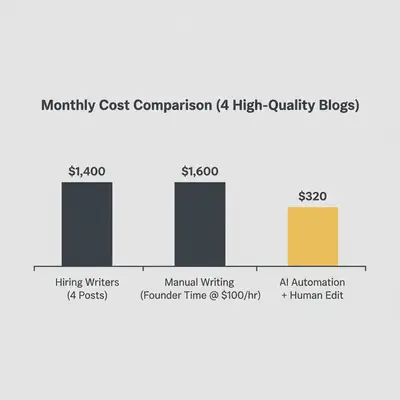
Let's look at the numbers for a standard month of content production (4 articles, 1,500 words each).
We assume:
- Founder Value: $100/hour.
- Freelancer Rate: $350/post.
- AI Setup: Includes API costs + 45 mins of human editing per post at $100/hour.
1. Manual Writing (DIY)
- Time: 16 hours (4 hours/post)
- Cash Cost: $0
- Total Economic Cost: $1,600
2. Hiring Freelancers
- Time: 2 hours (Briefing/Reviewing)
- Cash Cost: $1,400
- Total Economic Cost: $1,600
3. AI Automation (Hybrid)
- Time: 3 hours (45 mins edit/post)
- Cash Cost: ~$20 (APIs/Tools)
- Total Economic Cost: $320
The graph above illustrates this massive gap. Automation coupled with human editing is roughly 80% cheaper than the alternatives.
The Quality Debate: Can AI Actually Write?
This is the sticking point for most business owners. "I don't want my blog to sound like a robot."
This fear is valid, but it usually stems from using AI incorrectly.
If you give ChatGPT a simple prompt like "Write a blog about sales automation," you will get a generic, repetitive article that smells like AI.
However, if you use a sophisticated Agentic Workflow, the quality changes dramatically.
How an "Agentic" Blog Workflow Works
Instead of one prompt, the automation acts like a team of specialists:
- The Researcher Agent: Scrapes the top 10 Google results for the topic to find current data.
- The Outliner Agent: Creates a structure based on the research.
- The Writer Agent: Writes section by section, adhering to a specific style guide.
- The Editor Agent: Reviews the draft for repetition and "AI-speak," instructing the writer to fix it.
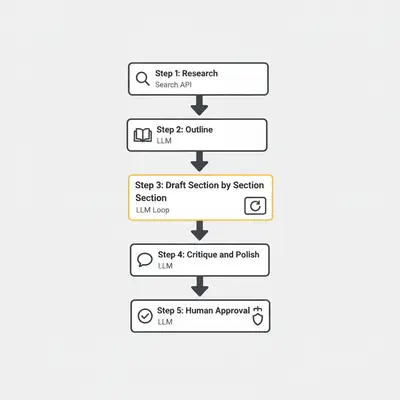
By breaking the task down, you bypass the "context window" limitations that make long AI text get fuzzy.
Key Insight: The quality of AI output depends heavily on your prompt engineering. Check out our prompt engineering checklist to see how to structure instructions for better results.
When to Use Which Method
Not every blog post should be automated. Here is a decision framework to help you choose.
Use Manual Writing When:
- You are writing a "Manifesto" or opinion piece about your industry.
- The post relies heavily on personal stories or sensitive client case studies.
- You are defining your brand voice for the first time.
Use Hiring When:
- You need investigative journalism or original reporting (interviews, field research).
- You have a large budget but zero time to even review content.
Use AI Automation When:
- You need educational "How-to" guides (like this one).
- You are creating comparison posts (e.g., Make vs n8n).
- You need to scale content production for SEO.
- You want to repurpose YouTube videos or podcasts into articles.
Implementation: How to Start Automating
If you decide that the hybrid AI approach is right for you, don't try to build the "perfect" system on day one.
Step 1: The "Cyborg" Phase
Start by using AI tools manually. Use Claude or ChatGPT to generate outlines. Write the draft yourself using the outline. Then paste your draft back into the AI for proofreading. This helps you understand where the AI adds value.
Step 2: Simple Automation
Use a tool like Make.com or n8n. Create a simple workflow:
- Trigger: New row in Google Sheets (with your blog topic).
- Action: AI generates an outline.
- Action: AI writes the draft.
- Action: Draft is saved to a Google Doc for you to review.
Step 3: Advanced Optimization
Once the basics work, you can add SEO optimization, automatic image generation, and direct publishing to WordPress.
Quick Win: Are you unsure if the tools are worth the money? Read our guide on free vs paid AI tools to see where to invest your budget first.
The Verdict
In 2025, the question isn't "Human vs. AI." It is "Human vs. Human utilizing AI."
A business owner manually writing blogs is competing against competitors who are using automation to publish 10x the content at 10% of the cost.
The goal isn't to remove the human from the loop. It's to remove the human from the drudgery. Let the AI handle the research, the structure, and the first draft. You handle the strategy, the stories, and the final polish.
That is how you win.
Related Resources
Official Sources
By Kevin Michael Schindler, AI Automation Expert at Evalics