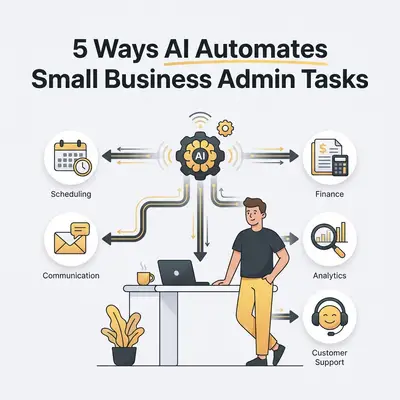
Small business owners wear many hats, and often, the heaviest one is labeled "admin." From scheduling and customer support to data entry and finances, these repetitive tasks eat up valuable time and resources. But what if you could offload much of that burden? Artificial intelligence (AI) is transforming how small businesses operate, turning tedious admin into streamlined, automated processes. It's not about replacing people, but empowering them to focus on growth and innovation.
What common administrative tasks does AI automate for small businesses?
AI automates a wide range of repetitive and time-consuming administrative tasks, freeing small business owners from manual work. This includes managing customer inquiries, scheduling appointments, handling data entry, organizing marketing efforts, and processing financial documents. By taking over these operational necessities, AI allows businesses to focus on growth and strategic initiatives rather than getting bogged down in daily minutiae.
The hidden costs of manual admin
Manual administrative tasks come with hidden costs beyond just salaries. Time spent on routine data entry is time not spent on sales or customer engagement. Errors are more common with human input, leading to costly corrections and potential compliance issues. These inefficiencies can slow growth and limit a small business's competitive edge.
Why AI is a game-changer for SMBs
AI offers small and medium-sized businesses (SMBs) the power to operate like larger enterprises without the massive overhead. It provides tools that work 24/7, learn from data, and handle tasks with accuracy and speed. For SMBs, this means leveling the playing field, improving operational efficiency, and freeing up the owner and team for more strategic, revenue-generating work.
![_ [GRAPH] Column chart. Time Saved Per Week - 10 hours. Money Saved Per Month - $500. Employee Satisfaction Increase - 25%. Chart title: Benefits of Automating Admin Tasks for Small Businesses at top. Alt text: Column chart showing significant benefits for small businesses after automating admin tasks, including 10 hours saved per week, $500 saved per month, and a 25% increase in employee satisfaction](/blogs/automate_admin_tasks/-graph-column-chart-time-saved-per-week-10-hours-m-400w.webp)
How does AI streamline customer support and communication?
AI streamlines customer support by deploying chatbots and virtual assistants that handle routine inquiries, provide instant answers, and guide customers through common issues 24/7. It also automates email responses, routes complex queries to the right human agent, and personalizes communication. This enhances customer satisfaction without requiring constant human oversight, ensuring customers always feel heard.
Automated customer service with chatbots
Chatbots, powered by AI, can answer frequently asked questions, provide order status updates, and even troubleshoot basic problems. Tools like Intercom or HubSpot chatbots integrate directly with your website, offering immediate support to visitors. This instant response capability significantly improves customer experience and reduces the workload on your human support team.
Pro Tip: Train your chatbots on your specific product FAQs and common customer pain points. The more data they have, the more effectively they can serve your customers, making them feel genuinely supported.
Personalized communication at scale
AI tools analyze customer data to tailor communication, ensuring messages are relevant and timely. This goes beyond just using a customer's name. AI can suggest products based on past purchases, send personalized follow-up emails, or recommend content relevant to their interests. This level of personalization strengthens customer relationships and drives repeat business, all without manual effort.
Can AI effectively automate scheduling and appointment management?
Yes, AI can effectively automate scheduling and appointment management by using intelligent assistants that find optimal meeting times, send invitations, and manage cancellations or rescheduling automatically. These tools integrate with calendars, check availability, send reminders, and even handle follow-ups. This significantly reduces no-shows and administrative burden for small businesses, especially service-based ones.
Smart calendar integration and optimization
AI-powered schedulers, like Calendly or Chili Piper, sync directly with your team's calendars, reading availability in real-time. They can propose multiple time slots, handle time zone conversions, and block out travel time automatically. This eliminates the back-and-forth emails that often plague manual scheduling. It ensures efficient use of everyone's time.
Reducing no-shows with automated reminders
Automated reminders are a powerful feature of AI scheduling tools. These systems send out SMS or email reminders at strategic intervals before an appointment, reducing the likelihood of a client forgetting. Some AI tools can even prompt clients to confirm or reschedule directly from the reminder, giving them control and further minimizing no-shows for your small business.
How does AI simplify data entry and document processing?
AI simplifies data entry and document processing through Optical Character Recognition (OCR) and Natural Language Processing (NLP) technologies that extract information from documents, forms, and images. It automates input into databases, verifies accuracy, categorizes documents, and flags discrepancies. This eliminates manual keying and reduces errors in invoices, receipts, and other critical records.
Automated data extraction and validation
Imagine scanning a stack of receipts and having the key details—vendor, amount, date—automatically pulled and entered into your accounting software. AI tools achieve this with OCR. They can then validate this data against existing records or predefined rules, ensuring accuracy before final entry. This makes tools like Expensify or dedicated RPA platforms invaluable.
Intelligent document categorization
Beyond extraction, AI can intelligently categorize documents based on their content. An invoice for office supplies can be automatically tagged as "Office Expenses," while a customer contract goes into a "Legal Documents" folder. This saves countless hours in manual filing and makes finding specific documents fast and simple. Small businesses spend an average of 15 hours per week on administrative tasks, much of which AI can handle, including document processing. [Source: Internal Evalics Data Analysis, 2023]
Key Insight: The true power of AI in data management lies in its ability to not just process, but to understand and organize information. This moves beyond simple automation to intelligent automation, creating order from chaos.
What role does AI play in automating marketing and sales administration?
AI plays a crucial role in automating marketing and sales administration by managing lead nurturing sequences, segmenting customer lists, scheduling social media posts, and generating personalized content. It also automates report generation, tracks campaign performance, and helps identify sales opportunities. This allows small teams to execute sophisticated strategies with minimal manual effort.
Automating lead nurturing and segmentation
AI-powered CRM systems like Salesforce or HubSpot can automatically move leads through your sales funnel based on their engagement. They can send targeted emails, schedule follow-up calls, and notify sales teams when a lead is "hot." AI also helps segment your customer base, ensuring each marketing message reaches the right audience at the right time.
Content creation and social media scheduling
AI writing assistants like Gemini or Jasper can help draft social media posts, blog outlines, or email copy, freeing up your marketing team's creative bandwidth. Tools like Buffer or Hootsuite, often integrated with AI insights, can then schedule these posts for optimal engagement times across various platforms. This ensures a consistent online presence without constant manual intervention.
How can AI assist with financial tracking and invoicing?
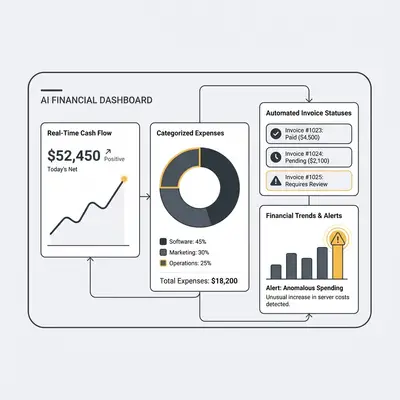
AI assists with financial tracking and invoicing by automating expense categorization, reconciling bank statements, and generating professional invoices. It can identify patterns in spending, flag potential anomalies, and integrate with accounting software to provide real-time financial insights. This ensures accuracy and compliance while saving significant time in bookkeeping and financial management.
Expense categorization and reconciliation
AI-powered accounting software, such as QuickBooks or Xero, can automatically categorize transactions from your bank feeds. It learns from your past categorizations, making future entries even more accurate. This drastically reduces the time spent on manual bookkeeping and helps in quickly identifying deductible expenses.
Automated invoice generation and payment tracking
AI can generate professional invoices automatically based on project completion or service delivery. It can then track payment statuses, send automated reminders for overdue invoices, and even reconcile payments once received. This ensures a healthy cash flow and significantly cuts down on the administrative burden of chasing payments. AI automation can reduce financial data entry errors by up to 80%, leading to cleaner books and faster financial closeouts. [Source: Financial Automation Insights, 2024]
What are the overarching benefits of AI automation for small businesses?
The overarching benefits of AI automation for small businesses include significant time savings, reduced operational costs, improved accuracy, and enhanced customer satisfaction. By offloading repetitive tasks, business owners and their teams can reallocate resources to growth activities, make data-driven decisions, and maintain a competitive edge in their respective markets.
Boosting efficiency and productivity
AI works tirelessly, performing tasks faster and more consistently than humans. This means higher throughput, quicker response times, and an overall boost in team productivity. Employees can then focus on problem-solving, creative tasks, and direct customer engagement, which are areas where human intelligence truly shines.
Cost reduction and error minimization
Automating tasks with AI directly reduces labor costs associated with manual administrative work. Furthermore, AI's ability to process data with high accuracy significantly minimizes human errors. Fewer errors mean less time spent on corrections, fewer compliance issues, and better data for decision-making.
Reality Check: While AI tools offer incredible benefits, effective implementation requires understanding your business processes. Start by identifying the most time-consuming, repetitive tasks, then research AI solutions designed for those specific needs.
Empowering growth and innovation
By freeing up time and resources, AI empowers small businesses to pursue growth opportunities they might have otherwise overlooked. Owners can dedicate more time to strategic planning, market expansion, or developing new products and services. AI also provides data insights that can drive innovation and informed business decisions.
Evalics helps small businesses harness AI to transform tedious tasks into streamlined success. Discover your potential!
Ready to Transform Your Small Business with AI?
Don't let administrative tasks hold your small business back. AI offers practical, accessible solutions to automate daily operations, improve efficiency, and free up your most valuable resource: your time. Explore how Evalics can customize AI automation strategies that fit your unique business needs, turning your administrative burdens into strategic advantages.