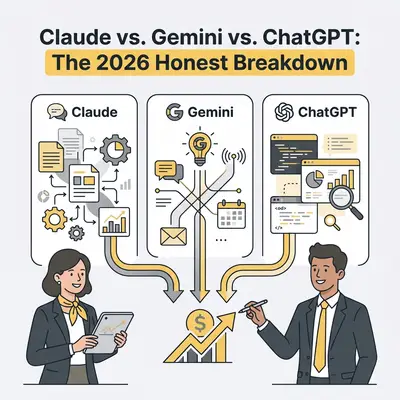
In 2025, the question was "should we use AI?" In 2026, the question is "which AI for which task?" The three dominant models—Claude (Anthropic), Gemini (Google), and ChatGPT (OpenAI)—are not interchangeable. They have genuinely different strengths, different pricing structures, different context window sizes, and different integration ecosystems.
Using the wrong model for a task is not a catastrophe—all three are capable—but using the right model consistently produces measurably better outputs with less prompting effort.
This breakdown maps each model to the business tasks it handles best, with honest assessments of where each falls short.
What Has Changed in 2026
The "ChatGPT does everything" era is over. The model landscape has matured into three distinct leaders with genuine differentiation:
- Claude (Anthropic) — best-in-class for long-context reasoning, precise instruction following, and analysis of complex documents
- Gemini (Google) — deepest integration with Google Workspace, competitive context window, and strong multimodal capabilities
- ChatGPT / GPT-4o (OpenAI) — most versatile, largest third-party integration ecosystem, strongest for creative and varied content
The pricing gap that made OpenAI the default choice has narrowed. All three major providers now offer comparable capabilities at comparable price points. The differentiation is in depth of capability for specific task types.
Context Windows: A Practical Difference
Context window size determines how much text (documents, conversation history, code) a model can process in a single request.
| Model | Context Window | Best For |
|---|---|---|
| Claude Opus 4.6 | Up to 1M tokens | Entire codebases, very long contracts |
| Claude Sonnet 4.5 | 200k tokens | Long reports, multi-document analysis |
| Gemini 1.5 Pro | 1M+ tokens | Full document libraries, video + text |
| GPT-4o | 128k tokens | Most business documents |
For most business tasks (emails, meeting notes, standard reports), GPT-4o's 128k context is sufficient. For tasks involving long contracts, large codebases, or multi-document analysis, Claude's and Gemini's larger windows are a practical advantage—not just a spec difference.
A 400-page legal contract is approximately 200,000 tokens. Claude Sonnet can process the entire document in one pass. GPT-4o cannot.
Task-by-Task Breakdown
Long Document Analysis — Claude Wins
Reading and reasoning across large documents is where Claude consistently outperforms the alternatives. This includes:
- Contract review and clause extraction
- Financial report analysis
- Technical documentation summarization
- Research paper synthesis
- Long-form due diligence
Claude's training emphasizes precise instruction following and nuanced reasoning. When you ask Claude to "identify all indemnification clauses and flag any that are non-standard," it does this systematically across a 300-page contract. It does not hallucinate clause locations, and it preserves the distinctions between what the contract says and what you need to act on.
Practical note: For document analysis workflows, Claude via API is the recommended choice. Feed the document, ask structured questions, receive structured answers. For very large documents (500+ pages), Gemini 1.5 Pro's 1M+ token context is the alternative.
Google Workspace Workflows — Gemini Wins (By Default)
If your business runs on Google Workspace—Gmail, Google Docs, Google Sheets, Google Meet—Gemini's native integration provides workflow benefits no competitor can match:
- Gemini in Gmail: Drafts email responses, summarizes long threads, extracts action items from inbox
- Gemini in Docs: Writes, edits, and reformats documents within the editor
- Gemini in Sheets: Generates formulas, analyzes data, creates reports from natural language queries
- Gemini in Meet: Real-time transcription and post-meeting summaries
- Google Workspace Flows: Build multi-step AI automations entirely within the Google ecosystem
This is not about raw model quality—it is about friction. A Gemini-powered action in Gmail happens in two clicks. The same action in Claude or ChatGPT requires copying text, switching tabs, running a prompt, and copying back. For the volume of tasks that happen daily in email and documents, this friction reduction compounds significantly.
For businesses already paying for Google Workspace, Gemini is partially included—check your plan for current AI feature access.
Creative and Marketing Content — ChatGPT / GPT-4o Leads
For content creation—blog posts, ad copy, social media, product descriptions, email campaigns—GPT-4o produces the most varied, polished, and naturally flowing output. It handles tone variations (formal, casual, humorous, authoritative) with less prompting, and its training on vast internet content makes it strong at matching specific brand voices.
This is where the "ChatGPT writes better" reputation comes from, and it holds for:
- Marketing copy and ad headlines
- Customer-facing email templates
- Social media posts
- Product descriptions for e-commerce
- Creative brainstorming and ideation
Claude produces excellent content too—often more precise and less prone to filler phrases. But GPT-4o's output tends to feel more natural to non-AI readers with less editing required for most marketing purposes.
DALL-E integration via ChatGPT also gives GPT-4o a native image generation capability that makes it the most complete tool for marketing workflows that combine text and visual content.
Following Complex, Multi-Part Instructions — Claude Leads
If your workflow involves long, detailed system prompts with multiple conditional rules, constraints, and output formatting requirements—Claude is the most reliable choice for following them precisely.
This matters for:
- Business process automations with strict output format requirements
- Customer service bots with complex escalation and deflection rules
- Document processing pipelines where specific extraction formats must be maintained
- Any workflow where prompt adherence is more important than creativity
Claude's constitutional AI training emphasizes careful instruction following. It is less likely to shortcut instructions, skip steps, or reinterpret the prompt in ways that break downstream processes. For automation workflows where you cannot review every output, Claude's reliability advantage is meaningful.
For a detailed comparison of how Claude and GPT handle system versus user prompts in production automation, see ChatGPT vs. Claude for Automation: When Prompts Break.
Coding Assistance — Competitive, IDE Matters More
All three models perform well on coding tasks in 2026. The more important choice is the IDE (Cursor, Windsurf, Claude Code) rather than the underlying model:
- Claude via Claude Code or Cursor: strong multi-file reasoning and large codebase understanding
- GPT-4o via Cursor or GitHub Copilot: most community examples and largest ecosystem
- Gemini via Android Studio or Google's Duet AI: strongest for Google Cloud and Android development
For most developers, the coding assistant tool they choose (Cursor, Windsurf, etc.) matters more than which LLM powers it. Both Claude and GPT-4o power strong coding assistants—choose based on your workflow tool rather than the underlying model.
Research and Current Information — Neither (Use a Search-Enabled Tool)
All three major models have knowledge cutoffs and can hallucinate recent events, pricing, or statistics. For research tasks requiring current information, use a search-enabled tool:
- Perplexity AI — best for citation-linked research
- ChatGPT with web search enabled — convenient if you are already in the ChatGPT interface
- Gemini with Google Search — integrated directly into Google's search infrastructure
Do not use Claude, ChatGPT, or Gemini for factual claims about current events, recent pricing, or anything that changes frequently—verify with a search-enabled source.
The Multi-Model Workflow (The "Triple Stack")
High-output teams in 2026 are increasingly using different models for different stages of their workflow:
- Perplexity / search-enabled model for research and gathering current facts
- Claude for analyzing the gathered information, synthesizing insights, and reasoning through implications
- ChatGPT (GPT-4o) for polishing the output into client-ready content
This plays to each model's genuine strengths. Research-gather-analyze-publish becomes a pipeline with the best tool at each stage.
The overhead: managing three model subscriptions (roughly $60-80/month total for individual plans) and learning each model's prompt conventions. For high-volume content and research workflows, the quality improvement justifies the cost.
Pricing Summary (API, March 2026)
| Model | Input (per 1M tokens) | Output (per 1M tokens) | Context |
|---|---|---|---|
| Claude Sonnet 4.5 | $3.00 | $15.00 | 200k |
| Claude Opus 4.6 | $15.00 | $75.00 | 1M |
| Gemini 1.5 Pro | $1.25 (<128k) | $5.00 | 1M+ |
| Gemini 1.5 Flash | $0.075 | $0.30 | 1M+ |
| GPT-4o | $2.50 | $10.00 | 128k |
| GPT-4o mini | $0.15 | $0.60 | 128k |
For cost-sensitive, high-volume automation at scale, Gemini 1.5 Flash offers the lowest cost per token among capable models. For quality-sensitive workflows, Claude Sonnet and GPT-4o are comparable in cost with different quality profiles depending on the task.
Summary: Which Model for Which Task
| Task | Recommended Model |
|---|---|
| Long document analysis | Claude Sonnet / Opus |
| Contract review | Claude |
| Google Workspace workflows | Gemini |
| Marketing and creative copy | ChatGPT / GPT-4o |
| Following complex instructions | Claude |
| Current research and facts | Perplexity / Search-enabled |
| Cost-sensitive high-volume tasks | Gemini Flash |
| Coding (IDE-based) | Cursor or Claude Code (Claude) |
| Image + text creation | ChatGPT (DALL-E integrated) |
No single model wins across every task. The businesses getting the most from AI in 2026 are the ones that have learned which model to reach for—rather than defaulting to the one they signed up for first.
Want to build AI workflows that use the right model for each task automatically? Book a strategy call at evalics.com/contact to map your business tasks to the models that handle them best.