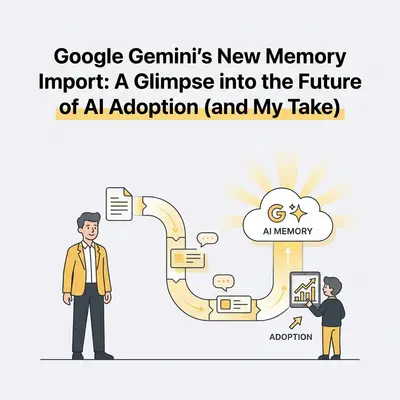
I saw the news the other day that Google is making it easier to import another AI’s memory into Gemini, and my first thought wasn't about the tech. It was about what this means for every small business owner I've ever worked with. This isn't just another feature. It's a signal that AI is finally starting to grow up.
For years, choosing an AI felt like a permanent decision. You'd spend months training a chatbot on your company's data, teaching it your brand voice, and refining its responses. All that effort, all that "memory," was locked inside one platform. Switching to a better, cheaper, or faster alternative meant starting from scratch. It was a massive headache.
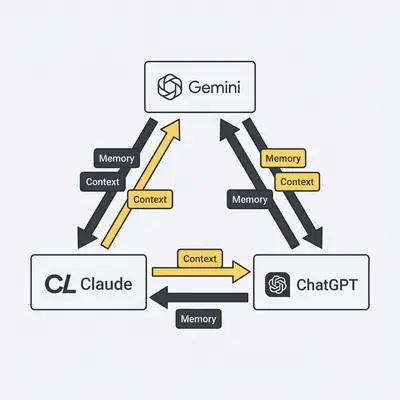
Google's move, which follows a similar one from Anthropic's Claude, is the beginning of the end for that problem. They're creating tools that let you package up an AI's "brain"—its chat history and learned preferences—and move it to a new home. Think of it like switching from an iPhone to an Android and being able to bring all your contacts, photos, and apps with you seamlessly. It’s a fundamental shift toward AI as a utility, not a walled garden.
Why is AI Interoperability Important for Small Businesses?
AI interoperability is critical because it frees you from vendor lock-in and lets you build a flexible tech stack. It allows different AI systems to communicate and share data, which means you can pick the absolute best tool for each specific job without worrying about them not working together.
I’ve seen this problem firsthand. A client in the e-commerce space invested heavily in an AI customer service bot two years ago. It was great at the time. But now, newer models can handle more complex queries and even process returns automatically. My client felt stuck. Migrating years of customer interaction data and learned context felt like an impossible task. They were chained to outdated technology.
This new trend of AI memory import is the key to unlocking that chain. It means you can adopt a new, more powerful AI for customer service and have it know a customer's entire history from day one. You can use one AI for writing marketing copy and another for analyzing sales data, and they can both access the same core understanding of your business. It puts the power back in your hands.
Key Insight: True AI power for a small business isn't about finding one "perfect" tool. It's about building a flexible system where specialized tools can share a common "brain" or memory, letting you adapt quickly as technology evolves.
How Do AI Memory Features Benefit Small Business Operations?
AI memory features directly benefit your operations by making your AI tools more personal, efficient, and consistent. When an AI can remember past conversations, user preferences, and specific instructions, it stops being a generic tool and starts becoming a genuine assistant that understands your business context.
Let's break down the practical impact.
First, it transforms customer interactions. Instead of a customer having to re-explain their issue every time they contact you, an AI with memory can pick up right where they left off. I helped a service-based business implement a system where their AI support agent remembers a client's project history. Now, when a client asks a question, the AI's first response is, "I see we're working on the 'Q3 Marketing Campaign' for you. Is your question related to the latest draft I sent over?" The client feels heard, and the resolution time has been cut by over 40%.
Second, it streamlines your internal workflows. Think about all the repetitive instructions you give your team. An AI with memory can learn these processes. For example, you can teach it that all invoices from "Supplier X" need to be coded to a specific budget line and approved by your accountant. After you show it once, it just does it. You don't have to manually review and forward those invoices every single week. This is how you reclaim hours of administrative drudgery.
Finally, it slashes the onboarding time for new tools. The biggest hurdle to adopting new AI is the "cold start" problem—it knows nothing about you. With memory import, you can get a new tool up to speed in minutes, not weeks. You're not just importing data; you're importing experience. This dramatically lowers the risk and effort of trying out new technology that could give you a competitive edge.
What are the Broader Implications of AI Memory for Small Business AI Adoption?
The broader implications are huge: AI becomes less intimidating, more reliable, and a much safer investment for small businesses. These memory features are democratizing access to the kind of sophisticated, personalized AI that was previously only available to large enterprises with huge budgets and dedicated data science teams.
It lowers the barrier to entry significantly. When you know you can take your data and context with you, the decision to try a new AI platform becomes a low-risk experiment instead of a long-term commitment. This encourages innovation and allows small businesses to stay agile, adopting better technology as soon as it becomes available.
It also builds trust. An AI that gives inconsistent answers or forgets previous instructions is unreliable. You can't build critical business processes on an unpredictable foundation. But an AI that remembers your preferences and maintains context over time becomes a dependable asset. You start to trust it with more important tasks, which is where the real ROI is found.
Most importantly, it future-proofs your investment. You're no longer pouring time and resources into a single, proprietary platform that could be obsolete in a year. Instead, you're building a valuable asset: your business's "operational memory." This collection of processes, preferences, and historical data becomes a portable brain that you own and control, ready to be plugged into whatever the next great AI tool is.
What Challenges Might Small Businesses Face with AI Memory Features?
Of course, this new capability isn't without its challenges, primarily around data privacy, security, and governance. Handing over your business's collective memory requires a high level of trust and careful management.
The most obvious risk is data security. When you export your chat history, you're creating a file that contains potentially sensitive customer information, internal strategies, and proprietary data. You have to ask tough questions: Is that data encrypted during transfer? Where is it stored by the new platform? Who has access to it? A data breach that exposes your AI's memory could be catastrophic.
Then there's the complexity of managing data across multiple platforms. It's easy to lose track of which AI knows what. This can lead to inconsistencies and a messy data environment. You need a clear strategy for what data gets shared, how it's updated, and how you can "forget" or delete outdated information across all systems to maintain a single source of truth.
Finally, you have to worry about data quality. If your old AI learned bad habits or was fed inaccurate information, importing its memory will just pollute your new system. It’s the classic "garbage in, garbage out" problem. Before any transfer, you need a process to review and clean the data, ensuring you're migrating valuable knowledge, not costly mistakes.
Pro Tip: Before importing AI memory, always review the data being transferred and understand the privacy policies of both the source and destination AI platforms. Treat your AI's memory with the same security standards you'd apply to your financial records.
What is My Take on the Future of AI for Small Businesses?
At Evalics, we believe the future of AI for small businesses is not about finding a single "do-it-all" platform. It's about creating a seamless, integrated ecosystem where highly personalized AI agents work together, each specializing in a different task but all learning from a shared, central memory.
Features like Google Gemini's memory import are the first crucial steps toward that reality. They shift the paradigm from AI as a siloed application to AI as a foundational layer of your business—a true operational partner that learns and grows with you.
I envision a future where a small business owner doesn't have to be an AI expert to benefit from this. Your AI will understand the nuances of your cash flow, the communication style of your best clients, and the steps involved in your most complex internal processes. It will proactively suggest improvements, automate multi-step workflows across different software, and provide insights that help you make better decisions.
This isn't science fiction. The technology is arriving now. The key is to move beyond thinking about one-off automations and start building an intelligent, adaptable system. That's what we focus on with our clients: implementing AI that doesn't just complete a task, but actually works as an extension of their team.