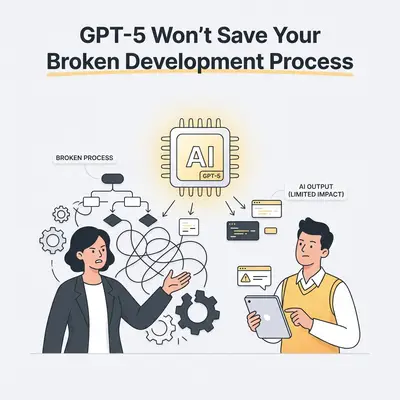
OpenAI recently published Coding and design with GPT-5, detailing how their latest model significantly lowers the barrier to entry for software development and UI/UX design. This post reacts to that announcement by examining why raw AI capability is insufficient for small business success.
While GPT-5 offers unprecedented speed in generating code and design assets, it does not solve the underlying operational inefficiencies that plague small businesses. Relying on a tool without a strategy is a recipe for technical debt and fragmented workflows.
Why Does Your Development Process Need More Than Just AI?
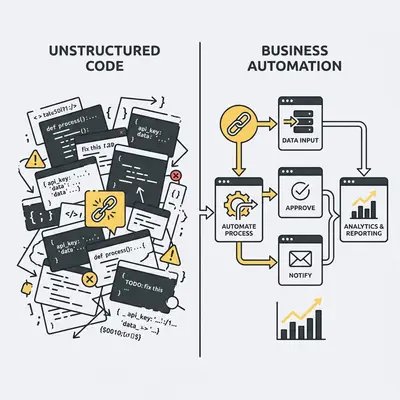
Your development process requires more than just AI because code is only a small fraction of a functional business system. Without defined requirements, integration logic, and maintenance protocols, GPT-5 will simply generate high-quality code that fails to solve your specific business problems or scale with your growth.
The Trap of "Instant" Development
The allure of "instant" development is dangerous. When you can generate a functional script in seconds, the temptation is to skip the planning phase. You end up with a collection of disconnected scripts that work in isolation but fail to communicate with your CRM, your accounting software, or your team’s actual workflow. Speed is a vanity metric if the output creates more work for you in the long run.
Why Strategy Must Precede Execution
Strategy is the filter that turns raw code into business value. Before you prompt an AI to build a feature, you must define the "why." What is the business outcome? How does this integrate with your existing stack? If you don't have a clear roadmap, you aren't building a system; you are building a graveyard of one-off tools that will eventually break.
Reality Check: AI is a force multiplier, not a replacement for sound engineering principles. If your process is broken, AI will just break it faster.
How Do You Evaluate Your Current Automation Readiness?
To determine if you are ready to leverage AI for development, you must audit your existing workflows for stability and documentation. If your current processes are manual, undocumented, or inconsistent, applying AI will only accelerate the creation of "broken" systems that are harder to debug and maintain.
| Criteria | Low Readiness | High Readiness |
|---|---|---|
| Documentation | None/Tribal Knowledge | Standard Operating Procedures |
| Workflow Logic | Ad-hoc/Reactive | Defined/Predictable |
| Integration Needs | Siloed Apps | API-First Architecture |
| Maintenance | Manual Fixes | Automated Monitoring |
If you find yourself in the "Low Readiness" column, stop. Do not touch the AI tools yet. Spend your time documenting your manual steps first. Automation is only as good as the process it replaces.
What Is the "Build vs. Buy" Framework for SMBs?
The "Build vs. Buy" framework for SMBs prioritizes core competency over custom development. If a task is central to your competitive advantage, build it with AI-assisted tools; if it is a commodity function (like CRM syncing or invoicing), buy a pre-built automation solution to avoid the long-term burden of maintenance.
Identifying Your Core Competencies
Ask yourself: Does this specific piece of software make us unique in the market? If the answer is no, don't build it. Use a standard tool. If the answer is yes, use AI to accelerate the development of that specific, proprietary advantage. Focus your engineering resources where they actually move the needle.
The Hidden Costs of Custom AI Code
Custom code is a liability. Every line of code you generate with AI is a line you eventually have to maintain, update, and secure. If you build a custom integration for a task that a $20/month SaaS tool already handles, you are effectively paying yourself to create technical debt.
Pro Tip: Don't build what you can buy. Don't automate what you haven't optimized.
How Can Evalics Bridge the Gap Between AI and Operations?
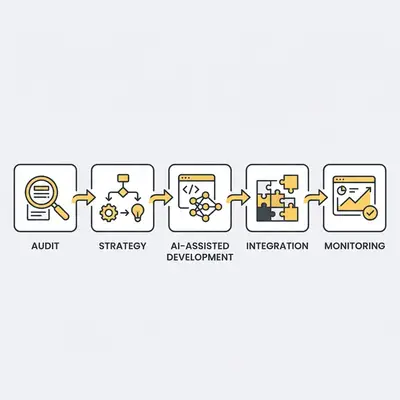
Evalics bridges the gap by transforming raw AI output into robust, integrated business systems. We move beyond simple code generation to ensure that every automation is mapped to your business goals, tested for reliability, and integrated seamlessly into your existing tech stack, preventing the "broken process" trap.
From Prompt to Production
We don't just write code; we build architectures. Our process starts with a deep dive into your current operational bottlenecks. We then use AI to draft the components, but we manually verify the logic, security, and scalability of every piece. We ensure that the final product is something your team can actually use and maintain.
Ensuring Long-Term System Stability
Stability comes from monitoring and error handling. We build systems that alert you when something goes wrong, rather than systems that fail silently in the background. By implementing robust logging and modular design, we ensure that your AI-assisted tools remain assets, not headaches.
What Are the Common Pitfalls of AI-Driven Development?
Common pitfalls include ignoring security vulnerabilities in AI-generated code, failing to document custom logic, and creating "black box" systems that no one on your team knows how to fix. These issues often lead to significant downtime and increased costs when the AI-generated solution inevitably requires an update.
Security and Compliance Risks
AI models are trained on public data, not your private business logic. When you ask an AI to write code, it might suggest patterns that are insecure or violate your internal compliance standards. You need a human in the loop who understands security to review every single line before it touches your production environment.
The "Black Box" Maintenance Problem
If you build a complex system using AI and you don't understand how it works, you are trapped. When the API changes or the logic breaks, you will be unable to fix it. Always prioritize transparency and documentation over clever, "black box" solutions that look impressive but are impossible to debug.
Key Insight: Your goal is a sustainable system, not a clever script. If you can't explain how it works to a new hire, it's a liability.
Source
This post is a response to the OpenAI article: Coding and design with GPT-5