Workflow automation has become essential infrastructure for small businesses—but choosing the wrong platform means either overpaying as you scale, hitting walls when you need custom logic, or compromising data privacy you cannot afford to lose.
n8n, Make, and Zapier are the three dominant tools in this space in 2026. They all connect apps and automate workflows. The differences between them are significant, and they compound quickly as your automation needs grow.
This comparison cuts through the marketing claims to show what each platform actually costs at scale, where each one excels, and which scenarios make one the clear winner.
The Fundamental Difference
Before comparing features, it is worth understanding what each platform is optimized for:
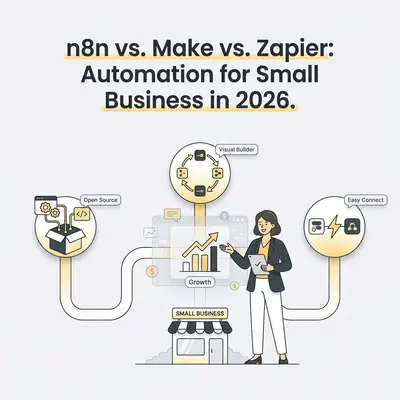
- Zapier was built to make automation accessible to non-technical users. Its 8,000+ integrations and simple linear workflow builder are unmatched for getting something working quickly without technical expertise.
- Make was built for users who think visually and need complex branching logic. Its canvas-based interface shows data flowing between modules—significantly more powerful than Zapier for complex scenarios, accessible without being a developer.
- n8n was built for developers and technical teams who want full control. Open-source, self-hostable, and with native code execution, it is the most powerful of the three—at the cost of a steeper learning curve.
Pricing: Where the Real Differences Live
Pricing is where the platforms diverge most dramatically, and the headline prices hide the reality.
Zapier
Zapier charges per task—each individual step in a workflow counts as a task. A five-step automation that runs 1,000 times per month consumes 5,000 tasks. This model is easy to understand but expensive as complexity grows.
| Plan | Tasks/Month | Price |
|---|---|---|
| Free | 100 | $0 |
| Starter | 750 | $19.99/mo |
| Professional | 2,000 | $49/mo |
| Team | 50,000 | $299/mo |
At 100,000 tasks/month—common for a business automating lead management, CRM sync, and email sequences—Zapier costs over $300/month. Multi-step workflows at moderate volume push costs significantly higher than competitors.
Make
Make charges per operation—each module (step) in a scenario counts as one operation. The pricing is more favorable than Zapier at equivalent volumes, and the free tier is more generous.
| Plan | Operations/Month | Price |
|---|---|---|
| Free | 1,000 | $0 |
| Core | 10,000 | $9/mo |
| Pro | 10,000+ | $16/mo |
| Teams | 10,000+ | $29/mo |
At 100,000 operations/month, Make stays well under $100. This is typically 60-70% cheaper than equivalent Zapier usage at scale. The trade-off: roughly 2,000 native integrations versus Zapier's 8,000+.
n8n
n8n charges per workflow execution—the entire workflow run counts as one execution, regardless of how many steps it contains. A 10-step workflow running 1,000 times per month = 1,000 executions, not 10,000.
| Plan | Executions/Month | Price |
|---|---|---|
| Free (Cloud) | 2,500 | $0 |
| Starter (Cloud) | 2,500 | $20/mo |
| Pro (Cloud) | 10,000 | $50/mo |
| Self-hosted | Unlimited | Hosting cost only (~$5-20/mo VPS) |
Self-hosted n8n with unlimited executions for the cost of a small VPS is the most cost-effective option at scale. For teams that do not want to manage infrastructure, n8n Cloud at $50/month for 10,000 executions is still competitive.
Cost at Scale: Honest Comparison
| Monthly Volume | Zapier | Make | n8n Cloud | n8n Self-Hosted |
|---|---|---|---|---|
| 1,000 operations | Free | Free | Free | ~$5 (VPS) |
| 10,000 operations | ~$49 | ~$9 | ~$20 | ~$5 |
| 100,000 operations | ~$300+ | ~$60-80 | ~$50 | ~$10 |
| Unlimited | Enterprise | Enterprise | Not available | ~$10-20 |
Integrations
Zapier wins on breadth. With 8,000+ app integrations—including many niche SaaS tools that Make and n8n have not built connectors for yet—Zapier is the only choice if you need to connect a specific tool that others do not support.
Make covers the most common use cases. Its ~2,000 integrations cover nearly every major business tool: Google Workspace, Microsoft 365, HubSpot, Salesforce, Slack, Notion, Airtable, Stripe, Shopify, and hundreds more. For most small businesses, the apps they need are in Make's catalog.
n8n uses a different model. With ~400+ native nodes, n8n's catalog is smaller than Make's—but its generic HTTP Request node can connect to any REST API, GraphQL endpoint, or webhook-based service, even without a pre-built integration. If the app has an API, n8n can connect to it. This matters when you need to connect to custom internal tools, less common platforms, or build integrations with exact control over the API calls.
AI Capabilities in 2026
All three platforms have added AI features, but the depth varies significantly.
n8n leads for AI workflows. Native LangChain integration means you can build multi-step AI agent pipelines directly in the visual editor: connect to an LLM, give it tools (search, calculator, API calls), and let it reason through complex tasks. Built-in support for OpenAI, Anthropic Claude, Google Gemini, and Ollama (for self-hosted open-source models) means you can run AI workflows entirely within your infrastructure. For businesses building AI-powered automation—document processing, intelligent routing, multi-step reasoning workflows—n8n is in a different class.
Zapier and Make both offer solid AI integrations. Both platforms have direct connections to OpenAI and Anthropic, and both have launched AI-powered workflow building assistants (describe what you want to automate, and the AI builds the workflow). These features work well for standard AI tasks: generating content, classifying data, extracting information from text. What they lack is n8n's ability to build custom agent loops and chains.
Zapier Agents is Zapier's autonomous AI feature: define a goal and available tools, and the AI decides how to execute. Early reviews suggest it works for straightforward tasks but lacks the reliability needed for complex, production business processes. It is promising, but not yet at parity with n8n's LangChain-based approach.
Data Privacy and Compliance
This is n8n's most important differentiator for regulated industries.
Zapier and Make are cloud-only. Your workflow data—including the content being processed—flows through their servers. Both have SOC 2 Type II certification and GDPR compliance programs, which is adequate for most business use cases. But for workflows involving healthcare records, financial data, legal documents, or any data subject to strict residency requirements, cloud-based platforms introduce risk.
n8n self-hosted keeps data within your infrastructure. Workflows run on your servers. Data never leaves your environment. This is the only option for businesses that must guarantee data locality—healthcare providers (HIPAA), financial services (PCI-DSS, SOX), law firms, and European businesses with strict GDPR data processing requirements.
Interface and Learning Curve
| Platform | Learning Curve | Best Interface Style |
|---|---|---|
| Zapier | Low | Linear, step-by-step |
| Make | Medium | Visual canvas, flowchart |
| n8n | Medium-High | Node graph, developer-friendly |
Zapier is fastest to get started with—a first automation can be live in under 10 minutes. Make requires understanding its scenario builder but rewards the investment with significantly more power. n8n's node-based interface is approachable with practice, but debugging failures requires comfort reading JSON data and understanding how nodes pass data between each other.
Which Platform Should You Choose?
Choose Zapier if:
- Your team is non-technical and needs to be self-sufficient with automations
- You need to connect a niche app that only Zapier supports
- Simple, linear workflows cover most of your use cases
- Speed of setup matters more than cost
Choose Make if:
- You need complex branching logic, routers, or multi-path scenarios
- You want a visual interface that shows data flowing through the workflow
- You want to significantly reduce costs compared to Zapier
- Your team can invest a few hours learning the canvas interface
Choose n8n if:
- You are building AI-powered automation workflows
- Data privacy or compliance requires self-hosted infrastructure
- You need custom API connections that no native integration covers
- You want to eliminate per-execution pricing entirely
- You have (or can hire) light technical capability
For most small businesses starting out: start with Make. It offers the best balance of power, visual clarity, and pricing. Graduate to n8n if AI workflows or data privacy become requirements.
Not sure which platform fits your automation needs? Book a strategy call at evalics.com/contact to map your workflows to the right tool before you invest in setup.