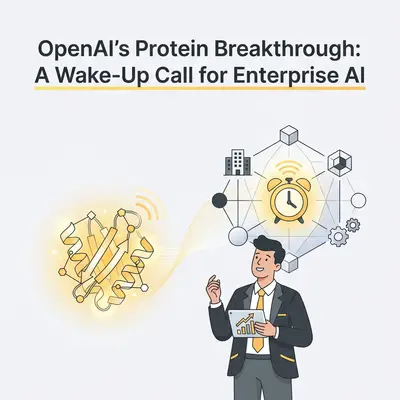
OpenAI recently published a report detailing a collaboration with Retro Biosciences, where they utilized a specialized version of GPT-4o to achieve a 50-fold increase in protein engineering efficiency. This breakthrough demonstrates how AI is moving beyond simple text generation into the realm of complex, high-stakes scientific discovery and physical world optimization.
This post reacts to the OpenAI article Accelerating life sciences research, which highlights how domain-specific AI models are fundamentally changing R&D timelines. When a model can be fine-tuned to understand the nuances of protein sequences—data that standard LLMs often struggle to parse—it proves that the "generalist" era of AI is hitting a ceiling. We are entering the era of the specialist.
What Does the Shift Toward Specialized AI Mean for Small Businesses?
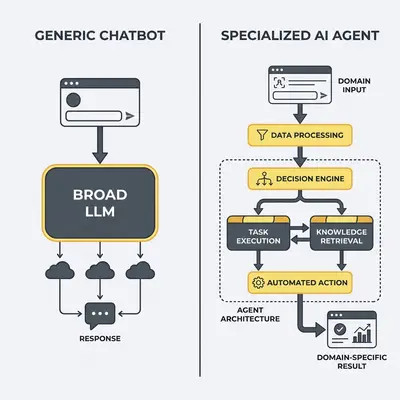
Specialized AI models are moving from experimental labs to practical business applications, signaling a shift from "general-purpose" chatbots to "task-specific" automation engines. For small businesses, this means the barrier to entry for high-level technical optimization is dropping, allowing owners to automate complex workflows that previously required expensive consultants or specialized software.
The move from general to vertical AI is the most important trend I see in my consulting work at Evalics. Broad tools like ChatGPT are great for brainstorming, but they lack the context of your specific business data. Vertical AI—models trained on your industry’s unique constraints—is where the real ROI lives.
The democratization of R&D means small teams can now leverage AI to iterate on products faster than ever before. You no longer need a massive data science department to run experiments. If you can define the parameters of a problem, you can now use AI to simulate outcomes and test hypotheses at a fraction of the traditional cost.
How Can SMBs Identify High-Impact Automation Opportunities?
Small businesses should look for repetitive, data-heavy processes where precision is currently limited by human bandwidth or generic software constraints. By identifying these "bottleneck" tasks, owners can apply targeted AI automation to achieve exponential gains in output, similar to how Retro Biosciences optimized protein markers.
To find these opportunities, start by auditing your manual workflows. Look for tasks that are high-frequency but low-complexity. If your team spends four hours a day manually reconciling invoices or categorizing customer support tickets, you have a prime candidate for automation.
Adopt the "50x" mindset. Don't just ask how to make a process 10% faster. Ask yourself: "What would happen if this process were 50 times more efficient?" This forces you to stop thinking about incremental improvements and start thinking about architectural changes to your business.
Key Insight: Don't just automate the task; automate the outcome. If your goal is customer retention, don't just automate emails—automate the personalized analysis of customer sentiment.
What Are the Risks of Adopting Emerging AI Technologies?
The primary risks for small businesses include data privacy concerns, over-reliance on third-party model providers, and the "black box" nature of complex AI systems. While the potential for growth is massive, businesses must implement robust validation protocols to ensure that automated outputs remain accurate, compliant, and aligned with business goals.
Data integrity and security are non-negotiable. When you feed proprietary business logic into an external model, you need to ensure that your data isn't being used to train public models. Always check the enterprise terms of service and consider using private, hosted instances of models when dealing with sensitive intellectual property.
Validation loops are your safety net. Even as AI capabilities scale, human-in-the-loop oversight remains critical. You should never let an AI make a final, irreversible decision without a human review step. Think of the AI as a highly capable intern—it can do the heavy lifting, but you need to check the work before it goes out the door.
Reality Check: AI is not a "set it and forget it" solution. The more complex the task, the more rigorous your testing and validation protocols must be.
How Will AI Automation Reshape Competitive Landscapes?
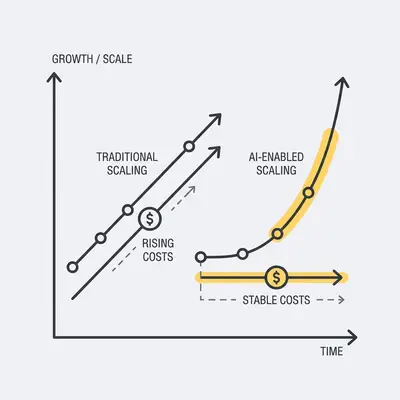
AI automation is creating a "velocity gap" between businesses that integrate specialized AI and those that rely on legacy manual processes. As AI becomes more capable of handling complex, domain-specific tasks, the businesses that adopt these tools early will be able to scale operations with significantly lower overhead, effectively out-competing larger, slower incumbents.
The velocity gap is real. If your competitor can iterate on their product, marketing, or operations 10 times faster than you, they will eventually win the market. Speed of iteration is the new primary competitive advantage. It’s not about who has the most capital; it’s about who can learn and adapt the fastest.
Scaling without headcount is the ultimate goal for most of my clients. AI allows small teams to punch above their weight class. By automating the "grunt work" of scaling—like lead qualification, data entry, and basic customer service—you can grow your revenue without needing to double your staff every year.
Source
This post is based on the research findings published by OpenAI in their article, "Accelerating life sciences research with Retro Biosciences," which details the development and impact of GPT-4b micro.
Accelerating life sciences research