
The AI automation landscape can feel daunting for new businesses. Startups often face significant challenges like limited budgets, a lack of technical expertise, and complex integration hurdles. Despite these obstacles, many innovative startups are successfully navigating AI implementation. They adopt smart, strategic approaches to leverage AI for growth and efficiency. This post will explore five proven methods that help new businesses overcome common AI automation challenges and harness the power of AI.
How Can Startups Begin with AI Automation Without Overwhelm?
Startups can begin with AI automation by defining small, manageable projects with clear, measurable goals. This focused approach reduces initial investment and minimizes risk. It allows teams to build confidence and expertise incrementally. By concentrating on a single, high-impact pain point, businesses can demonstrate tangible ROI quickly. This builds momentum for future AI initiatives.
Why Starting Small Matters for Quick Wins
Starting small creates a low-risk environment for experimentation. For example, automating customer support FAQs can save hours each week. It does not require a complete system overhaul. This allows teams to learn about AI capabilities and limitations. They can refine their approach based on real-world feedback. Small wins boost morale and provide clear data for future decisions.
Defining Your First AI Automation Goal
Define a goal that is specific, measurable, achievable, relevant, and time-bound (SMART). Instead of "automate marketing," try "automate lead qualification for new website sign-ups within two months." This clarity ensures everyone understands the project scope. It also makes it easier to track progress and measure success. Focus on tasks that are repetitive and prone to human error.
What Role Do User-Friendly AI Platforms Play in Startup Success?
User-friendly, no-code or low-code AI platforms significantly lower the barrier to entry for startups. These tools enable business users to build and deploy AI solutions without extensive coding knowledge. They provide intuitive interfaces and pre-built templates, drastically cutting development time and costs. This democratizes AI, allowing startups to rapidly experiment with and implement automation across various functions.
![_ [GRAPH] Column chart. Reduced Development Time - 70% Faster. Lower Costs - 50% Savings. Empowered Business Users - 85% Adopted. Chart title: Key Advantages of No-Code AI for Startups at top. Alt text: Column chart illustrating the benefits of no-code AI platforms for startups, highlighting reduced development time, lower costs, and increased business user adoption](/blogs/overcoming_automation_challenges/-graph-column-chart-reduced-development-time-70-fa-400w.webp)
Exploring No-Code/Low-Code Options
Platforms like Make (formerly Integromat), Zapier, and n8n offer visual builders for connecting apps and automating workflows. For more specific AI tasks, tools like Google's Gemini or OpenAI's custom GPTs can be integrated. These solutions allow business owners to configure complex automations. They do not need to write a single line of code. This dramatically reduces the need for specialized AI developers.
Bridging the Technical Skill Gap
No-code and low-code platforms empower non-technical team members to become "citizen developers." They can build solutions directly impacting their daily work. This reduces reliance on a small tech team and speeds up implementation. It fosters an environment of innovation where anyone can contribute to automation efforts. Training existing staff on these tools is often quicker and more cost-effective.
How Can Startups Ensure Their Data is Ready for AI Automation?
Startups ensure their data is AI-ready by focusing on data cleanliness, consistency, and accessibility. High-quality data is the bedrock of effective AI. This involves implementing robust data collection strategies and standardizing data formats. It also means regularly auditing datasets for accuracy and completeness. Without reliable data, AI models cannot learn effectively. They will not deliver accurate or valuable insights, leading to poor automation outcomes.
Reality Check: Poor data quality is the most common reason automation projects stall. A model can only be as consistent as the records it reads, so duplicate contacts, half-filled fields, and three spellings of the same company name become wrong answers rather than obvious errors. Invest in your data foundation early!
Steps to Improve Data Quality
- Standardize Data Entry: Create clear rules for how data is entered into all systems. This prevents inconsistencies from the start.
- Clean Existing Data: Remove duplicates, correct errors, and fill in missing information. Use tools designed for data cleansing.
- Ensure Data Consistency: Use uniform formats for dates, addresses, and other key fields across all databases.
- Validate Data Inputs: Implement checks to verify data accuracy as it is collected. This prevents bad data from entering your system.
- Regularly Audit Data: Schedule periodic reviews of your data to ensure it remains high quality over time.
Data Governance Best Practices for Startups
Establish simple data governance rules early on. Decide who owns data, how it is stored, and who has access. Document these processes clearly. This helps maintain data integrity as your business grows. It also ensures compliance with any relevant data protection regulations. A small investment in data governance today prevents major headaches tomorrow.
Why is an Iterative Approach Crucial for AI Automation in Startups?
An iterative approach is crucial because it allows startups to implement AI solutions in phases. They can gather feedback and make adjustments along the way, rather than aiming for a perfect, large-scale deployment from day one. This agile methodology minimizes risk and helps identify unforeseen challenges early. It ensures the AI solution evolves to meet changing business needs effectively. This fosters continuous improvement and adaptability, essential for dynamic startup environments.
The Build-Measure-Learn Cycle in AI
Adopt the "Build-Measure-Learn" loop. First, build a minimal viable automation (MVA) for a specific task. Second, measure its performance against your initial goals. Collect data on efficiency gains or error reductions. Third, learn from the results. Use this feedback to refine the automation, add new features, or pivot your approach. This cycle ensures continuous improvement and prevents wasted resources on solutions that do not fit.
Adapting to Feedback and Evolving Needs
Startup environments are always changing. Customer needs shift, and new technologies emerge. An iterative approach allows your AI automations to adapt. If an initial automation does not deliver expected results, you can quickly adjust or even abandon it without significant loss. This flexibility is key to ensuring your AI investments continue to provide value as your business grows. It encourages experimentation and reduces fear of failure.
How Can Startups Identify High-Impact AI Automation Opportunities?
Startups can identify high-impact AI automation opportunities by pinpointing repetitive, time-consuming tasks. Focus on tasks prone to human error that directly impact core business objectives or customer experience. This involves conducting an internal audit of workflows and identifying bottlenecks. Prioritize areas where automation can deliver significant cost savings, efficiency gains, or improved service quality. Focusing on these areas ensures AI investments yield the greatest returns.
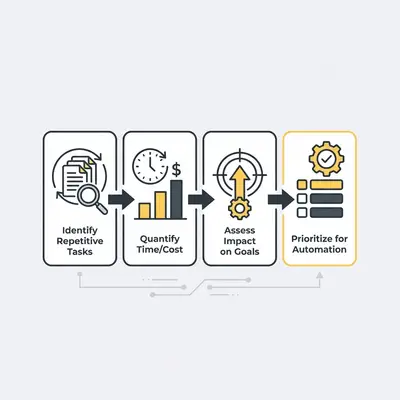
Mapping Your Business Processes for Automation
Start by listing every routine task performed by your team. For each task, ask:
- Is this task repetitive?
- Does it require human decision-making or is it rule-based?
- How much time does it consume weekly?
- What is the cost of errors associated with this task?
- How would automating it impact customer satisfaction?
Visualizing these processes with a simple flowchart can reveal hidden inefficiencies. It also highlights prime candidates for automation.
Prioritizing Use Cases for Maximum ROI
Once you have a list of potential automations, prioritize them. Focus on those that offer the highest impact with the lowest complexity. For instance, automating invoice generation or routine customer follow-ups might be simpler to implement. These can offer significant time savings compared to complex predictive analytics projects. Choose projects that offer clear, measurable benefits in the short term. This builds internal support and demonstrates value.
Quick Win: Evalics can help you identify and implement high-impact AI automations quickly. Book a demo today!
Conclusion
Conquering AI automation challenges is not just for tech giants; it is within reach for any startup ready to strategically embrace the future. By starting small, leveraging accessible tools, prioritizing data quality, adopting an iterative mindset, and focusing on high-impact opportunities, startups can successfully integrate AI into their operations. Evalics empowers businesses like yours to navigate these challenges. We transform potential hurdles into pathways for unprecedented growth and efficiency. Take the first step today and discover how AI can transform your startup.