You hear the promises everywhere. "AI agents will run your entire business." "Hire a digital workforce in five minutes." The marketing pitches make it sound like you can click a button and head to the beach while an algorithm builds your agency empire.
Then you sit down to actually build one, and reality hits. The bot hallucinates. It gets stuck in infinite loops. It sends weird emails to your best clients.
Most agency owners abandon AI agents because they try to automate complex, high-stakes creative work right out of the gate. But the real magic of AI agents doesn't lie in replacing your creative director. It lies in replacing the invisible, repetitive administrative friction that drains your agency's profit margins.
Before we dive in, let's clarify one crucial point. A standard automation just moves data from Point A to Point B. An AI agent uses a language model to analyze context, make decisions, and choose the right tools to execute a task.
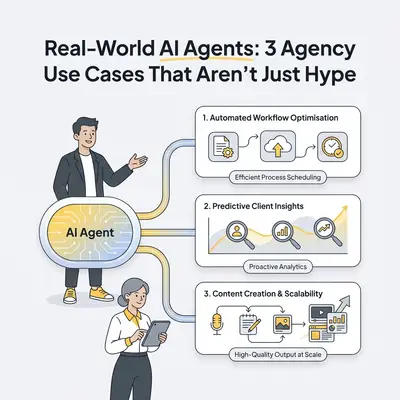
Here are three tested, real-world AI agent use cases that agencies are running right now to buy back their time.
1. The Autonomous Lead Qualification Agent
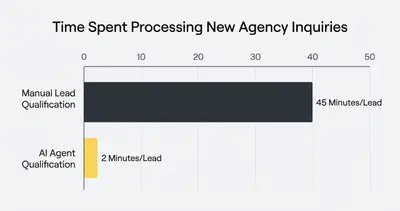
Every agency owner knows the pain of the "contact us" form. A new inquiry comes in. You get excited. You schedule a 30-minute discovery call. Ten minutes into the call, you realize the prospect has a budget of $500, needs the project done yesterday, and isn't a fit for your services.
You just wasted an hour of your day preparing for and hosting a useless meeting. Multiply that by ten bad leads a month, and you are losing days of productivity.
An AI agent solves this by acting as your frontline sales development rep (SDR).
How the Agent Works
When a prospect fills out your website form, the agent springs into action. It doesn't just send a generic "we received your message" email. It actively qualifies the lead.
- Intake and Analysis: The agent receives the form data via a webhook. It reads the prospect's message to understand their intent.
- Contextual Follow-Up: The agent drafts and sends an email asking 2-3 specific, conversational questions to uncover their budget, timeline, and exact needs.
- Scoring and Routing: When the prospect replies, the agent reads the response. If the prospect mentions a budget below your minimum, the agent politely declines and points them to a lower-cost resource (like an eBook or course).
- Booking the Call: If the prospect is highly qualified, the agent generates a personalized Calendly link and invites them to book a strategy session. It then logs the entire summary into your CRM.
Key Insight: The agent isn't just sending an autoresponder. It is dynamically reading the prospect's natural language reply, comparing their answers against your agency's ideal client profile, and making a routing decision.
The Real-World Impact
A human SDR might take 24 hours to review an inquiry, draft a reply, and chase down the prospect. An AI agent does this in three seconds. According to HubSpot research, responding to a lead within the first five minutes increases the odds of connecting by 100x.
2. The Zero-Touch Client Onboarding Agent
Closing a deal is thrilling. Onboarding the new client is tedious.
In a typical agency, a signed contract kicks off a chaotic chain reaction. Someone has to create a Google Drive folder. Someone has to invite the client to a Slack channel. Someone needs to set up a new project in Asana, send the welcome packet, and notify the accounting team.
This administrative drag delays the actual project start and often results in missed steps.
How the Agent Works
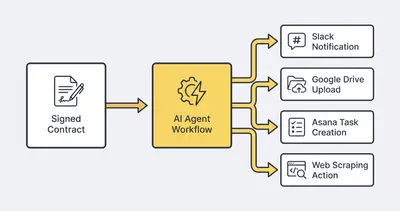
You can build a "Project Manager Agent" that listens for a signed contract (e.g., from PandaDoc or DocuSign) and takes complete ownership of the setup phase.
- Infrastructure Creation: The agent automatically creates a dedicated Google Drive folder structure for the new client.
- Workspace Setup: It creates a new Slack channel (e.g.,
#client-acme-corp) and invites the relevant internal team members based on the service type sold. - Project Management: It spins up a new board in Asana or ClickUp, populating it with your standard onboarding task templates.
- The "Agentic" Step - Client Research: Here is where the AI shines. The agent visits the new client's website, scrapes the homepage and "About Us" section, and summarizes the client's brand voice, target audience, and key products. It posts this executive summary directly into the new Slack channel so your team is instantly briefed.
- Client Communication: Finally, it emails the client a warm welcome message, complete with links to their new shared folder and an onboarding questionnaire.
Reality Check: Setting this up takes about 3-5 hours of dedicated focus in a tool like Make or n8n. However, once it runs, it permanently eliminates the 1-2 hours of administrative overhead associated with every new client you sign.
3. The Cross-Platform Content Repurposing Agent
Agencies are notoriously bad at marketing themselves. You spend all your energy on client work, leaving your own agency's blog and social media channels looking like a ghost town.
Creating original content takes time. But what if you could just hit record on your phone, talk for five minutes about a client win, and let an agent do the rest?
How the Agent Works
The Content Repurposing Agent turns a single raw asset into a week's worth of multi-channel marketing material.
- Audio Ingestion: You drop an MP3 voice memo into a specific Dropbox folder.
- Transcription: The agent detects the new file and sends it to an audio model (like OpenAI's Whisper) to transcribe the speech into text.
- Strategic Drafting: The agent passes the raw transcript to a smart model (like Claude 3.5 Sonnet). You provide a system prompt instructing the AI to act as an expert B2B copywriter.
- Multi-Format Output: The agent breaks the content down into three distinct formats:
- A 500-word blog post formatted in Markdown.
- A hook-driven, 300-word LinkedIn post.
- A punchy 5-part Twitter thread.
- Quality Control Queue: The agent pushes these drafts into a Notion database or an Airtable base with a status of "Needs Review."
Pro Tip: Never let an AI agent auto-publish directly to your social media accounts. Always insert a "human-in-the-loop" step where you or a team member reviews and approves the drafts before they go live. This protects your brand voice and prevents algorithmic penalties.
The Real-World Impact
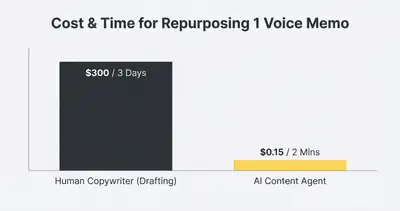
A freelance copywriter might charge $300 to turn a raw video into a blog post and social media assets. They might take three days to deliver. An AI agent handles the drafting process for about $0.15 in API costs, delivering the results in less than two minutes.
How to Actually Build These Agents Today
You don't need to hire a machine learning engineer to build these systems. The barrier to entry has completely vanished thanks to visual workflow builders.
Here is your straightforward tech stack to get started:
1. The Brain (The LLM)
You need a language model to power the agent's reasoning. OpenAI's GPT-4o is excellent for general tasks. Anthropic's Claude 3.5 Sonnet is arguably the best model on the market right now for coding and high-quality copywriting.
2. The Muscle (The Automation Platform)
You need a platform to connect your apps and house the agent's logic.
- Make.com: Visually intuitive and great for beginners. It integrates seamlessly with thousands of apps.
- n8n: The gold standard for agencies. It offers self-hosting options, lower long-term costs, and incredibly robust advanced agent nodes designed specifically for multi-step reasoning. Official n8n documentation offers excellent templates to start building agents immediately.
3. The Memory (The Storage)
Agents need context. If your lead qualification agent is going to work, it needs to remember the prospect's previous emails. You can use built-in memory nodes in n8n, or connect external databases like Supabase or Pinecone for long-term memory retrieval.
Quick Win: Start with the Content Repurposing Agent. It has the lowest risk. If the agent makes a mistake, it just sits in your Notion draft folder. It's the perfect sandbox to learn how system prompts and tool-calling work before moving on to client-facing processes.
Making Agents Work for Your Agency
The hype cycle around AI is deafening. It's easy to get distracted by demos of autonomous software engineers or theoretical general intelligence. But as an agency owner, your goal isn't to build the next tech breakthrough. Your goal is to protect your margins and buy back your time.
By deploying focused, tightly constrained AI agents to handle lead qualification, client onboarding, and content repurposing, you strip away the administrative friction that slows your team down.
These aren't hypothetical futures. These are workflows you can build this weekend. Pick one bottleneck in your agency, map out the logical steps, and hand it over to an agent.
Ready to transform your agency operations? Book a demo with Evalics today and let us help you build your first production-ready AI agent.
Related Resources
- What Are AI Agents a Practical Explanation for Businesses
- How to Get Leads with AI
- Automating Client Onboarding Paid Invoice to Welcome Packet
- Agentic AI in n8n How to Build Multi Agent Workflows for Complex Tasks
- Repurposing LinkedIn Posts to X Guide
Official Sources
- HubSpot: Sales Statistics and Lead Response Times
- n8n Advanced AI Documentation
- Anthropic Claude Sonnet Overview
By Kevin Michael Schindler, AI Automation Expert at Evalics