
Sales automation is the use of software to handle repetitive sales tasks, such as lead entry, follow-up emails, and appointment scheduling. For small businesses, it is a critical investment because it eliminates manual data entry, reduces human error, and ensures no lead falls through the cracks, which directly increases conversion rates and revenue.
![_ [GRAPH] Column chart. Manual Pipeline - 15% Conversion. Automated Pipeline - 22% Conversion. Chart title: Lead-to-Customer Conversion Rates at top. Alt text: Column chart comparing a 15% conversion rate for manual processes against a 22% conversion rate for automated pipelines](/blogs/roi_sales_pipeline/-graph-column-chart-manual-pipeline-15-conversion-400w.webp)
Why is sales pipeline automation a critical investment for small businesses?
Automation acts as a force multiplier for small teams. When you automate your pipeline, you stop relying on memory or sticky notes to track prospects. Without it, your team spends hours on administrative tasks instead of closing deals, and the follow-up that decides the deal is the one that gets forgotten.
Key Insight: Automation does not replace your sales team. It removes the "busy work" so your team can focus on high-value conversations that actually move the needle.
What are the primary options for managing your sales pipeline?
Small businesses typically choose between manual tracking, basic CRM tools, or full-scale AI-driven automation. Each approach carries different costs and efficiency levels. You must weigh the time spent on administration against the potential for scalable growth through automated workflows.
| Option | Cost | Efficiency | Scalability |
|---|---|---|---|
| Manual (Spreadsheets) | Low | Very Low | Poor |
| Basic CRM | Moderate | Moderate | Limited |
| AI Automation | High | Very High | Excellent |
How do you calculate the ROI of sales automation?
To calculate ROI, subtract the total cost of the automation software and implementation from the additional revenue generated by increased lead conversion, then divide by that total cost. A positive ROI occurs when the time saved by your team and the increase in closed deals outweigh the monthly subscription and setup fees.
Pro Tip: Use our free ROI Calculator to see your potential savings in under 60 seconds.
If your team saves 10 hours a week at an hourly rate of $50, you gain $2,000 in reclaimed productivity per month. If that time leads to just one extra closed deal worth $3,000, your monthly return is $5,000 against your software costs.
What is the framework for deciding if you are ready to automate?
You are ready to automate when your current manual processes become a bottleneck to growth. If your team spends more than 10 hours a week on manual data entry or follow-ups, or if you are losing leads due to slow response times, your business is ready for an automated pipeline.
Assessing your current lead volume
If you receive fewer than 10 leads a month, manual management is likely sufficient. However, once you cross the threshold of 30 to 50 leads per month, the risk of missing a follow-up increases exponentially. Automation ensures every lead receives a personalized touchpoint within minutes of inquiry.
Identifying bottlenecks in your sales cycle
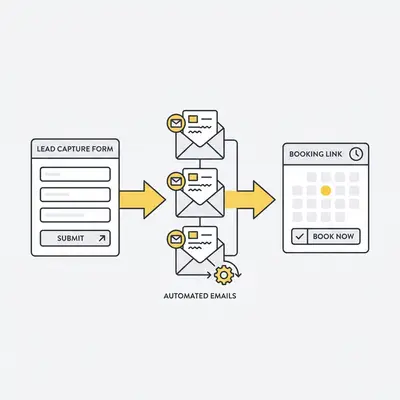
Look for stages where leads sit idle for more than 48 hours. Common bottlenecks include the gap between a form submission and the first email, or the delay in scheduling a discovery call. Automation tools like Make or n8n can bridge these gaps instantly.
Evaluating team capacity and technical readiness
Automation requires a clean data foundation. Before you deploy, ensure your team uses a centralized CRM. If your data is scattered across email inboxes and spreadsheets, you must consolidate it first. Automation will only amplify the speed of your existing process, whether that process is efficient or broken.
How have other small businesses successfully implemented automation?
Successful implementation involves auditing existing processes, selecting a scalable tool, and automating one stage of the funnel at a time. Businesses that start by automating lead qualification and follow-up sequences often see a 20-30% increase in lead-to-customer conversion rates within the first 90 days of deployment.
Reality Check: Do not try to automate everything at once. Start by automating your "speed to lead" follow-up. Once that is stable, move on to lead scoring or contract generation.
What are the next steps to begin your automation journey?
- Audit your process: List every manual task your team performs daily.
- Identify the biggest leak: Find the stage where you lose the most leads.
- Choose your stack: Select a CRM and an automation tool that integrate well.
- Map the journey: Sketch out the ideal path a lead takes from inquiry to sale.
- Run a pilot: Automate one specific lead source for 30 days to measure results.
Quick Win: Book a free 15-minute automation audit with an Evalics expert to identify your biggest pipeline leak before you spend a dollar on new software.