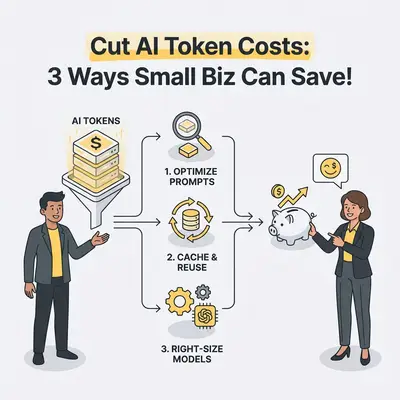
AI is changing how small businesses operate, but unexpected token costs can quickly turn innovation into a budget drain. Many small business owners are surprised by their AI bills. This often happens because they do not fully understand how tokens are used or how to optimize them. This post will explain AI tokens clearly. It will also give you three simple ways to cut your AI spending without losing powerful capabilities.
What Are AI Tokens and Why Do They Matter for Your Budget?
AI tokens are the basic units for measuring how much "data" or "processing" an AI model consumes. Understanding tokens is critical because they directly impact the cost of using large language models (LLMs). Each word, character, or code chunk you input (your prompt) or receive as output (the completion) converts into tokens. Providers like OpenAI then charge per token. Managing tokens directly translates to managing your operational budget. Inefficient token use means you pay more for the same, or even lower-quality, AI interactions.
How Do AI Models "Count" Tokens?
AI models do not simply count words. Instead, they break down text into smaller pieces called tokens. For English, a token might be part of a word, a whole word, or even a punctuation mark. For example, "tokenization" might be one token, or "token-iz-ation" could be three. This process varies slightly between models but aims to efficiently represent text for the AI.
What's the Direct Link Between Tokens and Your AI Bill?
The direct link is simple: more tokens equal higher costs. Every interaction with an AI model—from your prompt to its response—is measured in tokens. AI service providers charge a specific rate per token. If your prompts are verbose or the AI generates lengthy, unneeded responses, your token count and bill will climb unnecessarily. Efficient token use means you pay less for the same tasks.
How Can Small Businesses Effectively Track AI Token Usage?
Effectively tracking AI token usage typically involves using built-in API logs, monitoring dashboards from AI platforms, or integrating third-party cost management tools. Without a clear overview, finding where tokens are overspent or used inefficiently becomes impossible. Implementing a robust tracking system gives small businesses visibility into their consumption patterns. This allows data-driven decisions to optimize their AI budget.
How Can You Use API Logs and Provider Dashboards?
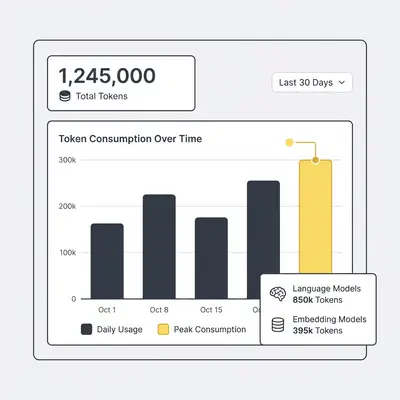
Most AI service providers offer native tools to view your token consumption. Platforms like OpenAI provide dashboards where you can see your usage broken down by model, project, and time period. Reviewing these API logs and dashboards regularly helps you identify peak usage times and specific applications that consume the most tokens. This direct data is your first line of defense against unexpected costs.
How Can You Set Up Custom Monitoring for Deeper Insights?
For more granular control, small businesses can implement custom monitoring solutions. This might involve setting up webhooks to capture usage data directly from API calls. You can then feed this data into a simple spreadsheet or a business intelligence tool. Tools like n8n or Make can also help you build workflows to track and visualize token usage. Deeper insights allow you to pinpoint exact inefficiencies.
What's the #1 Way to Save: Optimize Your Prompt Engineering?
Optimizing prompt engineering is the single most impactful way small businesses can cut AI token costs. It reduces the length and complexity of both inputs and outputs. Crafting concise, clear, and efficient prompts directly instructs the AI, leading to shorter, more relevant responses. This avoids "token waste" on unnecessary context or verbose instructions. This strategy directly reduces the number of tokens processed for each interaction, significantly lowering your overall AI spend.
How Can You Write Shorter, More Focused Prompts?
To save tokens, get straight to the point with your prompts. Avoid conversational filler or lengthy introductions. Clearly state the task, the desired output, and any necessary constraints. For example, instead of "Please write a long email to my customer about their recent order of X and why it's delayed," try "Write a concise customer email regarding delayed order #12345. Explain reason: supply chain issue, new delivery date: [Date]."
How Should You Use System Messages for Context, Not Repetition?
Many advanced AI models allow "system messages" to provide persistent context. Use these for general instructions, persona settings, or background information that applies across multiple interactions. This prevents you from repeating the same setup in every user prompt, which would otherwise consume more tokens each time. System messages establish a foundational understanding for the AI.
How Can You Request Specific Output Formats and Lengths?
Directly tell the AI what kind of output you need and how long it should be. For instance, instruct it to "summarize in 3 bullet points" or "generate a response under 100 words." This guidance forces the AI to be concise and prevents it from generating overly verbose answers. Explicit length and format constraints ensure the AI delivers exactly what is useful, minimizing token usage.
Pro Tip: Experiment with different prompt versions and compare their token consumption using an AI token calculator before rolling them out widely. This helps you find the most efficient phrasing.
How Can AI Token Calculators & Monitoring Tools Reduce Costs?
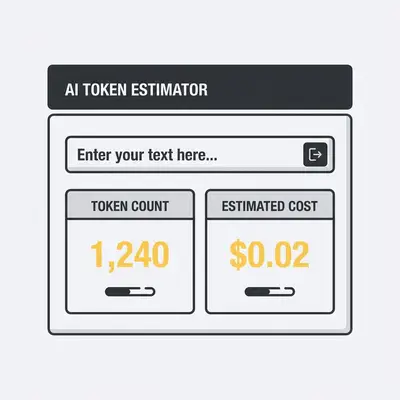
AI token calculators and monitoring tools enable small businesses to predict costs, analyze usage patterns, and identify areas for optimization. These resources are indispensable for saving money. They help you estimate a prompt's token count before sending it, compare costs across different AI models, and visualize spending trends over time. By providing clear insights and forecasting capabilities, these tools empower businesses to make informed decisions about their AI strategy and prevent budget overruns.
How Can Pre-computation Estimate Costs Before Running?
Before making an API call, use an AI token calculator to estimate the token count of your prompt and potential response. Many free online tools allow you to paste text and instantly see the token estimate. This "pre-computation" helps you refine prompts for efficiency before incurring actual costs. It's like checking the price tag before adding an item to your cart.
How Can You Compare Models to Find the Most Cost-Effective AI?
Different AI models have vastly different token pricing. A smaller model like GPT-3.5 Turbo is significantly cheaper per token than a powerful model like GPT-4. Use token calculators to compare the estimated cost of performing the same task across various models. This helps you select the most cost-effective AI for each specific job, avoiding overpaying for unnecessary complexity.
How Do Real-time Monitoring and Alerting Work?
Real-time monitoring tools track your token usage as it happens. You can often set up alerts that notify you when you approach predefined spending limits or unusually high consumption. This immediate feedback helps you catch and address budget overruns before they become serious problems. Timely alerts prevent unexpected bills and keep your AI spending in check.
Which AI Model & API Choice Can Significantly Lower Your Spend?
Choosing the right AI model and API for specific tasks can significantly lower your AI spend. This involves matching the model's capability and cost to the actual requirement. Larger, more powerful models are often more expensive per token. Smaller, specialized, or fine-tuned models can perform routine tasks just as effectively at a fraction of the cost. Evaluating your needs against various models' pricing structures helps you avoid overpaying for unnecessary AI horsepower on simpler tasks.
How Can You Match Model Complexity to Task Requirements?
Do not use a high-end, expensive model for simple tasks like basic text summarization or grammar checks. For example, using a cheaper model like GPT-3.5 Turbo for generating short social media captions or email drafts is often perfectly adequate. Using more cost-effective models like GPT-3.5 Turbo for simple tasks instead of GPT-4 can reduce token costs by up to 10-20 times for input and 2-5 times for output, depending on the model version and task complexity (Source: OpenAI's official pricing documentation). Reserve the more powerful, pricier models for complex problem-solving or highly creative tasks.
How Can You Leverage Open-Source or Self-Hosted Alternatives (When Feasible)?
For businesses with technical resources, exploring open-source models like Llama 2 or Mistral, or even self-hosting smaller models, can eliminate per-token charges entirely. While these options involve initial setup and maintenance costs, they offer long-term savings for high-volume or sensitive tasks. This approach gives you full control over your AI infrastructure and budget.
How Can You Understand Tiered Pricing and Volume Discounts?
Many AI providers offer tiered pricing or volume discounts as your usage increases. Review these structures carefully. Sometimes, optimizing your usage to cross into a lower price tier can yield substantial savings per token. For businesses with predictable high-volume needs, negotiating custom enterprise agreements might also be an option for even greater cost reductions.
Frequently Asked Questions About AI Token Costs
What is a "token" in AI terms?
A token is a fundamental unit of text that AI models process, roughly equivalent to a word or part of a word. When you interact with an AI, both your input (prompt) and the AI's output (completion) are converted into tokens. You are then charged based on the total number of tokens used for that interaction.
How can I find out the token cost for different AI models?
Most AI providers publish their token pricing on their official websites. Look for these details in their API documentation or dedicated pricing sections. It is crucial to check these pages directly, as prices can vary significantly between different models (e.g., GPT-3.5 vs. GPT-4) and may change over time.
Is there a free AI token calculator I can use?
Yes, many AI token calculators are available online for free. Some are even provided directly by AI model providers, while others are part of third-party developer tools. Simply search for "AI token calculator" to find various options that allow you to paste text and see its estimated token count instantly.
Can token costs vary by language?
Yes, token costs can vary by language. Non-English languages, especially those with complex character sets like East Asian languages (e.g., Japanese, Chinese), often consume more tokens per character or word than English. This happens because the tokenization process might break down these languages into smaller, more numerous units.
Conclusion: Take Control of Your AI Spend Today!
Managing AI token costs does not require advanced technical expertise. It simply requires awareness and a strategic approach. By understanding what tokens are, tracking your usage, optimizing your prompts, leveraging token calculators, and wisely choosing your AI models, small businesses can significantly reduce their expenditures. Start implementing these strategies today to unlock the full potential of AI without breaking your budget.
Ready to Automate Smarter, Not Harder? Evalics helps small businesses integrate AI solutions designed for efficiency and cost-effectiveness. Discover how to streamline your operations and save on AI costs. Learn more about our AI automation services!