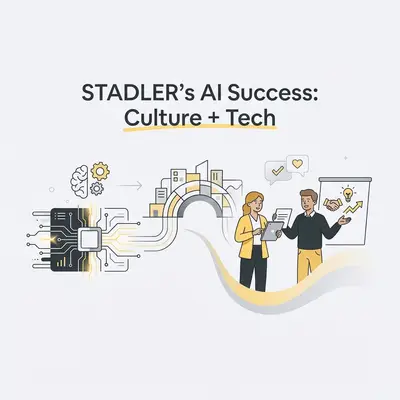
A 230-year-old company that builds waste sorting plants just showed everyone the right way to adopt AI. It’s a lesson many businesses are missing. OpenAI recently published a case study, STADLER reshapes knowledge work at a 230-year-old company, and it’s packed with insights. They didn't just buy a tool; they fundamentally changed how their people work.
STADLER saw their teams spending too much time turning raw information into something useful—summarizing, drafting, and translating. Instead of accepting this as the cost of doing business, they gave every employee on a computer access to ChatGPT. The results were immediate and impressive.
This story isn't about a massive tech budget or a team of data scientists. It’s about a clear vision from leadership and a focus on empowering people. It proves that the biggest barrier to AI success isn't technology; it's culture.
What Was STADLER's Approach to AI Adoption?
STADLER’s strategy was refreshingly simple and effective. They didn't get lost in complex roadmaps or endless pilot programs. They identified a real, everyday problem and found a direct solution that delivered value from day one.
Their approach boiled down to three key steps. First, they pinpointed the exact friction in their knowledge work. Second, they chose a tool that was powerful yet immediately usable. Finally, they rolled it out with a smart combination of top-down support and bottom-up freedom.
Reality Check: You can't just give your team an AI tool and expect magic. Without clear guidelines, training, and a specific problem to solve, you'll get inconsistent results and wasted effort. A tool is only as good as the strategy behind it.
STADLER’s leadership knew that turning raw knowledge into usable documents was a major bottleneck. Engineers, marketers, and project managers were all bogged down by the same tasks: summarizing long reports, drafting emails, and translating technical specs. This wasn't just inefficient; it was a drain on their most valuable resource—their experts' time.
They chose ChatGPT after evaluating other options because it consistently delivered structured, context-aware results. More importantly, it was fast and intuitive. There was no steep learning curve. Employees could start getting value in minutes, not months. For any business, especially smaller ones, this immediate ROI is critical.
The rollout was brilliant. Leadership provided company-wide access and clear guardrails. But they also encouraged employees to experiment and find their own use cases. This created a wave of adoption driven by genuine utility, not just a corporate mandate.
How Did STADLER Foster an AI-First Culture?
This is where the real magic happened. STADLER understood that successful AI integration is a human challenge, not a technical one. They built a culture where AI was seen as a helpful partner, not a threat.
It started at the very top. Co-CEO Julia Stadler set a clear principle: every employee working on a computer should use AI to improve their work. This wasn't a suggestion; it was the new standard. This clear mandate removed ambiguity and gave everyone permission to start experimenting.
Key Insight: STADLER's success wasn't about having a massive budget or a dedicated AI department. It was about having a clear vision from leadership that empowered every single person to think about how AI could make their own job better.
They backed this vision with real support. The company provided training and encouraged the creation of over 125 custom GPTs for specific tasks, from structuring project plans to drafting marketing copy. They didn't just hand over a login; they showed people how to fish.
They also measured what mattered. With over 85% of employees using the tool daily, the engagement was obvious. They tracked time savings—a reported 30-40% on common tasks—and celebrated these wins. When people see their colleagues saving hours of tedious work, adoption spreads organically.
What Were the Tangible Results of STADLER's AI Integration?
The numbers speak for themselves. STADLER didn't just see a small bump in productivity; they saw a transformation in how work gets done across the entire organization. The impact was both measurable and immediate.
Tasks that once took half a day were now being drafted in 20 minutes. That’s a massive acceleration. They saw a 2.5x faster time to a first draft on average, with some use cases, like social media content, speeding up by 6x. Think about what that means for your own business. How many more projects could you complete? How much faster could you respond to customers?
Quick Win: Create a custom GPT for your company's unique tone of voice. Feed it five examples of your best marketing emails or blog posts. Now, anyone on your team can generate on-brand content in seconds, ensuring consistency and saving hours.
The quality of work improved, too. Employees weren't starting from a blank page anymore. They were starting with a solid, structured draft and using their expertise for refinement and critical thinking. AI became a "thinking partner," helping them structure ideas and clarify complex problems before writing a single word.
This shift freed up their best people to focus on higher-value work. Instead of getting stuck on formatting a report, they could spend that time analyzing the data within it. This is the true promise of AI in business: amplifying human intelligence, not replacing it.
Can Small Businesses Replicate STADLER's AI Success?
Yes, absolutely. In fact, small businesses are often better positioned to move quickly and adopt these practices. You don't need 650 employees or a 230-year history to make this work. You just need the right mindset.
The key is to follow STADLER's playbook, scaled to your size. Start by identifying one or two major friction points in your daily operations. Is it answering the same customer service questions over and over? Is it writing proposals? Pick a specific, repetitive task that eats up valuable time.
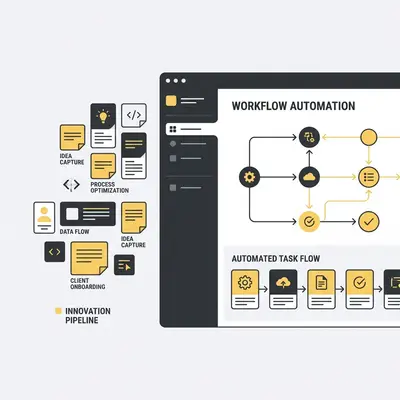
Next, choose an accessible and user-friendly tool. You don't need a custom-built enterprise solution. Tools like ChatGPT, Claude, or integrated platforms like n8n offer incredible power for a low monthly cost. The goal is to find something that provides immediate value without requiring a team of developers to set up.
Finally, build a culture of experimentation. Encourage your team to play with the tools. Set aside an hour a week for "AI exploration." Share wins, no matter how small. When your sales assistant saves an hour a day by automating email follow-ups, celebrate it. That success will inspire others to find their own efficiencies.
STADLER’s story proves that AI transformation is driven by strategy and culture, not budget. By focusing on people and problems, any business can achieve remarkable results.