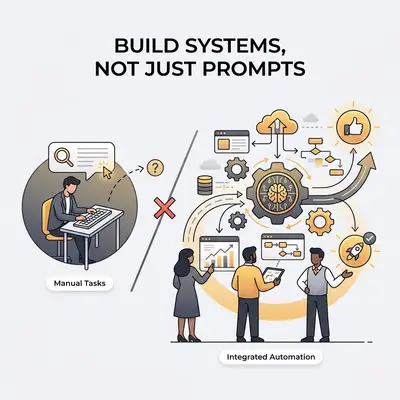
I saw a job posting last week that made me laugh. It asked for a "prompt engineer" with experience in distributed systems, API design, and security engineering. Let’s be honest: that isn’t one person. That’s an entire engineering department.
The recent video The 7 Skills You Need to Build AI Agents from the YouTube channel AI Explained hits the nail on the head regarding this industry identity crisis. We are obsessed with the "prompt" while ignoring the "system." This video is a wake-up call for anyone trying to move AI from a cool demo to a functional business asset.
If you are a business owner, stop looking for a "prompt whisperer." You need a systems architect. This post breaks down why the "prompting" era is over and how you can actually build AI that survives in the real world.
Why Is "Prompt Engineering" Failing Small Businesses?
Prompt engineering fails because it treats AI as a chatbot interface rather than a functional business engine. When you focus only on the prompt, you are optimizing the "what" while ignoring the "how." A clever sentence might get a great response once, but it won't handle a database error, a rate limit, or a malformed API response.
Small businesses need reliable, repeatable workflows. If your AI agent is just a fancy text box, it’s a toy. If it’s a system that handles data flow, manages security, and executes tasks without human intervention, it’s an asset. You don't need better adjectives in your prompt; you need better infrastructure.
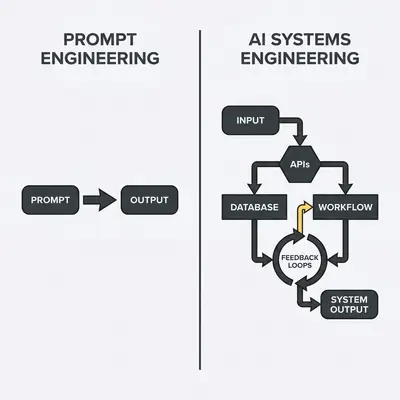
Reality Check: If your AI agent relies on a human to copy-paste data from a spreadsheet into a chat window, you haven't automated anything. You’ve just added a middleman.
Should You Build Your Own AI Agents or Buy Managed Solutions?
Deciding between building internal AI capabilities and purchasing managed automation depends on your technical overhead and business goals. Building requires a full stack of engineering skills, while buying allows you to leverage pre-built systems that handle the complexity of API design, security, and MLOps for you.
| Factor | Building In-House | Buying Managed Solutions |
|---|---|---|
| Technical Skill | High (Requires 5+ roles) | Low (Plug-and-play) |
| Customization | Unlimited | Limited to platform features |
| Maintenance | High (Constant updates) | Managed by vendor |
| Time to Value | Slow (Months) | Fast (Days) |
Most businesses I talk to at Evalics think they need to build from scratch. In reality, they need a partner who understands how to stitch together existing, robust tools. Don't reinvent the wheel unless your business is the wheel.
What Are the Core Components of a Production-Ready AI System?
A production-ready AI system requires more than just a Large Language Model; it requires a foundation of distributed systems, secure API architecture, and automated monitoring. To move beyond demos, you must integrate data pipelines that feed the AI, guardrails that prevent hallucinations, and feedback loops that allow the system to improve over time.
Think of your AI agent like a new employee. You wouldn't hire someone and give them zero instructions, no access to company data, and no way to report errors. Yet, that is exactly how most people deploy AI. You need to define the "contract" for every tool the agent uses. If the agent needs to query your CRM, the API schema must be rigid. If the schema is vague, the agent will hallucinate, and your data will suffer.
Key Insight: Don't let your AI be a black box. If you can't monitor the inputs and outputs, you don't have a system—you have a liability.
How Do You Transition from "Prompting" to "Systems Thinking"?
Transitioning to systems thinking requires shifting your focus from the "what" (the prompt) to the "how" (the infrastructure). You must map your business processes, identify where data enters and exits, and implement automated checks at every stage. This ensures that your AI agents function reliably without constant human intervention.
Follow these steps to move from tinkering to production:
- Map your current manual workflow: Document every single step of the process, including the "what-if" scenarios where things go wrong.
- Identify the specific data inputs: Determine exactly what data the AI needs to make a decision and where that data lives.
- Select an automation platform: Use tools like n8n that support robust API integrations and visual workflow management.
- Implement security protocols: Never give an agent broad access. Use the principle of least privilege for every API key and database connection.
- Establish monitoring: Set up alerts for when an agent fails or produces an unexpected output.
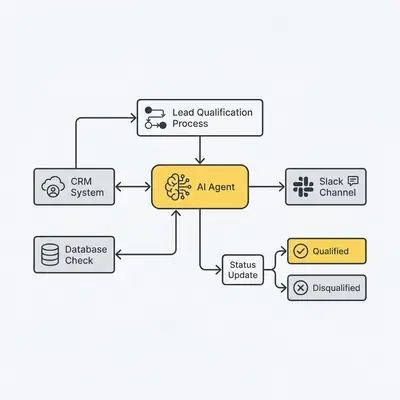
Pro Tip: Start by automating the "boring" parts of your workflow. If an agent can handle 80% of the data entry, your team can focus on the 20% that actually requires human judgment.
Source
This post is a strategic response to the insights provided in the video "The 7 Skills You Need to Build AI Agents" by AI Explained. You can view the original analysis here: The 7 Skills You Need to Build AI Agents