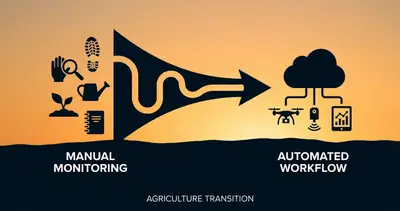
Why is manual crop monitoring holding your farm back?
Precision agriculture can increase crop yields by up to 15% while reducing input costs
Manual monitoring of crop health and soil moisture levels across large acreage is a significant drain on farm resources. By implementing ai automation for Agriculture, managers can shift from reactive scouting to data-driven decision-making. Precision agriculture can increase crop yields by up to 15% while reducing input costs, provided your sensor data is actionable rather than just raw numbers sitting in a dashboard.
How do sensor data and irrigation alerts integrate?
An automated workflow pulls real-time moisture data from field sensors via the John Deere Operations Center API. When soil moisture drops below a specific threshold, the system triggers a scenario in Make or n8n. This process then uses OpenAI to analyze the data against local weather forecasts, sending a prioritized irrigation alert directly to your mobile device.
Can n8n bridge the gap between field sensors and alerts?
Using n8n allows you to build custom logic that connects disparate agricultural hardware to your communication channels. Unlike rigid off-the-shelf software, n8n enables you to create complex conditional triggers based on specific crop growth stages or localized weather patterns. This level of ai automation for Agriculture ensures that your irrigation alerts are relevant, timely, and specific to the needs of each individual field.
Is the high setup complexity worth the investment?
The setup complexity for these systems is high because it requires mapping API endpoints and configuring secure data pipelines between field hardware and automation platforms. You must ensure that sensor calibration is accurate and that the data flow is resilient against connectivity drops in remote areas. While the initial integration is demanding, it creates a robust foundation for long-term operational efficiency.
How much time can you save with automated irrigation?
By automating the analysis of sensor data and the delivery of irrigation alerts, farm managers save 12–15 hours/week on manual field checks and data entry. This time is better spent on high-level crop management and strategic planning rather than driving between fields to check moisture levels. Reducing this manual burden directly impacts your bottom line by preventing over-irrigation and crop stress.
Typical time reclaimed when this work is automated: 12–15 hours/week.
Ready to automate your irrigation management?
Stop wasting hours on manual field monitoring and start leveraging your sensor data to its full potential. Contact Evalics today for a free automation audit to see how we can streamline your irrigation workflows and improve your farm's efficiency. Let us handle the technical integration so you can focus on growing your crops.
Further Reading:
- 5 High-Impact AI Automations You Can Build in n8n Under One Hour
- The 80/20 Rule for Business Automation: What to Automate First
Looking for automation guides for other industries? Browse the full AI Automation by Industry directory.