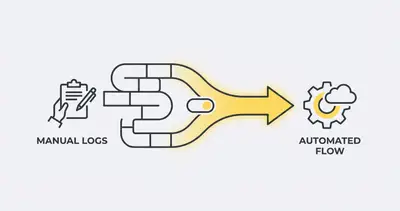
Why is manual catch reporting hurting your fleet?
Digital reporting can reduce regulatory compliance errors by 40% in maritime operations.
Manual logging of catch data and regulatory compliance reporting while at sea remains a significant burden for fleet owners. Implementing ai automation for Commercial Fishing allows you to replace error-prone paper logs with digital systems that sync directly to government databases. Digital reporting can reduce regulatory compliance errors by 40% in maritime operations, ensuring your fleet avoids costly fines and stays compliant with evolving maritime laws.
How does an automated catch reporting workflow function?
An automated workflow captures catch data at the point of entry using mobile-friendly forms that feed directly into a centralized database. By integrating tools like Zapier, Google Sheets, and Twilio, your crew can submit catch weights and species counts via SMS or satellite-linked tablets, which then automatically populate your regulatory reports. This eliminates the need for manual data entry once the vessel returns to port, ensuring your records are always audit-ready.
Can n8n streamline your regulatory compliance?
Using n8n for ai automation for Commercial Fishing provides a robust, self-hosted environment to manage complex data routing between your vessel and shore-based offices. Unlike rigid software, n8n allows you to build custom logic that handles intermittent satellite connectivity, ensuring that catch data is queued and transmitted the moment a connection is established. This reliability is essential for maintaining accurate, real-time compliance reporting across your entire fleet.
What is the setup effort for maritime automation?
The setup complexity for these systems is classified as medium, requiring a balance between hardware configuration and software integration. While you will need to map your specific catch data fields to government reporting requirements using tools like Airtable, the process is manageable for fleet managers who prioritize operational efficiency. Once the initial data pipelines are established, the system requires minimal maintenance to keep your reporting accurate and compliant.
How much time can your crew save with automation?
Typical time reclaimed when this work is automated: 5–8 hours/week.
Ready to modernize your fleet operations?
Stop wasting hours on manual paperwork and start focusing on your catch. Evalics specializes in building custom automation workflows for the maritime industry to help you meet every regulatory deadline with ease. Contact us today for a free automation audit to see how we can streamline your fleet’s reporting processes and improve your bottom line.
Further Reading:
- 5 High-Impact AI Automations You Can Build in n8n Under One Hour
- The 80/20 Rule for Business Automation: What to Automate First
Looking for automation guides for other industries? Browse the full AI Automation by Industry directory.