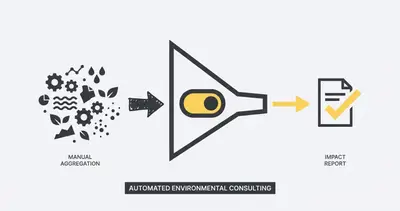
Why is manual data processing holding back your environmental firm?
Automated data analysis can cut report generation time by 60% in environmental science.
AI automation for Environmental Consulting addresses the bottleneck of manual data entry and report generation. Environmental consultants often spend days aggregating and analyzing large volumes of field sensor data for environmental impact reports, leaving little time for high-level analysis. By implementing AI automation for Environmental Consulting, firms can replace error-prone manual workflows with scalable, digital pipelines that ensure regulatory compliance and data integrity.
How can you automate field sensor data aggregation?
An automated workflow for environmental impact reports begins by pulling raw data from field sensors directly into a centralized repository like Google Drive. Using Python scripts, the system cleans and normalizes this data before passing it to OpenAI for preliminary trend analysis. Finally, the processed insights are pushed into PowerBI, creating real-time dashboards that visualize environmental metrics for stakeholders.
How does n8n streamline environmental data pipelines?
The n8n platform acts as the connective tissue for environmental data, allowing you to build complex workflows without writing custom code for every integration. It triggers data ingestion from your field sensors, manages the handoff between Python processing scripts and OpenAI, and ensures the final report data reaches your team’s dashboard. This creates a reliable, repeatable process for handling diverse environmental datasets.
Is the high setup complexity of AI automation worth it?
The setup complexity for these systems is high because environmental data often arrives in fragmented, non-standardized formats from various field sensors. Integrating Python-based data cleaning with AI analysis requires careful mapping of regulatory requirements to ensure the output meets strict reporting standards. While the initial architecture demands technical precision, it creates a robust foundation that eliminates the need for manual data manipulation in future projects.
How much time can your team save with automated reporting?
Typical time reclaimed when this work is automated: 15–25 hours/week.
Ready to modernize your environmental reporting workflow?
If your firm is ready to move beyond manual spreadsheets, Evalics can help you design a custom automation strategy. We specialize in building data pipelines that handle the heavy lifting of environmental reporting, allowing your team to focus on scientific interpretation rather than data entry. Contact us today to schedule a free automation audit and see how we can streamline your reporting process.
Further Reading:
- 5 High-Impact AI Automations You Can Build in n8n Under One Hour
- The 80/20 Rule for Business Automation: What to Automate First
Looking for automation guides for other industries? Browse the full AI Automation by Industry directory.