Choosing between Zapier and Make for your business
Make's Pro plan at $9/month handles 10,000 operations vs Zapier's equivalent tier at $49/month
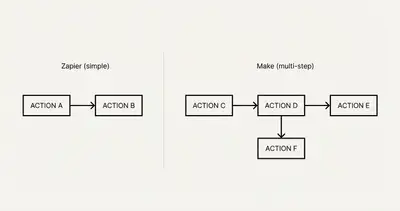
If you are a business owner or operations manager looking to streamline your workflows, you have likely narrowed your search down to Zapier vs Make. Both platforms allow you to connect your favorite apps without writing code, but they approach the task of automation in fundamentally different ways. While Zapier focuses on simplicity and speed, Make offers a visual canvas that provides more control over complex data paths. Choosing the right tool is a critical decision that impacts your operational efficiency and your monthly software budget as your business grows.
The final verdict on Zapier vs Make
It depends: choose Zapier when you need to get a simple task running in minutes, but choose Make if you are ready to build complex, cost-effective workflows. The price difference is significant for growing teams, as Make's Pro plan at $9/month handles 10,000 operations vs Zapier's equivalent tier at $49/month. If you are looking for the best balance of power and price, the Zapier vs Make debate often leads our clients to realize they need something even more robust, which is why we guide many businesses toward n8n.
Why businesses choose Zapier
Zapier is the industry standard for a reason, offering the easiest setup process for non-technical users who need to connect apps quickly. With over 6,000 integrations and excellent documentation, you can usually build a functional workflow in just a few clicks. However, the trade-off for this simplicity is a rigid structure that can become expensive and difficult to manage when your processes require complex logic, multiple branches, or high-volume data processing.
Why businesses choose Make
Make is designed for users who want more power and better error visibility through its unique visual scenario builder. It allows you to map out complex workflows with multiple paths and data transformations that would be nearly impossible to manage in Zapier. While it has a steeper learning curve, the ability to see exactly where a workflow fails makes it a favorite for operations managers who need reliable, scalable systems that do not break the bank as they grow.
Matching your business needs to the right tool
If you are a solo founder needing to sync email leads to a spreadsheet, Zapier is likely the right choice because it saves you time on setup. If you are an operations manager building a multi-step customer onboarding sequence that involves CRM updates, Slack notifications, and document generation, Make is the better fit for your requirements. For businesses that have outgrown these tools or need enterprise-grade control, we find that n8n provides the ultimate solution for both complexity and cost-efficiency.
Why Evalics recommends n8n for your automation
While Zapier and Make are popular, Evalics specializes in implementing n8n because it offers more power than Make at a lower cost than Zapier. We help businesses move beyond the limitations of standard automation platforms by building custom, self-hosted workflows that scale with your company. If you are ready to stop paying for expensive operation limits and want a professional to build your automation infrastructure, book a free consultation with Evalics today.
Other tool comparisons
- N8n Vs Make Vs Zapier 2026 Small Business Automation
- n8n vs Pipedream: A Developer's Guide to Automation | Evalics
- n8n vs Zapier: Which Automation Platform Wins for Your Business?
Comparing other tools? Browse the full Automation Tool Comparisons directory.