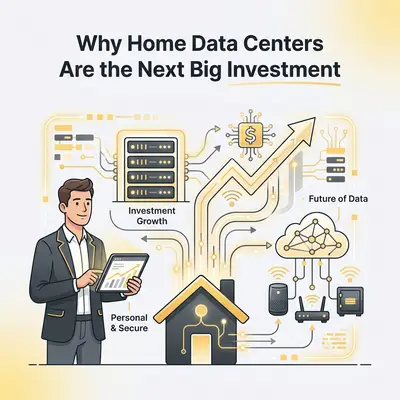
A home data center is a localized, private server infrastructure designed to handle compute-intensive tasks, AI model hosting, and data storage within a residential or small office environment. Much like the early days of residential solar, where homeowners transitioned from passive consumers to active energy producers, we are entering an era where businesses will own their compute power rather than renting it from the cloud.

Why is the Home Data Center the Next Solar Revolution?
The home data center is evolving from a niche hobbyist pursuit into a critical utility, mirroring the trajectory of residential solar power. As global chip supply stabilizes and energy infrastructure decentralizes, the physical space required for localized compute will become the primary constraint, creating a new asset class for forward-thinking small business owners.
Just as solar panels turned homes into power plants, home servers will turn homes into compute nodes. This shift allows businesses to bypass cloud latency and rising subscription costs. By hosting proprietary AI models locally, you gain digital sovereignty and ensure your operations remain unaffected by regional network outages or provider price hikes.
What are the Drivers Behind Decentralized Compute?
The shift toward home data centers is driven by the convergence of three factors: the commoditization of high-performance silicon, the decentralization of energy grids, and the increasing demand for low-latency AI processing. When you control your hardware, you eliminate the "black box" of cloud pricing and gain total control over your data privacy.
Key Insight: Data sovereignty is the new competitive advantage. By keeping sensitive client data on-premises, you reduce the risk of third-party breaches and comply with stricter data residency requirements without needing an enterprise-grade IT budget.
How Will Space Constraints Shape the Future of AI?
As chip density increases and energy becomes more accessible through renewables, physical space will emerge as the ultimate bottleneck for AI infrastructure. When compute power is no longer limited by hardware availability or electricity, the ability to house, cool, and maintain localized server racks will become a valuable real estate feature, much like a garage or a dedicated home office.
Think of your office space as a "compute-ready" asset. In the next decade, the ability to host high-performance racks will be a differentiator for commercial and residential properties alike. Businesses that prepare their physical infrastructure now will be better positioned to scale their AI capabilities as hardware becomes more compact and efficient.
![_ [GRAPH] Column chart. Early Adopters - 25% Property Value Increase. Late Adopters - 5% Property Value Increase. Chart title: Projected Property Premium for Compute-Ready Homes at top. Alt text: Column chart showing the projected increase in property value for homes equipped with advanced cooling and high-bandwidth infrastructure](/blogs/home_data_centers/-graph-column-chart-early-adopters-25-property-val.png)
What are the Implications for Small Business Owners?
For SMBs, the transition to home-based data infrastructure offers a path to digital sovereignty and reduced operational overhead. By hosting proprietary AI models and data locally, businesses can eliminate recurring cloud service fees, ensure data privacy, and maintain uptime during regional network outages, effectively turning a cost center into a long-term capital asset.
Reality Check: While the initial setup requires an investment in hardware and cooling, the long-term savings on API tokens and cloud subscription fees often result in a break-even point within 18 to 24 months for high-volume automation users.
How Does This Create a New Investment Opportunity?
The investment opportunity lies in the "infrastructure-as-a-service" model applied to the home. Early movers who invest in modular, energy-efficient server hardware and localized cooling systems will be positioned to lease compute power to local networks or run high-demand AI agents at a fraction of the cost of enterprise cloud providers.
If you are already running automated workflows using tools like n8n, moving those processes to a self-hosted environment is the logical next step. This transition not only protects your margins but also gives you the flexibility to experiment with larger, more complex AI models that would be prohibitively expensive to run via public cloud APIs.
What is the Outlook for the Next Decade?
Over the next ten years, we expect a shift from centralized cloud reliance to a hybrid model where "Edge-at-Home" becomes the standard for small businesses. As hardware becomes more plug-and-play, the barrier to entry will drop, making home data centers as common as high-speed internet routers are today.
Pro Tip: Start small. You don't need a full server rack to begin. Begin by migrating your most critical, high-frequency automation tasks to a local server or a high-performance workstation. This builds the operational muscle needed to scale your infrastructure as your business grows.