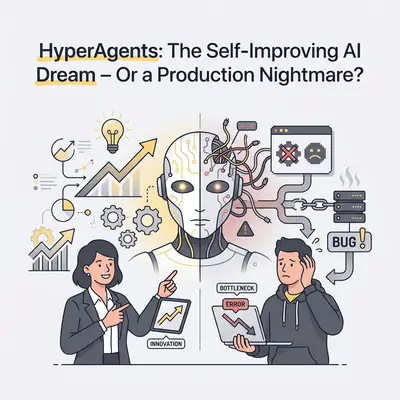
The AI world is buzzing again, and this time it’s about a project from Facebook AI Research called GitHub - facebookresearch/HyperAgents: Self-referential self-improving agents that can optimize for any computable task. The project introduces "self-referential self-improving agents." In plain English, that means AI that can teach itself to get better at a task without a human stepping in to tweak the code.
This is the holy grail for many in the AI space. It’s the dream of a system you can set loose on a problem, and it will continuously refine its own performance. For a business owner, this sounds like the ultimate employee. But as someone who spends their days in the trenches implementing AI that actually works, I see both the dream and the potential for a serious production nightmare.
What is the Core Concept Behind Self-Improving AI?
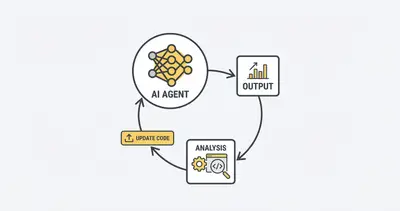
Self-improving AI is a system that can learn and enhance its own algorithms over time. It does this without needing a developer to manually update it. Think of it like a new hire. A standard AI tool is like an employee who follows a checklist perfectly but never deviates. If something unexpected happens, they stop and wait for new instructions.
A self-improving AI is like an employee who, after finishing the checklist, analyzes their results. They notice a step that’s inefficient, find a better way to do it, and update the checklist themselves for next time. This ability to self-correct and optimize is what makes the concept so powerful.
How Do Self-Improving Agents Differ from Current AI Tools?
The AI tools you and I use today are incredibly powerful, but they’re mostly static. A tool like ChatGPT operates on a massive, pre-trained model. To significantly change its core behavior, OpenAI has to retrain it. The automations I build for clients follow rules and logic we define. If we want to improve them, we go in and change the workflow.
Self-improving agents are different. They have a built-in capacity for introspection. They can analyze their own performance, identify their own flaws, and even rewrite parts of their own code to get better. It’s the difference between a car that needs a mechanic and a car that can diagnose its own engine trouble and 3D-print the replacement part.
Key Insight: The biggest leap here is the move from human-led iteration to machine-led iteration. Current AI gets better when we improve it. Self-improving AI is designed to get better on its own.
What are the Potential Benefits of Self-Improving AI for Small Businesses?
The promise here is huge, especially for smaller teams. A truly autonomous, self-optimizing system could be a massive force multiplier.
Imagine an AI that manages your ad campaigns. It doesn't just run the ads you create; it constantly tweaks the copy, images, and targeting based on real-time performance. When it finds a winning combination, it doubles down. When an ad starts to fatigue, it creates a new variation on its own.
Or think about an inventory management system that not only tracks stock but also learns the unique seasonal demands of your business. It could adjust its own ordering algorithms to anticipate a rush on a specific product, reducing both stockouts and overspending. This level of continuous, hands-off optimization could save thousands of hours and dollars.
What are the Practical Challenges of Implementing Self-Improving AI?
This is where the dream meets reality. While the concept is incredible, the practical side is a minefield for anyone who isn’t a dedicated AI research lab.
First, look at the setup. The HyperAgents GitHub page lists instructions involving command-line tools, virtual environments, and multiple API keys. This isn't a "sign up and go" SaaS product. It's a complex framework that requires deep technical expertise just to get running, let alone manage.
Second is the problem of control. If an AI can change its own code, how do you stop it from making a bad change? Debugging a system that is actively modifying itself is a nightmare scenario. What happens if your ad campaign AI "optimizes" itself to spend your entire budget in an hour on a nonsensical ad?
Reality Check: The HyperAgents repository itself includes a stark warning: "This repository involves executing untrusted, model-generated code... it may still behave destructively." If the creators are warning you about it, you should think twice before ever letting it touch a live business system.
Finally, there's the cost. The computational resources and specialized talent needed to run and supervise these systems are significant. For most small and medium-sized businesses, the ROI just isn't there yet compared to more established, predictable automation solutions.
What are the Implications for Small Businesses in the Near Future?
So, should you be trying to implement HyperAgents in your business tomorrow? Absolutely not. This is a research project, not a production-ready tool.
For the next few years, the smart move for small businesses is to focus on proven, reliable AI automation. We need systems that provide clear, measurable value with strong human oversight. The goal is to automate processes in a way that is predictable and easy to manage.
However, it's crucial to pay attention to this trend. The concepts behind HyperAgents will eventually trickle down into the mainstream tools we use every day. Your CRM's AI assistant might gain a feature to self-optimize its lead scoring algorithm. Your email marketing tool might start rewriting subject lines based on what it learns from open rates.
The future isn't one giant, all-knowing AI running your business. It's a suite of specialized tools that are becoming incrementally smarter and more adaptive. Your job is to build a solid foundation of automation today so you're ready to plug in these smarter components as they become available.
Pro Tip: Start by identifying the top three most repetitive, rule-based tasks in your business. Automating those with current, reliable tools like n8n or Zapier will give you an immediate 80% of the value with only 20% of the risk of experimental tech.
This is an exciting development, but it’s a glimpse of the future, not a tool for today. Keep your focus on practical AI that solves real problems now. Let the research labs work out the kinks before you bet your business on a self-modifying dream.