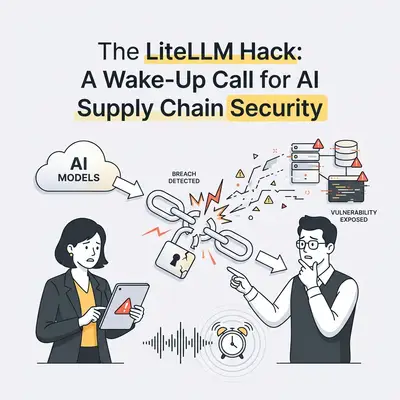
The news about the recent LiteLLM hack should be a massive wake-up call for every business using AI. In just 46 minutes, nearly 47,000 downloads of two compromised packages occurred. As Simon Willison's post, "LiteLLM Hack: Were You One of the 47,000?," highlighted, this wasn't a sophisticated, targeted attack on one company. It was a classic supply chain attack that sprayed shrapnel across the entire ecosystem.
What really hit me was the analysis showing 88% of packages that depend on LiteLLM didn't pin their versions. This is a rookie mistake, but it’s incredibly common. It means thousands of projects automatically pulled in the malicious code without anyone lifting a finger. For small businesses I work with, this is the stuff of nightmares. You think you're secure, but a library your AI tool depends on gets compromised, and suddenly you're exposed.
This isn't some abstract threat. It’s a direct risk to your operations, your data, and your reputation. It proves that AI security isn't just about your own code; it's about the entire chain of software you rely on.
What is AI supply chain security and why does it matter?
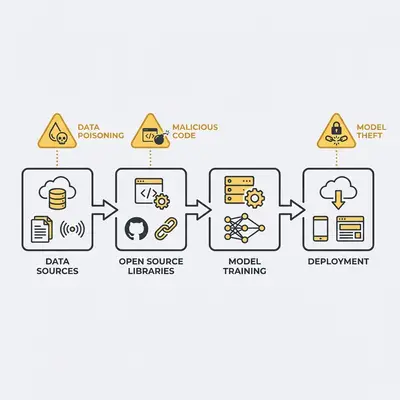
AI supply chain security is the process of protecting every single component that goes into building and running your AI systems. This includes the data used for training, the open-source libraries your developers use, the pre-trained models you download, and the cloud platforms where it all runs. It’s about securing the entire journey from concept to production.
For a small business, this is critical. You're likely using a mix of third-party tools and open-source code to build your AI solutions. Each one of those components is a potential door for an attacker to walk through. A single weak link can compromise your entire operation.
Understanding the AI Supply Chain Ecosystem
Think of your AI system like a car. You didn't manufacture the engine, the tires, or the electronics yourself. You sourced them from various suppliers. Your AI supply chain is the same. It includes:
- Data Sources: Where you get your training and operational data.
- Open-Source Libraries: Packages like LiteLLM, TensorFlow, or pandas.
- Pre-trained Models: Models you download from places like Hugging Face.
- Cloud Infrastructure: Services from AWS, Google Cloud, or Azure.
- Third-Party APIs: External services your AI calls to get information or perform tasks.
Each piece comes from a different "supplier," and you have to trust that they are all secure.
Reality Check: Most small businesses have no idea how many third-party dependencies are running in their AI stack. A handful of core tools can pull in hundreds of transitive open-source packages, and none of them show up on any list you keep.
Common Vulnerabilities in AI Components
Vulnerabilities can hide anywhere. A popular open-source library might have a security flaw discovered. A pre-trained model could be "poisoned" with malicious data that causes it to behave unpredictably or leak information. Even the platform you run your AI on could have a misconfiguration that exposes your data. The LiteLLM incident is a perfect example of a vulnerability in a single, popular library.
The Ripple Effect of a Single Compromise
When one component is compromised, the damage spreads fast. The malicious LiteLLM code didn't just affect people who directly installed it. It affected every project that depended on it, and every project that depended on those projects. A single breach can lead to data theft, service outages, and a complete loss of customer trust that can sink a small business.
How can you identify and mitigate these AI supply chain risks?
You can start mitigating these risks by adopting a security-first mindset and implementing practical, multi-layered defenses. This isn't about building an impenetrable fortress overnight. It's about creating processes that reduce your attack surface and help you respond quickly when something goes wrong.
The first step is to get visibility. You can't protect what you can't see. From there, you can enforce stricter controls and regularly check for weaknesses.
Vendor Vetting and Due Diligence for AI Tools
Before you integrate any new AI tool or service, you need to do your homework. Don't just look at the marketing features. Ask tough questions about their security practices. How do they handle data? Do they perform regular security audits? What is their policy for disclosing vulnerabilities? A reputable vendor will have clear answers. If they don't, that's a major red flag.
Implementing Strict Version Pinning and Dependency Management
This is the single biggest lesson from the LiteLLM hack. Version pinning means specifying the exact version of a library your project uses (e.g., litellm==1.82.6 instead of litellm>=1.82.0). This prevents your system from automatically updating to a new, potentially malicious version. It gives you control, allowing you to test new versions in a safe environment before deploying them.
Quick Win: Use a dependency management tool like Poetry or Dependabot. These tools can automatically scan your projects for outdated or vulnerable packages and create pull requests to update them, but they still require your approval. This gives you both automation and control.
Regular Security Audits and Penetration Testing
You should regularly audit your AI systems, both internally and with the help of external experts if possible. An audit involves reviewing your configurations, code, and dependencies for known security issues. Penetration testing goes a step further, simulating an attack to see how your defenses hold up in the real world. This might sound expensive, but even a basic, automated scan can uncover critical issues you might have missed.
What emerging trends are shaping AI security?
The field of AI security is evolving quickly, driven by the same innovation that powers AI itself. For small businesses, a few key trends are making robust security more accessible than ever before. These trends focus on being proactive rather than reactive.
The goal is to catch potential issues early and build systems that are secure by design.
AI-Powered Threat Detection and Response
One of the most powerful trends is using AI to defend AI. New security tools use machine learning to analyze system behavior and detect anomalies that could signal an attack. For example, an AI security tool could notice that a model is suddenly making unusual data requests. It can then automatically block the activity and alert your team, stopping a breach before it causes real damage.
The Shift-Left Security Paradigm in AI Development
"Shifting left" simply means thinking about security earlier in the development process, not waiting until the end. For AI, this means scanning datasets for bias or poison before training, checking open-source libraries for vulnerabilities before they're added to a project, and building security checks directly into your deployment pipeline. This approach saves time and money by catching problems when they are easiest to fix.
The Importance of Explainable AI (XAI) for Trust and Security
Explainable AI (XAI) refers to methods that help humans understand how an AI model makes its decisions. From a security perspective, this is huge. If you can't understand why your AI is doing what it's doing, you can't be sure it hasn't been compromised. XAI tools can help you audit model behavior, identify potential manipulation, and build trust with your customers by being transparent.
What role does automation play in strengthening AI security?
For small businesses with limited resources, automation is the key to effective AI security. You can't manually check every library and monitor every system 24/7. Automation acts as your tireless security guard, enforcing policies and responding to threats consistently and immediately.
A well-designed automation workflow changes a company's security posture. It turns security from a periodic, manual chore into a continuous, integrated process.
Automated Dependency Scanning and Vulnerability Management
This is the frontline defense against attacks like the LiteLLM hack. Automated tools can be integrated into your development workflow to scan every new piece of code and every dependency for known vulnerabilities. If a risky library is detected, the system can automatically block the code from being deployed until the issue is resolved.
Continuous Integration/Continuous Deployment (CI/CD) Security
Embedding security checks into your CI/CD pipeline is a game-changer. Every time a developer commits new code, an automated process can kick off that scans for security flaws, checks dependencies, and runs tests. This ensures that no insecure code ever makes it into production. It makes security a seamless part of how you build software.
Pro Tip: Start with one simple, automated check in your CI/CD pipeline, like a dependency scanner. Once that's running smoothly, add another layer, like static code analysis. Incremental improvements are much easier to manage than a complete overhaul.
Orchestrating Security Policies Across AI Workflows
Automation allows you to define your security policies as code and apply them consistently across all your AI systems. This could include rules for data access, model deployment approvals, and incident response procedures. When a potential threat is detected, an automated workflow can kick in to isolate the affected system, notify the right people, and begin the remediation process, all without human intervention.
Don't let a single compromised library derail your AI initiatives. The risks are real, but with the right strategy and tools, they are manageable.