Everyone's Excited About Local LLMs. I'm Cautiously Optimistic.
New apps like Ensu show the promise of local, private LLMs. But are they ready for real business use? Here's my take from the trenches on the trade-offs.
The launch of Ensu, a new app that runs a large language model (LLM) completely offline on your device, is getting a lot of attention. It taps into a growing desire for AI that respects privacy, works without an internet connection, and doesn't come with a monthly subscription fee.
I see the appeal. For years, the message has been that powerful AI lives in the cloud, controlled by a handful of big tech companies. The idea of taking back control is powerful.
But as someone who implements AI for businesses, I see both the promise and the pitfalls. The excitement is real, but so are the limitations. While I'm optimistic about the long-term trend, I'm advising my clients to be cautious about diving in headfirst. Local LLMs are a game-changer, but only if you understand exactly what game you're playing.
What Exactly Is a Local LLM?
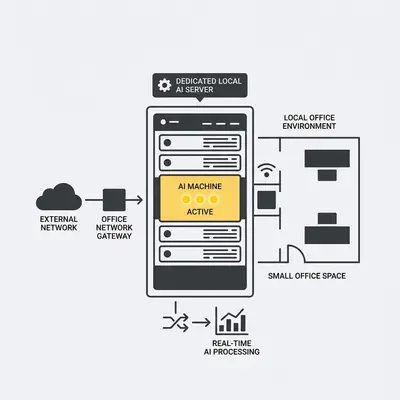
A local Large Language Model (LLM) is an AI model that runs entirely on your own hardware. This could be your laptop, a desktop in your office, or a dedicated server. It operates completely independently, without sending any data to external cloud services like those from OpenAI, Google, or Anthropic.
Think of it like the difference between Google Docs and a Microsoft Word application installed on your computer. With Google Docs, everything happens on Google's servers. With the installed Word app, your documents stay on your machine unless you choose to send them. A local LLM brings that same level of privacy and control to artificial intelligence.
Why Are Businesses Suddenly Interested in Local LLMs?
Businesses are exploring local LLMs for three main reasons: ironclad data privacy, predictable cost structures, and operational independence. The ability to process sensitive information without it ever leaving your network is the single biggest driver.
First, data privacy is non-negotiable in many industries. I work with clients in legal, healthcare, and finance who simply cannot send customer or patient data to a third-party API. It would violate regulations like HIPAA or GDPR and destroy client trust. Local models solve this problem instantly.
Second, costs become more predictable. API calls to cloud models can lead to surprise bills, especially as usage scales. A client in logistics was spending over $4,000 a month summarizing shipping manifests. By setting up a local model on a dedicated server, they faced a one-time hardware cost that paid for itself in under a year, with no recurring fees.
Finally, you gain independence. You're no longer vulnerable to an API provider's downtime, sudden price hikes, or changes to their terms of service. If your internet goes out, your local AI-powered tools keep working.
Key Insight: The conversation around local LLMs isn't just about technology; it's about risk management. It gives businesses a way to adopt AI without outsourcing their data security and operational stability.
What Are the Downsides? (The "Cautious" Part)
The main downsides of local LLMs are a noticeable performance gap compared to top-tier models, significant hardware requirements, and the technical expertise needed for setup and maintenance. They are powerful tools, but they are far from plug-and-play.
Let's be direct: a 7-billion parameter model running on your MacBook is not going to outperform GPT-4o or Claude 3 Opus in complex reasoning or nuanced creative writing. For many specific tasks, it's "good enough," but for cutting-edge performance, the big cloud models still lead. The gap is closing, but it's definitely still there.
You also need the right gear. To run these models effectively, you need a computer with a powerful GPU and a lot of VRAM—at least 16GB for decent performance. We often recommend NVIDIA RTX 40-series cards for desktop use or dedicated server-grade GPUs for heavier workloads. This is a real capital expense, not a small operational one.
Finally, there's the technical overhead. Someone has to install the software, download the models, configure the system, and keep it updated. This requires a level of technical skill that most businesses don't have in-house. It's not like installing Microsoft Office; it's a complex process that often requires a specialist.
Reality Check: Your first local LLM project will likely fail if you try to build a general-purpose "internal ChatGPT." The models aren't there yet. Focus on solving one specific, high-value problem where privacy is non-negotiable.
What Are the Best Business Use Cases for Local LLMs Right Now?
The best current use cases for local LLMs involve well-defined, repetitive tasks that handle sensitive data. The sweet spot is where the need for privacy outweighs the need for state-of-the-art creative intelligence.
Here are four areas where I see local LLMs delivering real value today:
Sensitive Document Q&A: A law firm can use a local model to index thousands of case files. Attorneys can then ask specific questions ("Show me precedents related to intellectual property in software contracts") without any confidential information ever leaving their secure network.
Internal Knowledge Base Chat: You can feed your entire company's internal documentation—from HR policies on SharePoint to technical guides in Confluence—into a local system. Employees get instant, private answers to questions like, "What is the process for submitting an expense report for international travel?"
Automated Data Extraction: A local model can be trained to read and extract specific information from standardized documents like invoices, purchase orders, or medical intake forms. The task is narrow, the data is sensitive, and the process is highly repeatable.
Secure Code Generation: Developers can use a local model that has been fine-tuned on their company's private codebase. This provides helpful code suggestions and completions without sending proprietary intellectual property to an external service.
Pro Tip: Start with a Retrieval-Augmented Generation (RAG) system. This is the fastest path to value with local LLMs. RAG combines a smaller, general model with your specific company documents, giving you accurate, context-aware answers without the massive cost and complexity of training a model from scratch.
How Do You Get Started with a Local LLM?
Getting started involves four practical steps: identifying a precise problem, securing the right hardware, selecting a suitable model, and using a management tool to simplify the process.
Define a Specific Pain Point. Don't start with the technology. Start with a business problem. What is a slow, manual process in your company that involves sensitive data? Automating the categorization of customer support tickets is a great start. Trying to build a "company brain" is not.
Acquire the Right Hardware. You need a machine with a modern NVIDIA GPU and at least 16GB of VRAM. For initial experiments, a high-end gaming desktop can work. For production, you'll want a dedicated server.
Choose an Open-Source Model. You don't need the biggest model. Start with a well-supported, efficient one like Mistral's 7B, Meta's Llama 3 8B, or Microsoft's Phi-3 Mini. These offer a great balance of performance and resource requirements.
Use a Management Framework. Don't try to build everything from the command line. Tools like Ollama, LM Studio, and Jan provide simple graphical interfaces to download, run, and manage different local models. They handle most of the backend complexity for you.
So, Are Local LLMs the Future?
Yes, but they are a part of the future, not the whole thing.
The future of AI in business is hybrid. Smart companies will use a mix of powerful, general-purpose cloud models for creative work and public-facing tasks, while deploying smaller, specialized local models for secure, private, and repetitive internal processes.
It's not an either/or choice. It's about using the right tool for the job. The rise of accessible local LLMs gives us a critical new option, especially for the thousands of businesses that have been hesitant to adopt AI due to privacy concerns. Apps like Ensu are a fantastic sign of progress, but for businesses, the real work is about turning that potential into a reliable, integrated, and secure operational advantage.
Book a free consultation and discover how AI automation can save you hours every week.
Frequently Asked Questions
A local LLM is a large language model that runs directly on your own device, like a laptop or phone, instead of on a remote server. This gives you complete data privacy and offline access, as your information never leaves your hardware.
It depends entirely on the task. For simpler, well-defined jobs like text summarization or internal Q&A, they can be sufficient and secure. For complex reasoning or high-stakes content creation, frontier models from providers like OpenAI or Anthropic still hold a significant capability advantage.
The key advantages are data privacy, cost control, and customization. You retain full ownership of your sensitive data and can fine-tune a model specifically for your company's needs, creating a powerful, long-term strategic asset.