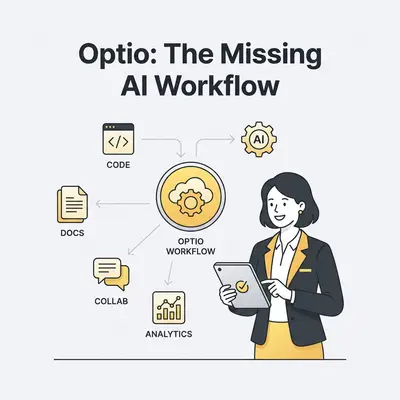
I see a new AI coding agent pop up almost every week. Most are just a thin wrapper around an API call, and frankly, they’re not that interesting. But every so often, a project appears that understands the real problem. The recently open-sourced project Optio is one of those.
It’s not just another tool that writes code. It’s a workflow orchestrator. This is a critical distinction that most people miss. The challenge isn't getting an AI to generate a function; the challenge is getting that function tested, reviewed, and merged into your main branch without a human babysitting the entire process. Optio tackles the boring, painful, and time-consuming part of software development that happens after the first draft of code is written.
This is the piece of the puzzle my clients are always missing. They get excited about an AI writing code, but then they realize a developer still has to copy-paste it, open a pull request, wait for the tests to run, fix the inevitable CI failure, and then shepherd it through code review. The "automation" just shifted the work. Optio represents a move toward solving the entire lifecycle, not just the easy first step.
Why Do Most AI Coding Agents Fail in Production?
Most AI coding agents fail because they operate in a vacuum. They are disconnected from the real-world development lifecycle of continuous integration (CI), code reviews, and iterative feedback. They generate code and then their job is done, leaving a human to handle the messy, crucial follow-up work.
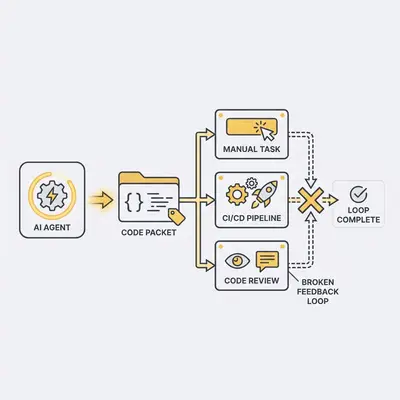
Think of it as a "fire-and-forget" model. You give the agent a prompt, it gives you a block of code. Now what? A developer has to manually create a branch, commit the code, push it, open a pull request, and then wait. If the automated tests fail, the developer has to debug the failure, fix the AI's code, and push again.
This manual intervention completely undermines the value of the AI. The time saved writing the initial code is lost ten times over in the administrative churn of managing the pull request. It’s an efficiency mirage.
How Does an AI Orchestrator Like Optio Solve This?
An AI orchestrator acts as an autonomous project manager for the AI agent. It connects the agent directly to the entire development workflow, from the initial task all the way to the final merged code, creating a closed-loop system that can operate with minimal human oversight.
The magic is in the feedback loop. When a CI pipeline fails, Optio doesn't just alert a human. It feeds the failure logs right back to the AI agent and tells it, "This broke. Here's the error. Fix it." The agent then attempts a fix and pushes a new commit automatically. The same thing happens with human feedback. A reviewer requests a change on the pull request, and Optio passes that comment to the agent as a new instruction.
This system also manages the environment. It provisions an isolated workspace for every task, ensuring the AI can't interfere with other ongoing work. It handles the entire PR lifecycle—opening it, monitoring its status, and finally, merging it when all checks have passed and it's been approved. It turns the AI from a simple code generator into a true autonomous teammate.
Key Insight: The most valuable part of an AI orchestrator isn't the specific AI model it uses; it's the feedback loop that lets the AI learn from CI failures and human reviews in real time.
What's the Real Business Impact of AI Workflow Orchestration?
Connecting AI agents to your workflows does more than just speed up coding. It fundamentally changes the economics of your development process by reducing hidden costs and bottlenecks that kill productivity.
First, it drastically cuts down on cognitive overhead. Developers spend a huge amount of time context-switching between writing code, checking build statuses, and responding to review comments. By automating this entire sequence, an orchestrator allows your team to focus on complex problem-solving instead of PR administration. A 2022 study from GitHub found that developers spend less than 30% of their time writing code. Orchestration attacks the other 70%.
Second, it increases true development velocity. Velocity isn't about how fast you can write code; it's about how fast you can get working code merged and deployed. A pull request that sits idle for hours waiting for a small fix is a major drag on momentum. An AI orchestrator that can address feedback in minutes keeps the entire process flowing.
Reality Check: An AI agent without a workflow is just a fancy autocomplete. It often creates more review work and administrative overhead than it saves. True value comes from automating the entire lifecycle.
Finally, this approach provides clear cost and performance tracking. Tools like Optio include dashboards that show exactly how much each AI-driven task costs to run. This is critical. Without it, you're just blindly throwing API calls into the void. With it, you can calculate the ROI of every automated task and make informed decisions about where to apply this technology.
Is Your Business Ready for an AI Code Orchestrator?
This level of automation is powerful, but it's not a magic wand. You can't just drop an orchestrator into a chaotic process and expect great results. You need a few key things in place first.
Your DevOps foundation must be solid. The AI relies on your existing continuous integration and deployment (CI/CD) pipeline to get feedback. If your tests are flaky, unreliable, or incomplete, the AI will be flying blind. It will either fail constantly or, even worse, merge broken code. Before you automate the developer, make sure you've properly automated the testing and deployment process.
You also need a culture of writing clear, well-defined tasks. An AI agent can't read your mind. It needs a specific, actionable brief. If your project management tickets are vague descriptions like "improve user dashboard," the AI will have no idea where to start. The process forces you to get better at defining work, which is a benefit in itself.
Pro Tip: Before you try to implement an AI code orchestrator, audit your CI/CD pipeline. If a human developer struggles to get their code tested and merged efficiently, an AI will struggle even more. Fix the process first.
The Future Isn't Just AI Agents—It's Agent Orchestration
For the past year, everyone has been obsessed with the capabilities of individual AI models. But the models are quickly becoming commodities. The real, lasting value won't come from having a slightly better code generator. It will come from building robust systems that can manage these agents and integrate them into real business processes.
The pattern we're seeing with Optio for software development is a blueprint for the future of work in many other areas. Think about marketing, sales, and finance. An AI that can write a marketing email is useful. But an AI system that can propose a campaign, generate the copy, run an A/B test, analyze the results, and then iterate on the campaign based on performance data is transformative.
That's what orchestration is. It's the difference between a clever tool and a truly autonomous system. Stop focusing only on the agent. Start thinking about the workflow. That's where the real breakthroughs are going to happen.