
A biotech company just unveiled a 4.9 billion-parameter AI model to simulate a human cell. The headlines are buzzing. This is the kind of breakthrough that could change medicine forever, predicting how drugs will work before they ever reach a patient.
But that’s not the real story.
I see this pattern with my clients every day. They get mesmerized by the latest, biggest AI model. They want the "magic button" that will solve all their problems. The real story behind Xaira's success, however, isn't the shiny model. It’s the boring, difficult, and expensive work they did for years before they could even think about building it.
What's the Real Story Behind Xaira's AI Breakthrough?
The real story is the data. Xaira spent its first years building what it calls "the largest genome-wide CRISPRi Perturb-seq dataset ever reported." That’s a mouthful, but it boils down to this: they created a massive, one-of-a-kind library of 25.6 million cells to teach their AI.
They didn't download a generic dataset. They didn't just grab public information. They invested millions to create a unique, proprietary asset. The model is the impressive tip of the iceberg, but the data is the colossal mass hidden beneath the surface. This is the single biggest lesson for any business trying to make AI work.
Reality Check: You can't buy a competitive advantage from an AI vendor. You have to build it with your own data. The model is just the engine; your data is the fuel.
I constantly see companies fixate on whether to use GPT-4o or Claude 3.5 Sonnet. They're debating the horsepower of the engine without ever checking if they have any gas in the tank. The truth is, the model is becoming a commodity. Your unique, well-structured data is the only real defensible moat you have.
Why Does Your Data Matter More Than Your AI Model?
Your AI model is a commodity, but your data is your unique advantage. A simple model trained on high-quality, relevant data will always outperform a sophisticated model trained on generic, messy data. It’s a principle we see proven on every project.
The old programming mantra of "garbage in, garbage out" is ten times more important in the age of AI. If you feed an AI messy, incomplete, or inaccurate information, you will get useless, incorrect, or even harmful results. The AI can't magically fix your broken processes or clean up a decade of inconsistent data entry.
Think about it. Your competitors can access the exact same AI models from OpenAI, Google, or Anthropic. What they can't access are your customer support tickets, your project management history, your sales call transcripts, or your financial records. That information, when cleaned and structured, is the context that makes an AI genuinely useful for your business.
How Can You Prepare Your Business Data for AI?
You can start by identifying one high-impact business problem. Then, work backward to find, clean, and structure the specific data needed to solve that single problem. Don't try to boil the ocean and organize all your company data at once.
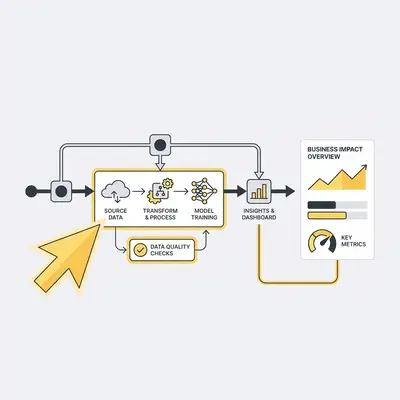
Here’s a simple, five-step process we walk clients through:
- Identify a Pain Point, Not a Technology. Don't start with "we need an AI." Start with a concrete problem like, "Our sales team spends 10 hours a week writing follow-up emails," or "We can't figure out why customers in this region are churning."
- Audit Your Data Sources. Where does the information related to this problem live? Is it in your CRM? A dozen different spreadsheets? A shared folder of PDFs? Make a list of every single source.
- Create a "Single Source of Truth." This is the hardest part. You need to get all the relevant data into one clean, reliable place. This might mean a proper data warehouse, or it could be as simple as a well-managed Google Sheet for a small project. The goal is one place for the AI to get its facts straight.
- Standardize and Structure It. This is the unglamorous work that makes or breaks AI projects. Are customer names consistent? Are dates in the same format? Are product SKUs correct? According to Anaconda's 2023 State of Data Science report, data scientists spend about 40% of their time just on data preparation and cleaning. It’s not sexy, but it’s essential.
- Start Small and Iterate. Pick one small piece of the problem and build a pilot. Automate the first draft of those follow-up emails. Generate a weekly churn risk report. Prove the value with your clean data, get a win, and then expand from there.
Pro Tip: Your first AI project shouldn't be a moonshot. Automate a single, repetitive report or classify one type of inbound email. A small, tangible win builds momentum and proves the value of good data hygiene.
What Does This Mean for Your AI Strategy?
It means your AI strategy is your data strategy. You need to shift your focus, budget, and attention away from chasing the newest, shiniest model and toward building a solid data foundation.
The Xaira story is the perfect blueprint. They are a multi-billion dollar company, and their first move wasn't to build a model. It was to build a world-class dataset. For your business, that doesn't mean sequencing genes. It means investing in a good CRM, enforcing data entry standards, and documenting your business processes.
Think of it like the plumbing in a house. No one gets excited about pipes, but without them, the fancy faucets and rainfall showerheads are useless. Your data infrastructure is the plumbing for your AI.
Key Insight: The most successful AI implementations I've seen treat data as a product. It's managed, versioned, and improved over time, just like a piece of software.
So the next time you read a headline about a revolutionary new AI, ask a different question. Don't ask, "What can this model do?"
Instead, ask, "What data did they build to make it work?"
That’s the question that separates the hype from the reality. It’s the difference between a cool tech demo and an AI that actually delivers business value.