Here is a common picture in mid-sized companies: a few colleagues use ChatGPT on their own, management has the topic on the list, and somewhere there was once a demo that looked good. There is no plan for where AI should concretely help the company. And nobody owns it.
This guide gives you an order of steps. It is not a technology comparison or a tool list. It answers one question: what do you do first, second, and third, so that interest in AI turns into something your team uses every day?
Why "adopt AI" is not a good goal
"We have to do something with AI" is an understandable thought, but a poor starting point. It leads to two typical patterns:
- Tool first. A license is bought or a tool is chosen, and only then does the search for uses begin. The licenses often stay unused.
- A pilot with no follow-through. A demo convinces people in a meeting, but nobody turns it into something that runs day to day. The project fizzles out.
The way out is to think the other way round: which process costs your team the most time or nerves today? And which of those suits AI? Everything else follows from that.
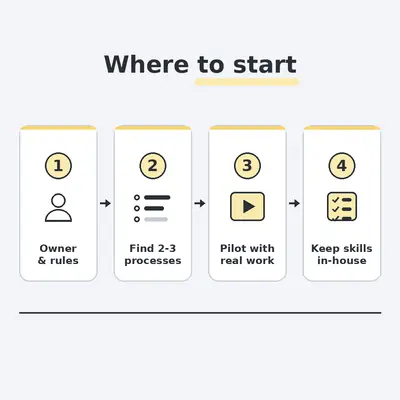
Step 1: One owner and one rule
Before anyone experiments, you need two things that cost little and save a lot of trouble.
One person who owns the topic. They do not have to be an AI expert. They make sure access is documented, questions have a contact point, and the topic does not get stuck between departments. One person is better than a committee.
A simple data rule. Write down which data may go into which tool and which tasks are always reviewed by a human. A practical baseline: work with test data first. Real customer data only comes in with a data processing agreement under GDPR, preferably with hosting in the EU. For the AI itself: read first, then write. Write access only comes once the process runs cleanly on test data. For tasks you should not leave to AI alone even later, see the post 7 Business Tasks You Should Never Trust an AI to Do Unsupervised.
Step 2: Find two or three processes
You do not need a list of thirty ideas. Two or three processes are enough to begin. Look at how work actually runs in your team, not at how it looks on the org chart.
Good candidates tend to share traits: they repeat often, follow reasonably clear steps, and today run by copy and paste between programs or spreadsheets. Rare one-off cases usually do not pay off.
Then rank the candidates by two questions: how much effort is it to try? And how big is the benefit if it works? The process with manageable effort and a noticeable benefit is your starting point. For how to recognise individual tasks and avoid typical traps, see the post The Automation Mindset.
Step 3: Test with real work, not on a slide
Pick one process and test it in a small pilot with the people who actually do the work. That has two advantages: the results are realistic, and your colleagues are involved from the start instead of being handed a finished solution.
To keep the pilot from fizzling out, settle three things beforehand:
- What should get better? A concrete statement such as "prepare quote drafts" is enough. Roughly note how long the task takes today so you can compare later.
- Who decides at the end? Whether the pilot moves into daily work is decided by a named person, not by the mood in the room.
- Where does the human stay? For anything that goes to customers, involves money, or changes important data, a human signs off.
A pilot that runs well is not yet a success. The effort has only paid off once the team keeps using the solution after the test.
Step 4: Keep the knowledge in-house
The last step is the one forgotten most often: what worked has to be captured so that your team can carry on without outside help. That includes guides, templates, and the data rules from step 1. If a solution runs in your own accounts, you stay independent and do not have to operate a black box.
This is where training comes in. It is not the first step but the reinforcement of a process that already works. What makes good AI training for teams is described in the guide What AI Training Teams Actually Need. You can find our offer on the page AI training for companies and teams.
Consulting, training, or implementation: which fits when?
After the pilot the question is how to continue. Roughly, there are three paths, and they can be combined:
- Consulting, if you want to build know-how in-house and stay independent. You find, test, and document use cases together with your team. More under AI consulting for mid-sized companies.
- Training, if the tools are already in place but barely used in daily work. See AI training.
- Implementation, if you simply want the problem solved. Depending on the task, that is process automation, document processing, an AI agent, or custom software.
Not every problem needs its own solution. If a standard product covers your process well, buy it. Custom software only pays off when the process is special or you keep paying for workarounds. Whether that applies to you can usually only be said after step 2 or 3.
Typical false starts
- Buying licenses before a process is set. The tool should follow the problem, not the other way round.
- Everything at once. Several pilots at the same time spread your team's attention. One process after another is usually clearer.
- No data rule. Without clear guidance, the careful people avoid AI altogether and the bold ones use it too freely.
- Nobody responsible. Topics without an owner stay on the shelf, however important they are.
- The pilot belongs to IT or the vendor. If the people who do the work are not involved, the solution is rarely used.
- Believing number promises. How much time a process saves depends on your process. Blanket percentages are no substitute for your own before-and-after comparison.
Next step
Write down two or three processes that cost your team the most time, and who on your side could own the topic. With those two answers, the conversation about AI becomes concrete.
If you want to tackle it together: in the free intro call we look at your process and tell you honestly whether consulting, an implementation, or nothing at all makes sense. You can find us under AI consulting for mid-sized companies. Evalics is based in Göppingen and works for companies in the Fils valley, the district and the Stuttgart region: AI consulting in Göppingen.