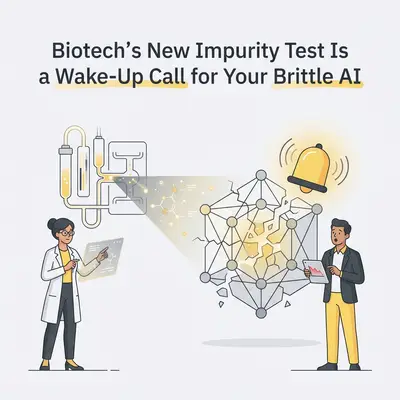
I just read a fascinating article in Genetic Engineering & Biotechnology News about a problem in bioprocessing. Scientists were struggling to detect tiny impurities called host-cell proteins (HCPs) in manufactured drugs. Their old testing method was incredibly fragile. It worked perfectly, but only if everything lined up exactly as expected. If a sample was slightly different, the test would fail, missing the very impurities it was designed to find.
Their solution was brilliant. Instead of looking for a target at a fixed, predetermined point, they created a system that first sends out a "scout" to find a reliable landmark. Once the scout finds its mark, it triggers the main test to begin its work relative to that landmark. It's a dynamic, adaptable system. And it's a perfect metaphor for the biggest problem I see with business AI today: brittleness.
What Makes an AI System "Brittle"?
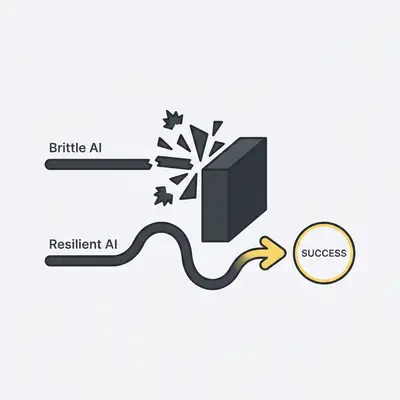
A brittle AI system is one that breaks with the slightest change in its environment. It’s an automation built on rigid assumptions. It works flawlessly under perfect, lab-like conditions but shatters the moment it encounters the messy reality of your actual business operations.
I see this constantly with clients. They build an AI to process invoices, and it works great for a month. Then, a vendor changes their invoice layout—moves the PO number from the top right to the top left—and the entire automation grinds to a halt. The AI was hard-coded to look for data in a specific spot, not to understand the document's context.
Reality Check: Most off-the-shelf AI tools are designed for the 80% of common cases. Your business's competitive edge often lives in the 20% of exceptions. A brittle AI will fail on that 20%, forcing your team back to manual work and eroding any trust in the system.
This isn't a small problem. A system that requires constant human intervention and re-engineering isn't an asset; it's a liability. It creates more work, not less.
How Does the Biotech Solution Inspire Better AI?
The biotech researchers solved their problem with something called "scout-triggered" monitoring. This approach is the exact opposite of a brittle system. It doesn't assume conditions will be static. It actively looks for a known, reliable signal—a scout—before it commits to its main task.
We can apply this exact same logic to business AI. Instead of telling an AI to "extract the text from box number three," you build a system that first finds a landmark. For an invoice, the AI's "scout" could be the label "Invoice #". Once it finds that label, it knows the string of numbers immediately following it is the data it needs, no matter where it appears on the page.
This is the fundamental shift from rule-based automation to intelligent automation. It’s about building systems that can orient themselves in a changing environment before they act.
Key Insight: A resilient AI doesn't just follow a script. It perceives its environment, finds its bearings using reliable landmarks, and then executes its task based on that real-time context.
This approach makes your AI workflows transferable and robust. The same invoice-processing AI can now handle templates from ten different vendors without needing ten different sets of brittle, location-based rules.
How Can You Build More Resilient AI?
Building adaptable AI isn't about finding some magic, all-powerful model. It's about smart system design and expecting things to change. Here are a few practical steps my team at Evalics uses to build AI that doesn't break.
First, we prioritize dynamic triggers over fixed rules. We teach the AI to look for contextual clues, or "scouts," before extracting data. This could be a specific keyword, a table header, or even a formatting pattern. The goal is to anchor the AI's actions to the content, not the layout.
Second, we implement intelligent error handling. When a brittle AI fails, it just stops. A resilient AI knows what to do when it gets stuck. If it can't find the "Invoice #" scout, its fallback plan might be to flag the document for human review and send a notification. It fails gracefully instead of silently.
Pro Tip: Your AI's error-handling logic is just as important as its primary logic. A system that can intelligently ask for help is infinitely more valuable than one that just breaks.
Third, we continuously monitor for performance drift. Data formats change, software gets updated, and business processes evolve. We track key metrics, like the percentage of documents processed without errors. A sudden dip in that success rate, say from 98% to 90%, is an early warning that a "scout" or process has changed and the AI needs a tune-up.
Finally, we build with modular components. Instead of one giant AI that does everything, we create a series of smaller, specialized agents. One agent finds the document, another finds the scouts, a third extracts the data, and a fourth enters it into the CRM. If a vendor changes their invoice format, we only need to retrain or adjust one small module, not the entire system.
The lesson from that biotech lab is clear. The most advanced systems aren't the ones that follow a perfect plan. They're the ones that can adapt when that plan meets reality. Stop building brittle AI that depends on a perfect world. Start building resilient systems that are prepared for the one we actually work in.