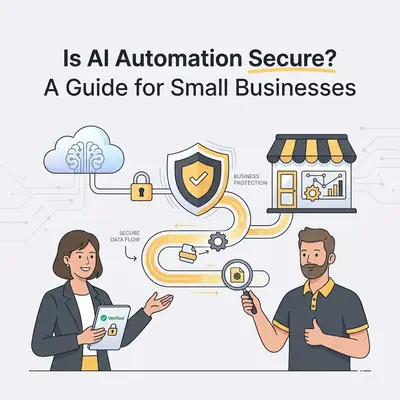
AI automation is the use of artificial intelligence to perform repetitive business tasks without human intervention. For small business owners, it is generally secure when implemented with proper governance. However, it introduces significant risks if you rely on public, non-enterprise tools that train their models on your proprietary data.
Is AI Automation Inherently Risky for Small Business Data?
AI automation is not inherently risky, but the way you deploy it determines your security posture. The primary risk is data leakage, where sensitive business information is ingested into public AI models. Once your data enters a public model, it may be used to train future versions of that AI, potentially exposing your trade secrets or client details to competitors.
By choosing enterprise-grade, private-instance solutions, you can mitigate these risks effectively. These platforms ensure your data remains isolated, encrypted, and under your control, allowing you to reap the benefits of automation without compromising your business integrity.

What Are the Primary Security Risks for SMBs Using AI?
The main risks include unauthorized data exposure, "shadow AI" usage by employees, and potential compliance violations regarding customer privacy regulations like GDPR or CCPA. When employees use free, consumer-grade AI tools, they may inadvertently upload proprietary data or customer PII (Personally Identifiable Information) into public databases. This creates a permanent security vulnerability for your business.
Reality Check: Many free AI tools explicitly state in their terms of service that they reserve the right to use your inputs for model training. If you paste a client contract into a free chatbot, that contract is no longer private.
How Should You Evaluate AI Automation Tools for Your Business?
To evaluate AI tools, you must prioritize data residency, encryption standards, and the vendor’s data-training policy. A secure tool should offer a "zero-retention" policy, meaning your data is never used to train the provider's models. Always verify if the tool is SOC2 Type II compliant before integrating it into your workflow.
- Data Training: Public tools use your data; Enterprise tools never use your data.
- Compliance: Public tools offer low or no compliance; Enterprise tools are SOC2/GDPR compliant.
- Access Control: Public tools use shared access; Enterprise tools use Role-Based Access (RBAC).
- Data Residency: Public tools have global or unknown residency; Enterprise tools offer region-specific storage.
What Is the Framework for Secure AI Implementation?
- Audit Data Sensitivity: Categorize your data into public, internal, and restricted tiers.
- Select Private Infrastructure: Choose platforms that offer private instances or API-based connections.
- Implement Access Controls: Use RBAC to ensure only authorized staff can trigger automations.
- Establish Usage Policies: Create a clear "AI Acceptable Use Policy" for all employees.
- Continuous Monitoring: Regularly review automation logs for anomalous data patterns.
Pro Tip: Never input customer credit card numbers or passwords into any AI prompt, regardless of the security settings of the platform.
How Do You Balance Innovation with Data Protection?
Balancing innovation requires a "Privacy by Design" approach where security is integrated into the automation workflow rather than added as an afterthought. By using middleware that acts as a secure gateway between your business apps and AI models, you can redact sensitive information before it ever reaches the AI processor.
This gateway approach ensures that only the necessary, non-sensitive data is sent to the AI, while your core business secrets remain safely behind your firewall.
What Are the Real-World Implications of Secure Automation?
Businesses that prioritize security see higher ROI because they avoid the costly legal and reputational damage of data breaches. For example, a small accounting firm that implemented a private-instance AI for document processing reduced manual entry by 80% while maintaining 100% compliance with client confidentiality agreements. This proves that security is a competitive advantage, not just a cost center.
Key Insight: Secure automation allows you to scale your operations without increasing your risk profile. When your data pipeline is locked down, you can focus on growth rather than damage control.
Ready to automate securely? Contact Evalics today for a free security audit of your current business workflows.