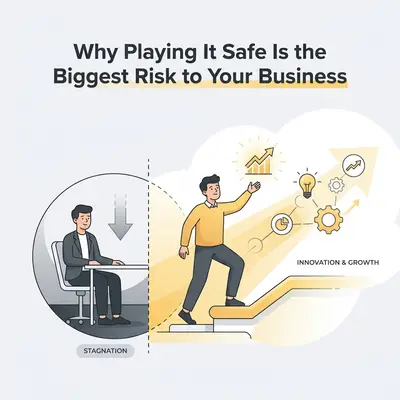
Playing it safe is a psychological trap that feels like risk mitigation but is actually a slow-motion business failure. By avoiding necessary evolution, you aren't protecting your company; you are allowing it to become obsolete. True safety in business is found in agility and calculated risk-taking, not in stagnation.

Why is the "Safety Paradox" destroying your business?
The Safety Paradox occurs when the desire to avoid short-term discomfort leads to long-term catastrophe. Much like the German energy policy shift—where the pursuit of perceived safety led to economic instability—businesses that avoid innovation to "stay the course" eventually find themselves unable to compete when the market inevitably shifts.
When you choose the "safe" path, you aren't standing still; you are falling behind. A competitor who adopts a tool you skipped does not beat you in one quarter. They compound a small operating advantage until the gap is no longer closeable. By avoiding the "risk" of new technology, you are guaranteeing a slow, quiet decline that is often invisible until it is too late. (digital transformation tools) (digital transformation tools)
How can you distinguish between reckless gambling and calculated risk?
Calculated risk is a strategic decision based on data, potential upside, and the ability to recover from failure, whereas reckless gambling is an impulsive move without a safety net. (AI-driven lead qualification workflow) To grow, you must identify "asymmetric risks"—decisions where the potential gain significantly outweighs the manageable cost of failure.
- Calculated Risk: You test a new AI-driven lead qualification workflow. If it fails, you lose a few hours of setup time. If it succeeds, you increase your conversion rate by 15%. (AI-driven lead qualification workflow)
- Reckless Gambling: You pivot your entire business model based on a hunch without testing the market or validating the demand.
Key Insight: If your business model hasn't changed in three years, you aren't playing it safe—you are becoming a relic. (automate emails & delight customers)
What is the framework for evaluating high-stakes business decisions?
To move away from the "safe" trap, use this four-step decision framework to evaluate your next move. This process helps you separate fear from actual business risk.
- Identify the "Slow Death" Baseline: What happens if you change nothing? Usually, this reveals a slow decline in margins as your costs rise and your output remains stagnant.
- Define the "Asymmetric Upside": What is the best-case scenario if this risk pays off? Look for high-leverage outcomes that compound over time.
- Quantify the "Controlled Downside": What is the absolute worst-case scenario, and can you survive it? If the answer is "yes," the risk is likely worth taking. (automation)
- Execute with Automation: Use AI and automation to lower the cost of experimentation, making the risk cheaper to take.
![_ [GRAPH] Column chart. Before Automation - 12 Hours/Week. After Automation - 2 Hours/Week. Chart title: Weekly Time Spent on Reporting at top. Alt text: Column chart showing time savings from automation: 12 hours before vs 2 hours after](/blogs/why_playing_safe/-graph-column-chart-before-automation-12-hoursweek-400w.webp)
How does AI automation serve as a hedge against business stagnation?
AI automation allows small businesses to take risks by reducing the overhead and human error associated with new initiatives. By automating repetitive tasks, you free up capital and mental bandwidth to focus on high-value innovation, effectively turning "risky" pivots into data-driven experiments that are easier to manage.
When you automate, you aren't just saving time; you are building a "safety net." If an automated experiment fails, you haven't wasted a human employee's week—you've simply adjusted a workflow in n8n or updated a prompt. This lowers the barrier to entry for innovation, allowing you to iterate faster than your competitors who are still stuck in manual processes.
Pro Tip: Use AI to run low-cost, high-speed tests. If you want to try a new marketing channel, automate the data collection and reporting first to see if the ROI is there before you commit significant budget.
What are the common pitfalls when trying to pivot away from "safe" habits?
The most common pitfall is "analysis paralysis," where business owners over-research to avoid making a decision. Other traps include underestimating the cost of inaction and failing to build a culture where small, iterative failures are viewed as learning opportunities rather than career-ending mistakes.
- The Inaction Trap: You assume that doing nothing costs nothing. In reality, inflation and competitor innovation make "doing nothing" the most expensive choice you can make.
- The Perfectionism Trap: You wait for the "perfect" automation or the "perfect" AI model. By the time you launch, the market has already moved on.
Reality Check: The cost of being wrong is usually temporary; the cost of standing still is permanent.
How to move forward
Stop viewing automation as a luxury or a "future" project. It is your primary tool for de-risking your business. Start by identifying one manual process that drains your team's energy—like lead entry or reporting—and automate it this week. By reducing your reliance on manual labor, you create the space to take the risks that actually move the needle.
If you are ready to stop playing it safe and start building a more resilient, automated business, look at your current workflows. Identify where you are losing the most time, and replace that manual effort with a system that works while you sleep.
Related Resources
- the-5-minute-test-to-see-if-your-business-process-can-be-automated — The 5-Minute Test to See if Your Business Process Can Be Automated
- ai-automation-benefits-small-business-marketing — 7 Ways AI Automation Transforms Small Business Marketing
- why-automating-a-broken-process-will-kill-your-business-faster — Why Automating a Broken Process Will Kill Your Business Faster