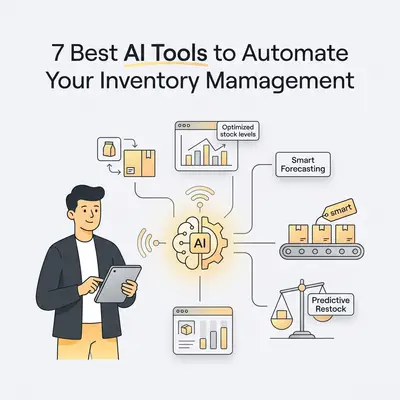
Automating inventory management is the process of using software to track stock levels, orders, and deliveries without manual intervention. For small businesses, this shift is critical: it removes the manual counting errors that cause stockouts and overselling, and it replaces yesterday's spreadsheet with a current view of your stock.
Quick Win: Are you spending more than 5 hours a week manually updating spreadsheets? Evalics can help you integrate these tools directly into your existing workflow.
Why Should Small Businesses Automate Inventory Management?
Automating inventory management eliminates human error, prevents stockouts, and optimizes cash flow by ensuring you only hold the stock you need. By leveraging AI, small businesses can predict demand patterns, automate reordering processes, and gain real-time visibility into their supply chain, ultimately saving hours of manual data entry every week.

What Are the Top 7 AI-Powered Inventory Tools?
The following tools represent the current gold standard for small businesses looking to scale their operations through intelligent automation. Each platform offers unique strengths, ranging from predictive analytics to seamless e-commerce integration, allowing you to choose the solution that best fits your specific industry and growth stage.
- Inventory Planner: Best for e-commerce businesses needing predictive demand forecasting to avoid overstocking.
- Katana: Best for manufacturing teams requiring real-time production scheduling and raw material tracking.
- Sortly: Best for small teams that need visual, intuitive inventory tracking across multiple locations.
- Fishbowl: Best for wholesale businesses that require advanced multi-location management and complex reporting.
- Zoho Inventory: Best for SMBs looking for an all-in-one solution with automated reorder point triggers.
- Cin7: Best for omnichannel retailers needing centralized stock synchronization across Shopify, Amazon, and physical stores.
- Ordoro: Best for shipping and dropshipping businesses focused on AI-driven shipping optimization and label generation.
How Do You Choose the Right AI Inventory Tool for Your Business?
Choosing the right tool requires balancing your current operational complexity against your future growth goals. You should prioritize platforms that offer native integrations with your existing sales channels, provide intuitive dashboards for non-technical staff, and offer scalable pricing tiers that grow alongside your inventory volume and SKU count.
![_ [GRAPH] Column chart. Manual Spreadsheet Tracking - 12 Hours/Week. AI-Automated Inventory Flow - 2 Hours/Week. Chart title: Weekly Time Spent on Inventory Management at top. Alt text: Column chart showing time savings from automation: 12 hours before vs 2 hours after](/blogs/best_tools_automating/-graph-column-chart-manual-spreadsheet-tracking-12-400w.webp)
How Does AI-Driven Demand Forecasting Work?
AI-driven demand forecasting works by analyzing historical sales data, seasonal trends, and external market factors to predict future inventory needs with high precision. Unlike static reorder points, these algorithms continuously learn from your business performance, automatically adjusting stock levels to prevent overstocking while ensuring you never miss a sale due to shortages.
What Are the Common Pitfalls When Implementing AI Inventory Systems?
The most common pitfall is failing to clean your existing data before migrating to an automated system. If your historical records are inaccurate or fragmented, the AI will generate flawed insights. Additionally, businesses often fail to train their staff properly, leading to a disconnect between the software’s automated suggestions and the team’s manual warehouse actions.
Reality Check: AI is only as good as the data you feed it. If your current spreadsheet has duplicate entries or missing SKUs, the AI will simply automate those mistakes at scale.
Pro Tip: Need help cleaning your data before automation? Contact the Evalics team for a custom data-mapping consultation.
How Can You Integrate These Tools With Your Existing Tech Stack?
Integration is achieved through API connections or middleware platforms that allow your inventory software to "talk" to your accounting, e-commerce, and shipping tools. By creating a unified data ecosystem, you ensure that a sale on your website automatically updates your inventory levels, triggers a purchase order if stock is low, and notifies your accounting software.

Related Resources
- stop-manual-data-entry-ultimate-n8n-lead-gen-workflow — Stop Manual Data Entry: The Ultimate n8n Lead Gen Workflow
- ensure-data-accuracy-automated-workflows — 5 Ways to Ensure Data Accuracy in Automated Workflows
- inventory-management-automation-for-small-ecommerce — 7 Best Inventory Automation Tools for Small E-commerce