
Why the "Full Automation" Hype is Finally Breaking
The AI industry is hitting a wall, and it’s a good thing. For the last two years, the narrative has been about "replacing" human work with autonomous agents. We’ve all seen the demos: AI agents that book meetings, write emails, and manage entire workflows with zero human input. But in the trenches, these systems rarely survive contact with reality.
A recent video from the True Horizon YouTube channel, You’re Doing AI Automation Wrong (Here’s How to Fix It), perfectly captures the shift we’re seeing with our clients at Evalics. The core argument is simple: stop trying to automate everything and start focusing on leverage. If you are still chasing the dream of a "set-and-forget" agent, you are likely building a liability, not an asset.
This pivot from "automation" to "leverage" is the single most important strategic decision for small business owners in 2024. It’s the difference between a business that scales and one that spends all its time debugging broken workflows.
Why Is "Full Automation" a Trap for Small Businesses?
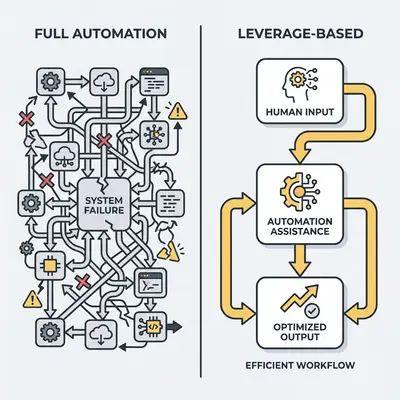
Full automation is a trap because it prioritizes replacing human judgment rather than enhancing human capability. When you try to automate an end-to-end process, you create a brittle system. It works perfectly in a vacuum, but the moment an edge case appears—a weird email, a missing data field, or a client request that doesn't fit the template—the system breaks.
- The Myth of the "Set-and-Forget" Agent: Most "autonomous" agents are just complex scripts that fail silently. You end up spending more time monitoring the AI than you would have spent doing the task yourself.
- Why Complexity Kills ROI: Every additional step you automate adds a point of failure. If you have a five-step process, automating all five creates a fragile chain. If step three fails, the whole thing collapses.
- The Hidden Cost of Over-Engineering: You aren't a software company. You are a business owner. Spending 40 hours building a complex automation to save two hours of work per week is a losing game.
What Is the Leverage Framework for AI Implementation?
The Leverage Framework is a decision-making model that prioritizes high-impact, low-complexity AI integrations. Instead of asking, "Can I automate this task?" you ask, "How can AI make my best employee 10x more effective?" This shifts your focus from cost-cutting to revenue-generating capacity.
- Step 1: Identify High-Value Human Bottlenecks: Look for tasks where your team is doing high-level thinking but getting bogged down in data gathering or formatting.
- Step 2: Apply AI for Data Synthesis and Drafting: Use AI to do the heavy lifting of research, summarization, or drafting. Let the machine handle the "boring" 60% of the work.
- Step 3: Maintain Human Oversight for Final Decisioning: The final 10%—the strategy, the empathy, the final sign-off—must stay with a human. This is where your value lives.
- Step 4: Measure Output per Hour, Not Tasks Completed: Don't count how many tasks you automated. Count how much more revenue or client satisfaction you generated per hour of human effort.
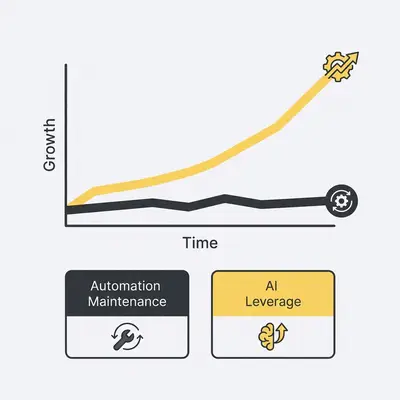
Key Insight: If your AI system requires more time to manage than it saves, it is not leverage—it is a liability.
How Do You Choose Between Automation and Leverage?
Choosing between automation and leverage requires evaluating the cost of error versus the frequency of the task. Use this framework to decide where to deploy your resources for maximum business growth.
| Criteria | Full Automation | Leverage (Human-in-the-Loop) |
|---|---|---|
| Task Complexity | Low (Repetitive) | High (Strategic) |
| Cost of Error | Negligible | High |
| Goal | Efficiency/Cost Reduction | Growth/Quality Scaling |
| Implementation | Rigid/Rules-based | Flexible/AI-Assisted |
What Are the Real-World Results of a Leverage-First Strategy?
A leverage-first strategy results in faster scaling because it allows small teams to handle enterprise-level workloads without the overhead of massive software stacks. When you treat AI as a force multiplier, you maintain the agility of a small business while increasing your total output.
- Case Study: Scaling Agency Operations: We worked with a marketing agency that tried to automate their entire lead qualification process. It failed because the AI couldn't read the nuance in client emails. By switching to a leverage model—where AI summarizes the lead's intent and drafts a response for the account manager to review—they increased their lead-to-meeting conversion rate by 22%.
- The Impact on Employee Retention: When you remove the soul-crushing, repetitive data entry from your team's plate, they actually enjoy their jobs more. They get to focus on the creative, strategic work they were hired to do.
- Quantifying the "Leverage Multiplier": You aren't just saving time; you are increasing the quality of your output. An AI-assisted human is consistently better than a human working alone or an AI working alone.
How Can You Start Implementing Leverage Today?
To start implementing leverage, you must audit your current workflows for "high-friction, high-value" tasks. Begin by integrating AI tools that assist in drafting, summarizing, or data analysis, ensuring that a human remains the final gatekeeper for all client-facing or critical business decisions.
- Audit your top 3 time-consuming tasks: Write down exactly what you do for two hours every day.
- Select one task where AI can draft or summarize: Pick the one that requires the most "grunt work" before the actual thinking starts.
- Implement a "Human-in-the-Loop" review process: Build the workflow so the AI presents a draft, and you (or your team) must click "approve" or "edit."
- Measure the time saved vs. the quality of the output: If the quality drops, you’ve automated too much.
- Iterate based on feedback loops: Refine the prompt or the process based on what actually happens in the real world.
Pro Tip: Don't build a robot to do your job; build a tool that makes you the best version of yourself.
Source
This post is a strategic response to the insights shared by True Horizon regarding the shift from automation to leverage in AI implementation. You’re Doing AI Automation Wrong (Here’s How to Fix It)
Related Resources
5 Ways AI Automation Streamlines Your Lead Qualification The Danger of Over-Automation: When You Must Keep a Human in the Loop 7 Business Tasks You Should Never Trust an AI to Do Unsupervised