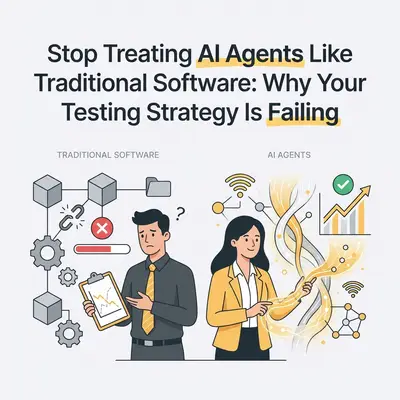
Stop treating your AI agents like traditional software. If you are still using standard unit tests to validate your automation, you are setting yourself up for a silent failure.
Why Is Traditional Software Testing Failing Your AI Agents?
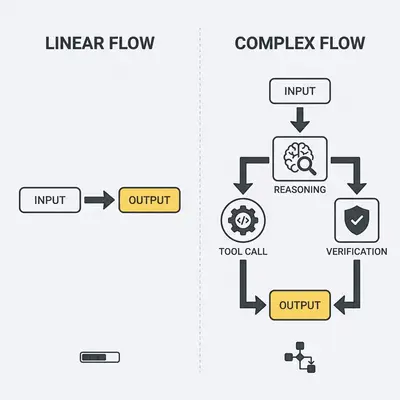
A recent analysis from n8n, How to evaluate the performance of AI agents?, hits the nail on the head: we are trying to force non-deterministic, reasoning-based systems into a rigid, deterministic box. In traditional software, input X always yields output Y. If it doesn't, the code is broken.
AI agents don't play by those rules. They make decisions, call tools, and interpret results in ways that change based on context. An agent might give you the right answer today but hallucinate tomorrow because the underlying model shifted or the prompt context became too noisy. If you aren't evaluating the trajectory of the agent—the steps it takes to get to the finish line—you are flying blind.
Reality Check: An agent that completes a task correctly 90% of the time but hallucinates or takes insecure shortcuts the other 10% is not an asset. It is a liability that will eventually erode your customer trust or break your data integrity.
How Can You Build a Reliable Evaluation Strategy for AI Agents?
Moving from "it works on my machine" to a production-ready agent requires a shift in mindset. You need to stop looking at the final output and start auditing the reasoning process. Here is how I build evaluation pipelines for my clients:
- Define your "Golden Dataset": Create a list of 20–50 inputs that represent the most common (and most difficult) scenarios your agent will face. Include the "ideal" output for each.
- Implement "Trajectory Logging": You must capture every tool call, parameter passed, and intermediate thought. If the agent fails, you need to see exactly which step went off the rails.
- Establish subjective rubrics: Define what "good" looks like. Is the tone professional? Did it follow your internal compliance policy?
- Automate "LLM-as-a-Judge" workflows: Use a more powerful model (like GPT-4o or Claude 3.5 Sonnet) to review the logs of your agent. It can score the agent’s performance against your rubric at scale.
- Set up continuous monitoring: Don't just test once. Monitor live traffic to detect "model drift" where the agent’s performance degrades over time.
- Create a human-in-the-loop feedback loop: For edge cases the AI struggles with, flag them for human review. Use those examples to refine your system prompts.
- Version control your prompts: Treat your system prompts like code. If an update breaks your agent, you need to be able to roll back to the last known good configuration instantly.
What Are the Most Common Pitfalls in AI Agent Testing?
The biggest mistake I see is "output obsession." Business owners often check if the final email was sent or the lead was added to the CRM, but they ignore the how. If your agent is taking five steps to do a one-step task, you are burning through tokens and increasing the surface area for errors.
- Ignoring Tool-Use Efficiency: If your agent is redundant, it’s wasting money and increasing latency.
- Neglecting Hallucination Checks: Just because the output looks professional doesn't mean the facts are accurate.
- Static Testing: Models are updated constantly by providers. A test that passes today might fail next week after a model update.
- Lack of Contextual Rubrics: Using generic "accuracy" metrics for a specialized task like legal document review is useless. You need domain-specific scoring.
Pro Tip: Always test your agent against "adversarial" inputs. Try to trick it into ignoring your system instructions. If it’s easy to break, it’s not ready for production.
How Do You Measure Subjective Quality in AI Outputs?
Subjective quality is the hardest part of AI implementation, but it’s the most important for your brand. You need a weighted scorecard. For example, if you are building a customer support agent, "Accuracy" might be weighted at 50%, "Tone" at 30%, and "Policy Compliance" at 20%.
| Metric | Weight | Scoring Criteria (1-5) |
|---|---|---|
| Accuracy | High | Does it cite the correct internal documentation? |
| Tone | Medium | Is it empathetic and on-brand? |
| Compliance | High | Does it avoid promising unauthorized discounts? |
By quantifying these, you turn "I don't like how this sounds" into "The agent scored a 2/5 on tone, so we need to adjust the system prompt."
How Can You Automate the Evaluation Process?
You cannot manually review 500 agent interactions every day. You need to build an automated "Judge" pipeline. In this setup, your primary agent performs the task, and a secondary, high-intelligence model reviews the transcript and the tool-use logs.
The Judge model compares the agent's output against your Golden Dataset and your rubric. It then outputs a JSON object with a score and a reason for that score. If the score falls below a certain threshold, the system alerts you. This allows you to iterate on your prompts and see the impact of your changes in minutes, not days.
Key Insight: Evalics specializes in building these automated evaluation pipelines for SMBs. We don't just build the agent; we build the testing infrastructure that keeps it reliable as your business scales.
Source
Original reporting: How to evaluate the performance of AI agents?
Related Resources
Stop Manual Data Entry: The Ultimate n8n Lead Gen Workflow n8n vs. Make vs. Zapier in 2026: Which Automation Platform Wins for Small Business? 7 Business Tasks You Should Never Trust an AI to Do Unsupervised