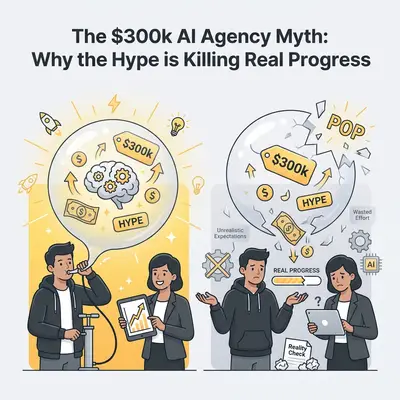
The recent viral discourse surrounding the "AI Agency" business model—specifically the critique presented in the YouTube video The TRUTH About Selling AI Automations to Businesses—has exposed a dangerous disconnect between influencer hype and operational reality. Many small business owners are being misled by claims of $300k monthly revenues that often stem from selling "how-to" courses rather than actual client-facing automation services.
This post reacts to the specific claims made in that video, which highlights that even experienced practitioners often see monthly revenues closer to $10k–$15k. We are analyzing these claims to help SMB owners distinguish between "get-rich-quick" marketing and sustainable, value-driven AI implementation.
Why is the "AI Agency" Hype Misleading for Small Businesses?
The hype is misleading because it conflates "selling the dream of AI" with "delivering functional AI." While influencers focus on high-ticket course sales, small business owners need reliable, low-maintenance automations that solve specific operational bottlenecks. The $300k monthly revenue figures often cited are outliers or revenue from education, not service delivery.
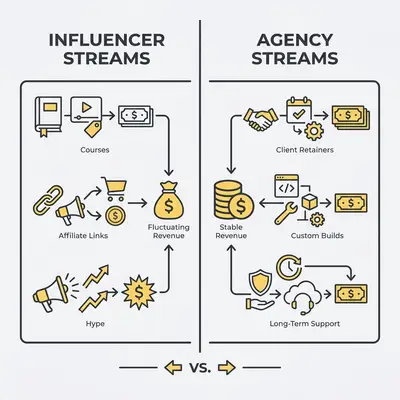
The revenue discrepancy is the first thing you should notice. When someone claims they are making $300,000 a month, they are almost always selling a course on how to build an agency, not actually building automations for clients. Real agency work is high-touch, high-effort, and rarely scales to that level without a massive team.
The "shiny object" trap is equally dangerous. Many consultants push complex, unproven automations because they look cool in a demo. If an automation doesn't solve a specific, painful bottleneck in your business, it is just a liability. You don't need a "revolutionary AI agent"; you need a system that stops your team from manually copying data between spreadsheets.
Sustainability is the final gap. One-off projects are easy to sell but hard to maintain. A real AI partner wants a long-term relationship because they understand that your business processes will change. If a consultant is only interested in the initial build fee and disappears when the API breaks, they aren't a partner—they are a vendor.
Reality Check: If your AI consultant promises "passive income" or "instant scaling" without asking about your current CRM or data structure, walk away.
What Should SMBs Look for When Hiring an AI Partner?
Small business owners should prioritize partners who demonstrate deep operational knowledge over those who simply showcase the latest AI tools. A legitimate partner focuses on business outcomes—such as time saved or lead conversion rates—rather than the complexity of the tech stack used to achieve them.
First, look for proven operational experience. Does the partner understand your specific industry workflows? If they don't know the difference between a lead and a qualified opportunity in your CRM, they cannot automate your sales process effectively.
Second, demand outcome-based pricing. Are they charging for results or just for "hours spent" on automation? A good partner will tie their value to your success, whether that is a reduction in manual labor hours or a measurable increase in lead response speed.
Finally, clarify maintenance and support. Who handles the system when the API breaks or the workflow fails? AI automations are not "set it and forget it." They require monitoring, error handling, and occasional updates as the underlying AI models evolve.
Pro Tip: Ask a potential partner to show you a workflow they built six months ago and explain how they have maintained it since.
How Do You Evaluate the Build vs. Buy Decision for AI Automations?
The decision to build or buy depends on your internal technical capacity and the criticality of the process being automated. For most SMBs, buying a managed service or using a low-code platform is safer than attempting to build custom, high-maintenance AI infrastructure from scratch.
| Factor | Build (In-House) | Buy (Managed Service) |
|---|---|---|
| Cost | High (Time/Talent) | Predictable (Subscription/Fee) |
| Risk | High (Maintenance/Security) | Low (Vendor Responsibility) |
| Speed | Slow (Learning Curve) | Fast (Immediate Deployment) |
| Control | Total | Limited to Vendor Features |
Building in-house gives you total control, but it also makes you responsible for every bug, security patch, and API update. If your team isn't full of developers, this is a massive distraction from your core business. Buying a managed service shifts that burden to someone else, allowing you to focus on your actual work.
What Are the Realistic Expectations for AI ROI?
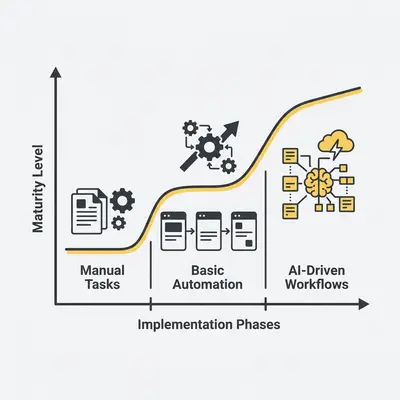
Realistic AI ROI is measured in incremental efficiency gains rather than overnight revenue explosions. Most successful implementations start by automating repetitive, low-value tasks—like data entry or lead qualification—which frees up human capital to focus on high-value client interactions and strategy.
Focus on the 80/20 rule. Automate the 20% of tasks that consume 80% of your team's time. If your sales team spends three hours a day manually entering lead data, that is the first place to start. Don't try to automate the entire business at once.
Measure success through clear KPIs. Track metrics like "Time to Lead Response" or "Cost Per Acquisition." If you aren't measuring the before and after, you aren't doing business—you're just playing with software.
Finally, embrace the iteration cycle. The first version of an automation is rarely the final one. You will learn more about your process in the first week of running an automated workflow than you did in the previous year of manual work. Use that data to refine the system.
Key Insight: The goal of AI automation is not to replace your team, but to remove the "drudge work" so they can do the work they were actually hired for.
Source
This post is a direct response to the insights shared in the YouTube video: "The TRUTH About Selling AI Automations to Businesses" The TRUTH About Selling AI Automations to Businesses