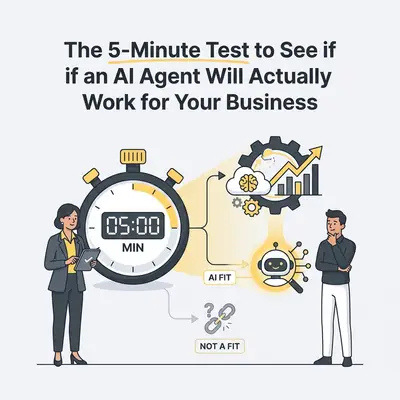
You hear the hype about AI agents working around the clock. You want one to handle customer support, qualify leads, or manage your inbox while you sleep. The idea of a digital employee is incredibly appealing.
But there is a catch. Most businesses build AI agents for processes that are doomed to fail from the start.
When you automate a bad process, you don't fix the process. You just make bad things happen much faster. Before you spend hours configuring tools or pay an agency thousands of dollars, you need to know if your specific workflow is actually ready for an AI agent.
Take this 5-minute test. It relies on five critical questions. If you cannot answer "yes" to these questions, your AI agent will hallucinate, stall, or cost you customers.
Question 1: The "New Hire" Rule
Can you explain this task to a brand-new human employee in under 15 minutes?
AI models are incredibly smart, but they lack your business context. They do not know your company history. They do not know which clients prefer formal emails and which prefer emojis.
If a task requires years of tribal knowledge to execute correctly, an AI agent will fail.
To test this, write down the instructions for the task. If the instructions include phrases like "just use your best judgment" or "it depends on the vibe," the process is not ready. AI agents need logic, not vibes. They need a framework to follow. You can learn more about how to structure these instructions in our guide on what AI agents actually are.
Reality Check: If your instructions fit on a single page, an AI agent can likely do it. If the instructions require a three-week onboarding bootcamp, the AI agent will hallucinate.
Question 2: The "Input Chaos" Rule
Are the inputs for this task reasonably consistent?
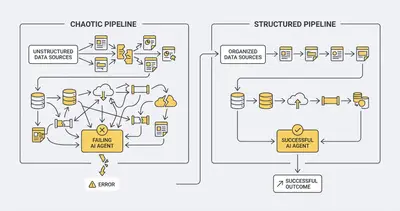
AI agents excel at reading unstructured data. They can read a messy, rambling email and extract the core request. But there is a limit.
If the inputs arrive in completely unpredictable formats across ten different platforms, your agent will break.
Ask yourself:
- Do requests come through a single channel (like an email inbox or a web form)?
- Is the required information usually present, even if it is hidden in a block of text?
- Do you have a clear way to handle missing information?
If your sales team receives leads via text message, Instagram DM, random phone calls, and carrier pigeon, do not build an agent yet. Centralize the inputs first. Once the inputs flow into a single pipeline, the agent can take over.
Question 3: The "Objective Outcome" Rule
Is there a clear, measurable definition of "done"?
Standard automations run on triggers and actions. AI agents differ from basic automations because they are goal-oriented. You give an agent a goal, and it decides which tools to use to reach that goal.
But the goal must be objective.
- Bad Goal: "Make the customer happy." (Too subjective. How does the AI measure happiness?)
- Good Goal: "Refund the customer's order if it is under $50 and the purchase was made in the last 30 days. Otherwise, escalate to a human."
If you cannot define exactly what a successful outcome looks like in a binary way (pass/fail), the agent will loop endlessly or make bad decisions.
Question 4: The "Cost of Failure" Rule
If the AI makes a mistake, is the damage easily reversible?
AI models hallucinate. Even the best models on the market will occasionally make a logical error. You must evaluate the blast radius of a potential mistake.
If an AI agent categorizes a support ticket incorrectly, a human can easily fix it. The cost of failure is near zero.
If an AI agent incorrectly negotiates a $50,000 contract and emails a legally binding discount to a client, the cost of failure is catastrophic.
Pro Tip: Never give an AI agent autonomous control over your primary database, your bank account, or your final legal agreements. Always keep high-stakes tasks behind a human approval wall.
Question 5: The "Safety Net" Rule
Do you have a human-in-the-loop fallback mechanism?
A successful AI deployment does not eliminate humans. It elevates them.
Your workflow must account for the moments when the AI agent gets confused. What happens when a customer asks a question that is not in the knowledge base? What happens when an API goes down?
If the workflow simply drops the ball and ignores the customer, you fail the test.
You need a fallback mechanism. The workflow must be designed to alert a human team member via Slack, Microsoft Teams, or email when the agent's confidence score drops below a certain threshold. Read about why your first AI automation might fail if you skip this step.
The Financial Impact of Forcing It
What happens if you ignore this test and build an agent for a broken process anyway? You bleed money.
Instead of saving time, your team spends hours fixing the agent's mistakes. Instead of reducing software costs, you rack up massive API token bills because the agent gets stuck in infinite reasoning loops trying to solve impossible problems.
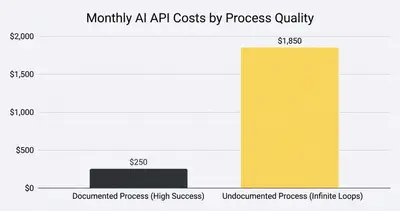
When a process is undocumented, the AI requires massive context windows and complex reasoning steps to guess what you want. This burns through tokens. A clean, tested process requires minimal tokens and operates smoothly.
Scoring Your 5-Minute Test
Count your "Yes" answers to the five questions above.
5 Yes Answers: Ready to Build Your process is perfect for an AI agent. It is documented, structured, and low-risk. You can confidently move forward with building an agentic workflow in tools like n8n or Make.
3-4 Yes Answers: Proceed with Caution You have a solid foundation, but you need to tighten up your parameters. You likely need to improve your data inputs or add stricter human-in-the-loop approvals before deploying.
0-2 Yes Answers: Stop and Fix Your Business Do not build an AI agent. Your problem is not technological; it is operational. Spend the next week documenting your standard operating procedures (SOPs). Clean up your data streams. Once the human process works smoothly, take the test again.
Example: A small marketing agency wanted an AI agent to write and publish client blog posts automatically. They failed the test because they had no brand voice guidelines (Failed Question 1) and no final review step (Failed Question 5). They paused, wrote a 2-page brand guideline, added a "Draft for Review" step in their CMS, and took the test again. They passed, built the agent, and safely saved 15 hours a week.
Next Steps for Your Automation Journey
If you passed the test, congratulations. You are ready to start building.
Start small. Do not try to automate your entire business in one weekend. Pick the single most repetitive task that passed the test. This might be lead qualification, invoice categorization, or initial email triage. You can use our guide to see if your process can be automated to narrow down the specific use case.
Build a simple workflow. Test it with your own internal data first. Do not let it face customers until it has successfully handled 50 consecutive internal tests without a major hallucination.
If you failed the test, do not be discouraged. Most businesses fail on the first try. Use the failure as a roadmap. The test just showed you exactly where your internal operations are weak. Fix those weak points, and your business will become more profitable—even before you introduce AI.
Related Resources
- AI Agents in 2025: What's Real, What's Hype
- The 90 Percent AI Failure Rate How to Build Workflows That Survive
- How to Measure if Your AI Automation Is Working Simple Metrics Guide
- AI Automation Improves Business Workflows 2025
Official Sources
- Harvard Business Review: When to Automate a Process
- McKinsey: The Economic Potential of Generative AI
- Gartner: AI Projects Failure Rates and Prevention
By applying this 5-minute test, you protect your margins and your sanity. AI agents are powerful, but they require discipline to implement correctly. Focus on the process first, and the technology will easily follow.
Book a demo with Evalics today to discuss how we can help you build AI agents that actually pass the test and drive real revenue for your business.
By Kevin Michael Schindler, AI Automation Expert at Evalics