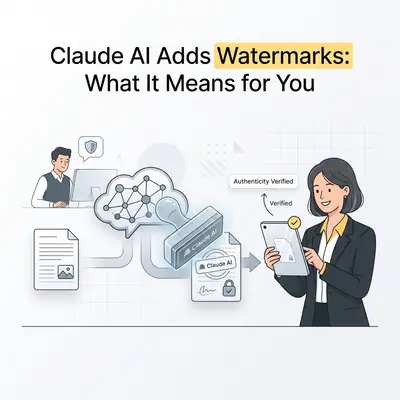
What is AI content watermarking? AI content watermarking is the process of embedding machine-detectable signals into synthetic text, images, or media to verify their origin. Unlike visible stamps, modern watermarking methods use mathematical algorithms or embedded metadata to indicate that a specific artificial intelligence model processed or generated the file.
What Is Changing With Claude’s New Content Watermarking?
Anthropic announced that future Claude models will embed invisible statistical watermarks into generated text and attach C2PA signed provenance metadata to generated files like images and SVGs, with the marking applied globally at launch (Anthropic, "How Claude's text watermarking works," 2026). As of August 2, 2026, the EU requires AI providers serving its market to mark AI-generated content under Article 50 of the EU AI Act (EU AI Act, Article 50); rather than build separate systems per region, Anthropic applies the same watermarking across the Claude app, API, and platform tools worldwide.
Key Insight: Watermarking identifies model involvement without modifying the underlying meaning of your output or adding visible markings to your text.
How Does Claude’s Invisible Text Watermarking Work?
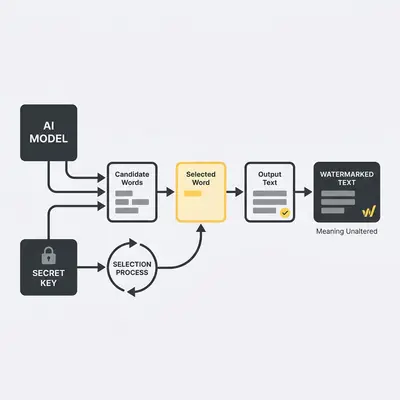
Claude’s text watermarking works by altering the source of randomness used during word selection, applying a secret key to choose between nearly identical candidate words without changing the meaning or quality of the output. Based on Google DeepMind’s SynthID-Text framework, the system leaves no hidden characters, adds zero extra tokens, and carries no identifying user or account data.
When a large language model generates prose, it evaluates potential candidate words for each step. For example, after "The sky today is cold and...", candidate words like "grey" or "overcast" carry near-equal probability. standard generation uses an arbitrary random number generator to pick between them. Watermarking replaces that arbitrary generator with a pseudorandom function driven by a secret key and preceding words.
Because the selection draws entirely from natural, high-probability words, the resulting text reads normally to humans. However, anyone holding the corresponding key can analyze a passage and calculate the statistical probability that Claude selected those specific sequences.
How Does File Metadata Differ From Text Watermarking?
While text watermarking adjusts token selection directly inside the prose, non-text files like images or SVGs rely on signed provenance metadata based on the open C2PA standard. This metadata attaches clear attribution details directly to the file without altering visual pixels, though unlike embedded text watermarks, file metadata can be stripped if a file is re-saved or re-formatted without C2PA support.
The distinction between these two tracking approaches comes down to structural permanence:
- Text Watermarking: Modifies the statistical distribution of words directly in the output. It survives copy-pasting and mild editing because the pattern lives inside the choice of vocabulary itself.
- C2PA File Metadata: Embeds a cryptographically signed manifest into image headers or file containers. It records creation tools and timestamps accurately, but taking a plain screenshot or running a basic file conversion strips the manifest entirely.
Pro Tip: If your workflow relies on preserving C2PA visual credentials for client compliance, export formats directly and avoid processing images through aggressive asset compression tools that scrub EXIF and header data.
What Are the Emerging Trends in AI Content Transparency?
Regulatory frameworks like the EU AI Act are pushing major foundation model providers to adopt industry-wide tracking standards. In response, AI vendors are standardizing machine-detectable outputs, driving a broader shift toward verifiable content provenance for small businesses, creators, and enterprise teams.
Shift 1: Regulatory Mandates Driving Global AI Tracking
Article 50 of the EU AI Act (EU AI Act, Article 50) requires that AI systems producing synthetic content mark outputs in a machine-detectable format for the EU market. Rather than maintaining fragmented codebases for different regions, providers like Anthropic apply these marks universally across all API calls and consumer interfaces.
Shift 2: Industry Convergence Around Open Technical Standards
Major platforms are standardizing detection methods using shared architectures like SynthID for text generation and C2PA for digital media provenance. Instead of every software vendor inventing proprietary tracking schemes, foundation model developers are aligning around established frameworks. Google DeepMind published its SynthID-Text framework in Nature (Google DeepMind, 2024) - https://www.nature.com/articles/s41586-024-08025-4, establishing the core pseudo-random sampling technique that Anthropic now implements.
How Will Watermarking Impact Small Business Workflows?
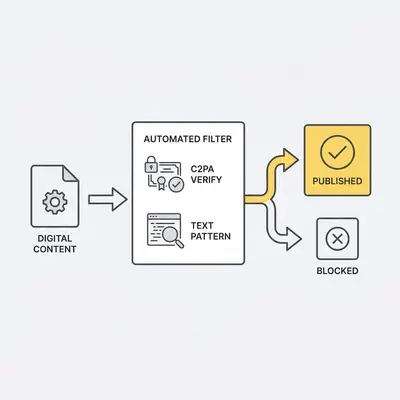
Invisible watermarking has zero impact on Claude’s output quality, readability, or API pricing, ensuring day-to-day operations remain entirely unaffected. However, small businesses using AI for client deliverables, marketing copy, or public documentation should prepare for increased scrutiny as detection tools make synthetic text easier for platforms and search engines to verify.
If you build internal tools or automate marketing pipelines using n8n or Python, the API response payload and token billing remain completely identical. You do not pay for extra tokens, nor do you experience higher latency.
However, operational workflows require attention in how raw outputs are handled:
- Grammar Editing vs. Generation: Running a light proofreading pass over your own draft leaves minimal watermarking signals because most words remain yours. Asking an AI model to draft an entire piece from scratch embeds a dense statistical pattern throughout the output.
- Detection Key Privacy: Verification tools require access to the provider's secret key. Public search engines cannot inspect Claude watermarks unless the model vendor explicitly shares the detection endpoint or key.
Reality Check: Watermarking does not store your account ID, company name, or prompt details inside the generated text. It only indicates that a specific model helped choose the words.
To ensure your automated pipelines remain clean and high-quality, implement an explicit editing pass. Here is a paste-ready system prompt designed to strip machine-like phrasing while preserving your core factual content:
You are an expert editor refining AI-assisted drafts for small business publishing.

Task: Rewrite the provided draft to adopt a direct, professional, human tone while preserving all facts, technical steps, and structure.

Editing Rules:
1. Remove generic transitional filler (e.g., "In today's fast-paced digital landscape", "leveraging", "unleash").
2. Replace passive sentence structures with active voice.
3. Vary sentence length. Alternate between short statements (5-10 words) and compound explanations (15-20 words).
4. Do not add speculative claims, unsourced statistics, or artificial fluff.
5. Retain all literal code snippets, URLs, and exact tool configurations unchanged.

Input Text:
[Paste raw model output here]
Executing a prompt refinement step alongside human oversight helps transform raw model generation into polished, brand-aligned documentation why your AI content sounds fake.
What Is the Long-Term Outlook for AI-Generated Business Content?
As AI watermarking becomes standard practice across major providers, hiding AI involvement will become increasingly difficult and impractical. Small business owners should shift toward workflow policies focused on human oversight, editing, and brand authenticity rather than relying on unvetted, raw synthetic outputs.
To adapt your business workflows for total content transparency:
- Audit your automation stack: Review where your systems generate client-facing content using automated tools like a Telegram-driven blogging pipeline.
- Establish human-in-the-loop review: Ensure every public post, proposal, or legal document undergoes review by a team member before publishing why over-automation is a risk.
- Focus on unique expertise: Inject proprietary data, original customer stories, and hands-on insights into your materials, which synthetic generators cannot replicate.
- Standardize image asset pipelines: Maintain original source files for graphics and media to preserve verifiable provenance when clients require it.